




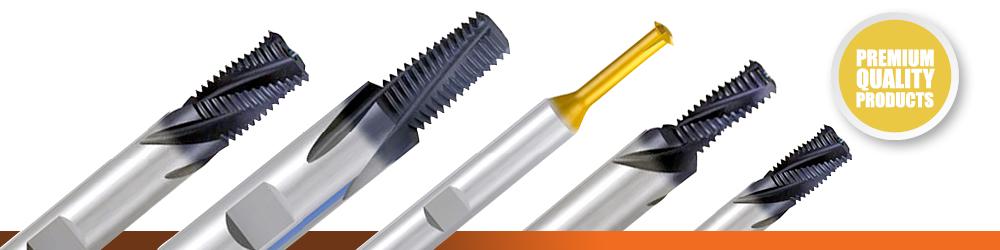
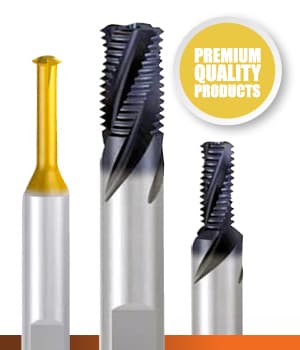
Emuge Franken solid carbide circular drill thread mill
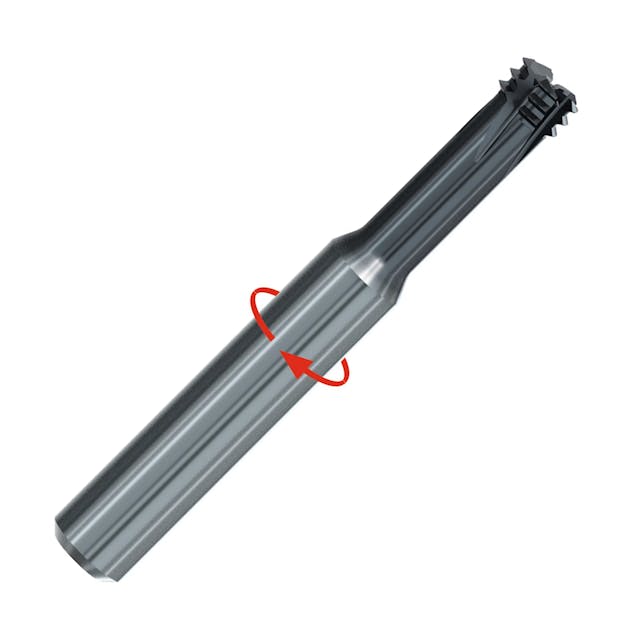
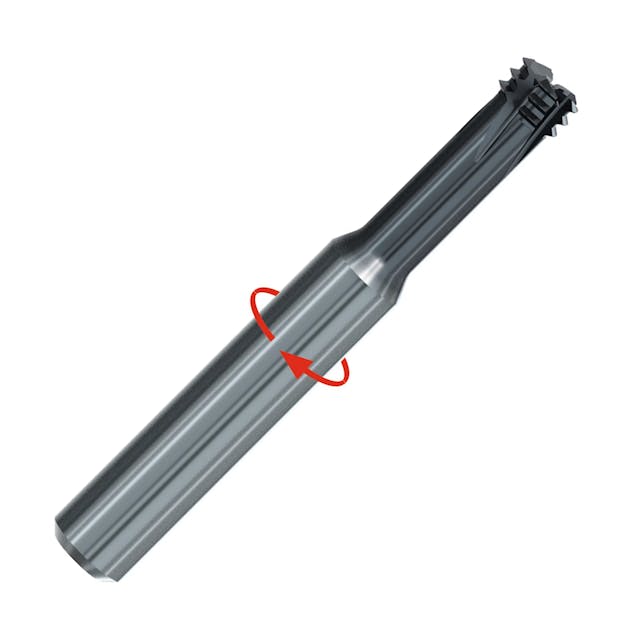
Emuge Franken solid carbide circular drill thread mill
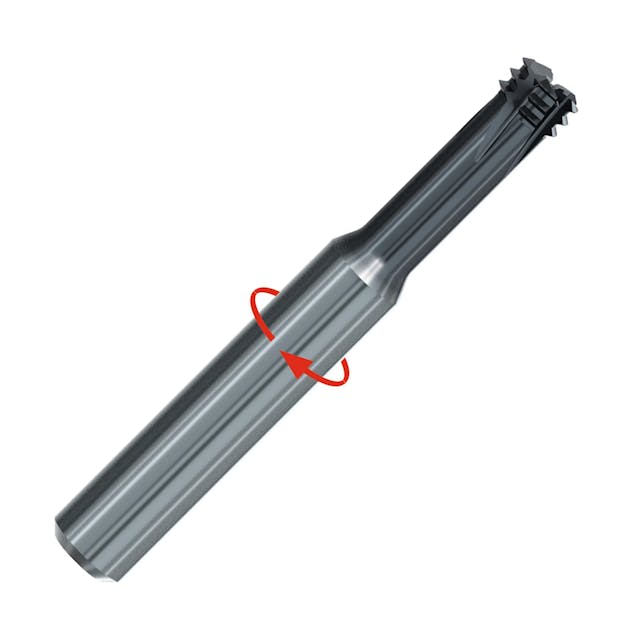
Emuge Franken solid carbide circular drill thread mill
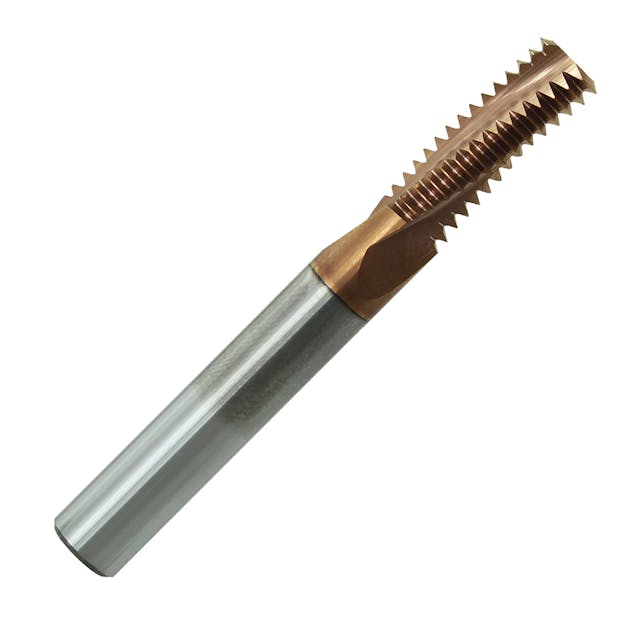
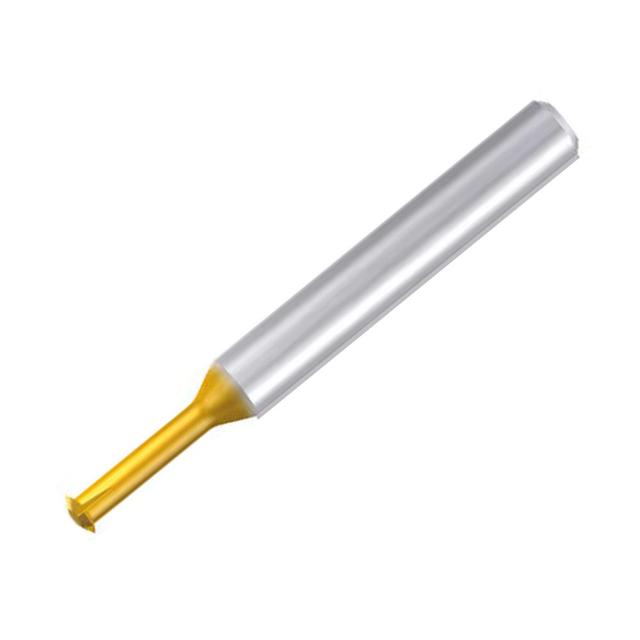
Solid carbide circular thread mill
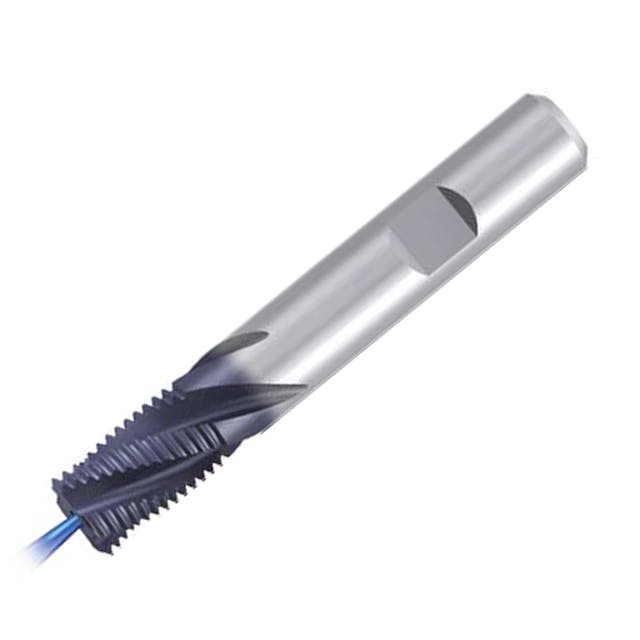
For the machining of internal threads
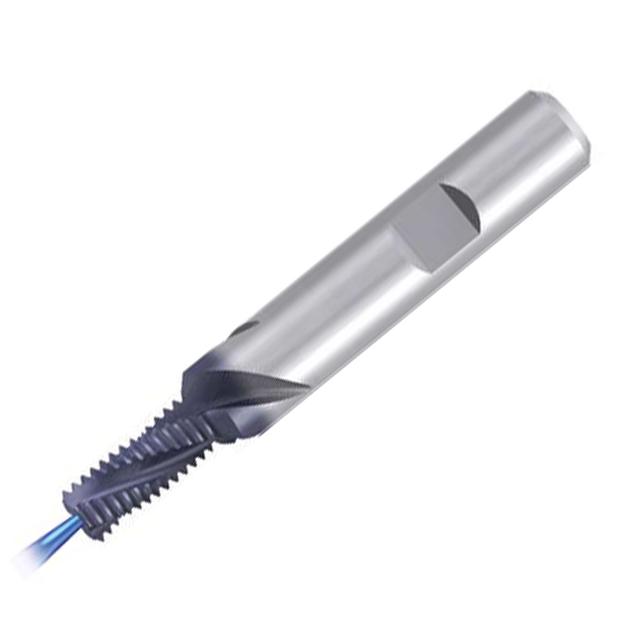
For the machining of countersink chamfer or internal threads
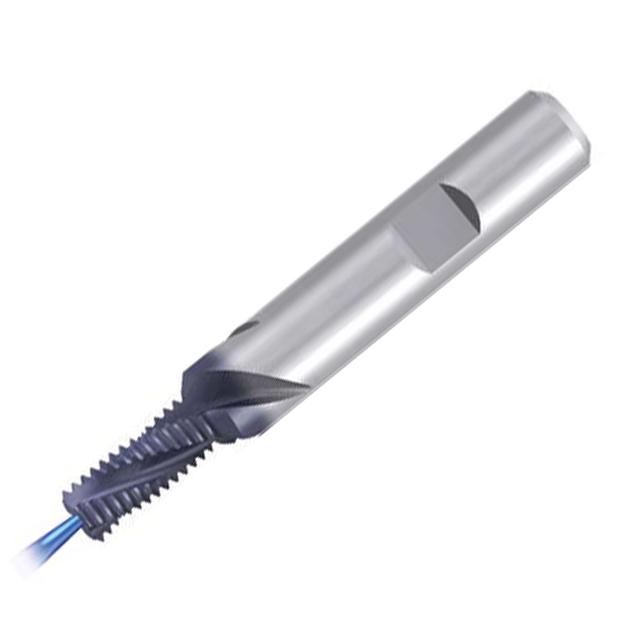
For the machining of countersink chamfer or internal threads
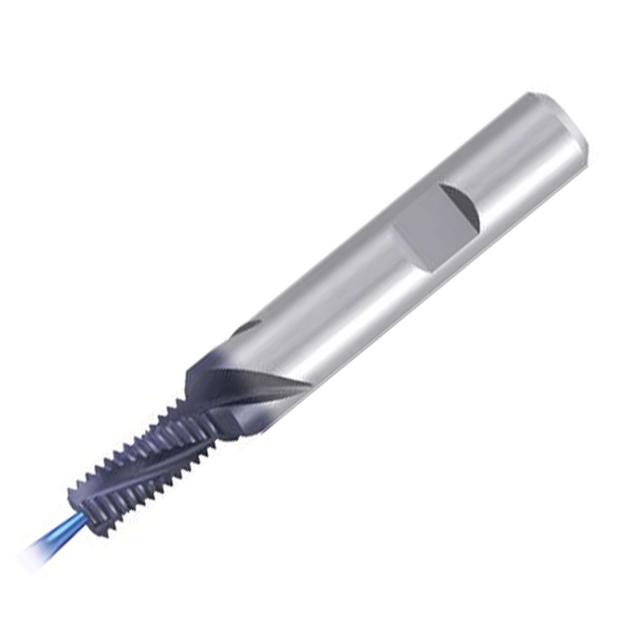
For the machining of countersink chamfer or internal threads
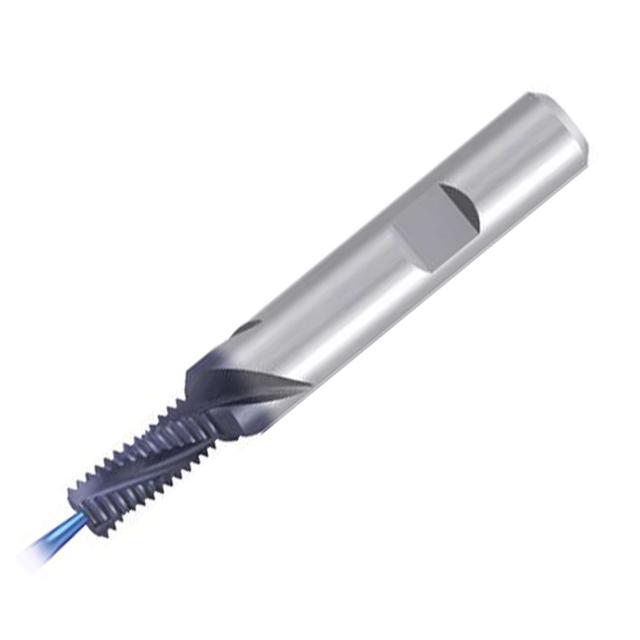
For the machining of countersink chamfer or internal threads
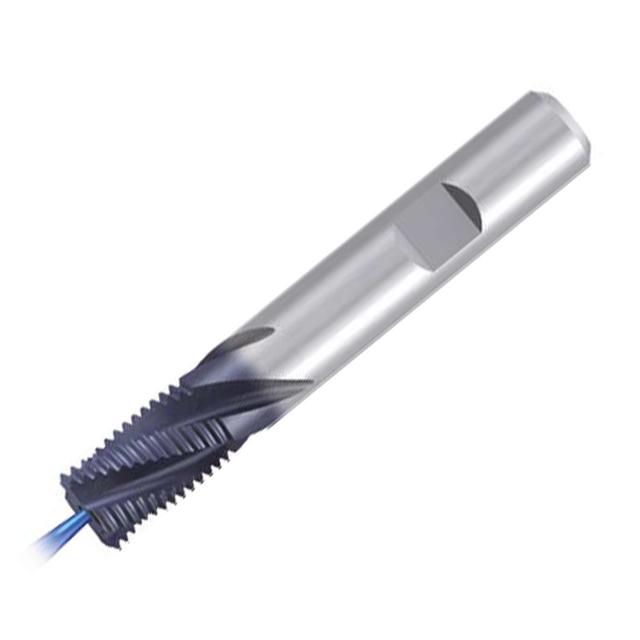
For the machining of internal threads
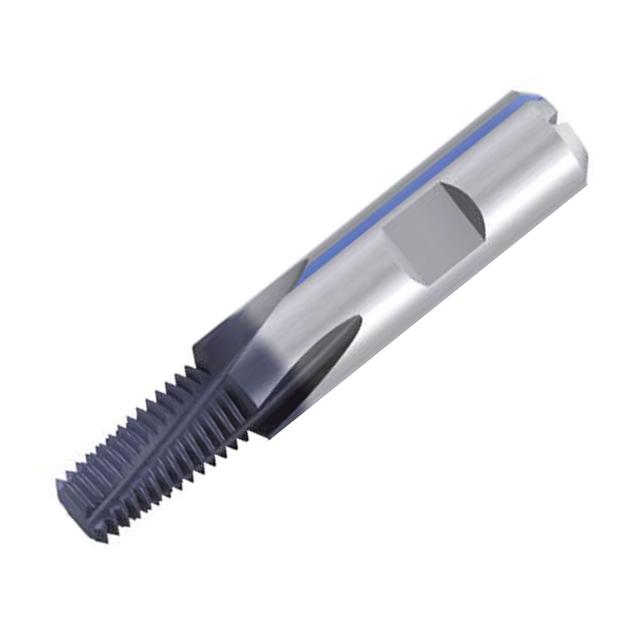
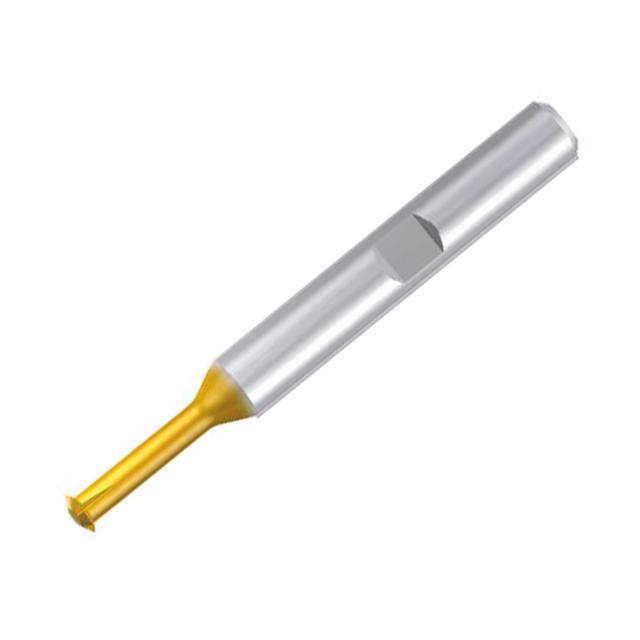
Solid carbide circular thread mill
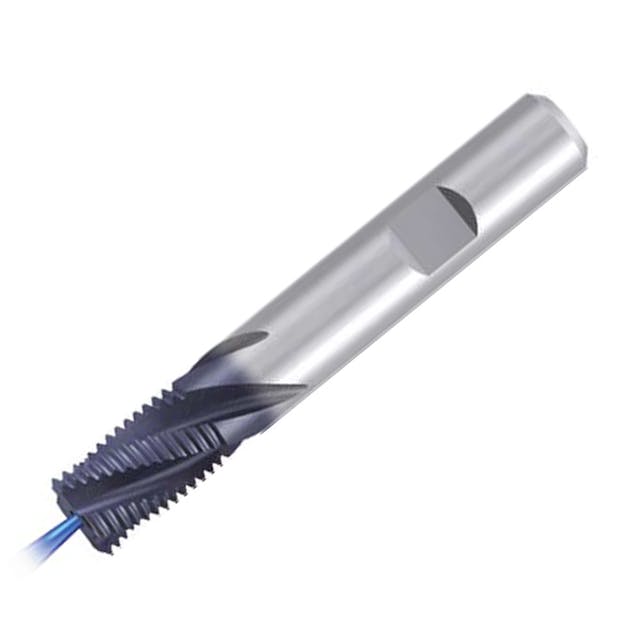
For the machining of internal threads
A thread mill is a solid carbide cutting tool that produces internal (or external) threads by milling rather than cutting the full thread in a single pass like a tap (hand tap / machine tap). Thread milling uses a CNC machine's helical interpolation capability where the tool moves in a circular path in the XY plane while simultaneously advancing in Z tracing a helix that matches the thread pitch. The tool cuts the thread progressively, removing material in a controlled helical motion.
Tapping cuts the full thread depth in a single axial pass. The tap is driven into a pre-drilled hole and forms all thread flanks simultaneously. This requires significant torque, produces a single continuous chip (or chips) that must be evacuated through the flutes and is prone to tap breakage (a broken tap stuck in a hole is extremely difficult to remove and often scrapes the workpiece).
Thread milling advantages over tapping:
Lower cutting forces: The thread mill cuts a small arc of the thread at a time, not the full circumference meaning that the cutting forces are a fraction of tapping. This enables threading thin-walled parts and large diameters where tapping torque would distort or break the workpiece
No breakage risk: If a thread mill breaks, it can often be extracted (it is smaller than the hole). A broken tap is usually permanent and scrapes the part
Better surface finish and accuracy: The controlled chip load produces a smoother, more accurate thread than tapping, particularly in difficult materials
Single tool for multiple sizes: A multi-profile thread mill can cut different thread diameters with the same pitch — one tool covers a range of hole sizes. A tap is dedicated to one size
Left-hand threads: Thread milling can produce left-hand or right-hand threads with the same tool by reversing the helical direction. Tapping requires a dedicated left-hand tap
Blind hole threading: Thread milling produces a clean thread to the bottom of a blind hole with a controlled lead-out. Tapping leaves an incomplete thread run-out at the bottom
Larger diameter threads: Thread milling is the standard method for threads above ~M20. Large taps are expensive, require huge torque and are impractical.
Tapping advantages: faster cycle time for small standard threads (single pass vs. multi-revolution helical interpolation), simpler programming and lower tool cost for common sizes.
Out range includes thread mills from STARKE and Emuge-Franken, in solid carbide with various coatings, covering thread forms from M3 to M16 and UNC/UNF equivalents.
The range covers six thread form standards, organised into sub-categories:
Metric Coarse (MC) Thread Mills: The ISO metric coarse thread series, the standard thread form used throughout Europe and most of the world for general-purpose fasteners. Designated by thread diameter × pitch in millimetres, e.g. M6x1.0, M8x1.25, M10x1.5, M12x1.75. The "coarse" series uses the largest standard pitch for each diameter providing maximum thread strength and ease of assembly. Available pitches in our range include: 0.5mm (M3), 0.6mm (M3.5), 0.7mm (M4), 0.8mm (M5), 1.0mm (M6 and M10), 1.25mm (M8), 1.5mm (M10, M12, M16), 1.75mm (M12), 2.0mm (M14, M16). a
Metric Fine (MF) Thread Mills: The ISO metric fine thread series have the same thread profile as MC but with smaller pitches (finer threads) for the same diameter. Fine threads have a smaller helix angle providing better locking against vibration, greater tensile stress area and finer adjustment. Used in aerospace, automotive and precision applications. Example: M10x1.0 fine vs. M10x1.5 coarse.
Unified Coarse (UNC) Thread Mills: The American imperial coarse thread series, the standard in the USA and Canada. Designated by nominal diameter (inch) x threads per inch (TPI), e.g., 1/4-20 UNC (1/4" diameter, 20 TPI). The Emuge ZBGF-MULTI-UNC series covers UNC drill thread mills.
Unified Fine (UNF) Thread Mills: The American imperial fine thread series have finer pitches than UNC for the same diameter. Used where finer adjustment or better vibration resistance is needed. Example: 1/4-28 UNF.
Whitworth (G) Thread Mills: The BSPP (British Standard Pipe Parallel) thread form, designated G (e.g. G1/8, G1/4, G1/2). Used for parallel pipe threads in British and Commonwealth plumbing and hydraulic systems. The G thread has a 55° thread angle (vs. 60° for metric and unified).
American Tapered (NPT) Thread Mills: National Pipe Tapered thread which is the American standard for tapered pipe threads. NPT threads are tapered (3/4" per foot) so they seal on the thread flanks as they are tightened with thread sealant. Designated NPT (e.g. 1/8-27 NPT). The tapered thread form requires the thread mill to interpolate a taper rather than a straight cylinder.
Our thread mill selection guidance:
Match the thread form to your fastener or fitting specification:
Metric (MC/MF) for European/ISO fasteners
UNC/UNF for American/imperial fasteners
G for British parallel pipe fittings
NPT for American tapered pipe fittings.
The thread mill must match the exact thread form, meaning that an MC thread mill cannot cut a UNC thread due to them having a different thread angle and pitch definition.
The range includes three distinct thread mill geometries, each performing a different combination of operations:
Single-profile thread mills (STARKE / ETM): The tool has a thread profile ground into its tip that matches one specific thread size and pitch, e.g. ETM060100 is dedicated to M6x1.0. The tool cuts only the thread (no drilling, no chamfering). A pre-drilled tap hole is necessary and the tool enters the already-drilled hole and interpolates the thread. The "2xD minimum flute length" means the flute length is at least twice the thread diameter, allowing threads to be cut up to 2x the diameter deep. Single-profile tools produce the most accurate thread form because the profile is ground specifically for that pitch. Each tool covers one thread size only. The STARKE ETM series is a single-profile thread mill (e.g. ETM030050 = M3x0.5, ETM160200 = M16x2.0).
Multi-profile thread mills (Emuge / GSF-MULTI): The tool has a thread profile that can cut multiple thread diameters with the same pitch meaning that one tool can thread a range of hole sizes. The Emuge GSF-MULTI is described as a "tool for a specific dimension with corrected thread profile" and it produces an accurate thread form across its range. It includes a 30° countersinking step which is a step ground into the tool that machines the chamfer (countersink) at the top of the hole in the same operation as threading. The tool requires a pre-drilled tap hole. The GSF-MULTI has a 15° helix angle for smooth milling and is TiAlN T4 coated with through-coolant capability. The "multi" designation means one tool covers several thread sizes with the same pitch.
Drill thread mills (Emuge / ZBGF-MULTI): The most advanced type of thread mill. A single tool that drills the hole, thread mills & chamfers in one operation. "No pre-drilled taphole necessary" because the tool plunges to drill the hole, then interpolates the thread, then chamfers the entry. This eliminates the separate drilling operation and tool change, "speeding up cycle times and reducing tooling cost with 1 tool." The ZBGF-MULTI has a left-hand rotation, 4 or 5 flutes (4 flutes for M3-M10, 5 flutes for M12), AlCr 89 coating and through-coolant holes above M5. The tool includes a drilling tip, a thread-milling section and a chamfer step. It is a "solid carbide circular drill thread mill" designed for CNC machines.
Which Product to Choose?
Single-profile (STARKE ETM): Thread only, pre-drilled hole needed, one size per tool, most economical for dedicated high-volume single-size threading
Multi-profile (Emuge GSF-MULTI): Thread + chamfer, pre-drilled hole needed, multiple sizes per tool, TiAlN coated, through coolant. Best for job shops threading multiple sizes with one tool
Drill thread mill (Emuge ZBGF-MULTI): Drill + thread + chamfer, no pre-drilled hole, multiple sizes, AlCr 89 coated, through coolant above M5, left-hand rotation. Fastest cycle time, highest tool cost but lowest total cost per hole (one tool, one operation).
The "xD" designation refers to the maximum thread depth the tool can cut, expressed as a multiple of the thread diameter:
2xD (2 times diameter): The tool can cut threads up to twice the nominal thread diameter deep. For example, a M6x1.0 thread mill with 2xD capability can cut a thread 12mm deep (2 x 6mm). This is the standard depth for most general-purpose threaded holes, ISO 273 and common engineering practice specify thread engagement depths of 1x to 1.5x diameter for most applications, so 2xD provides ample margin. The STARKE ETM series specifies "2XD minimum flute length", meaning that the flute length is at least 2x the thread diameter, ensuring the cutting section can reach the full 2xD depth. For example, the ETM060100 (M6) has a 13mm flute length (2.17x the 6mm diameter), and the ETM160200 (M16) has a 27mm flute length (1.69x the 16mm diameter which is slightly under 2x but adequate for standard engagement).
Thread depth column (Emuge ZBGF-MULTI): The variant table for this product includes a "Thread Depth" column specifying the maximum threading depth per tool. For the drill thread mills: M3 = 6.8mm, M4 = 9.1mm, M5 = 11.2mm, M6 = 13.5mm, M8 = 17.9mm, M10 = 22.3mm, M12 = 26.6mm. These depths are approximately 2.2–2.3x the thread diameter, providing slightly more than 2xD capacity.
Flute length: The flute length is the length of the cutting section / the maximum depth the tool can reach in a single pass. For thread milling, the flute length must be at least as long as the required thread depth. The STARKE ETM flute lengths range from 6.4mm (M3) to 27mm (M16). The Emuge ZBGF-MULTI flute lengths range from 1.5mm (M3) to 5.25mm (M12) and is shorter because the drill thread mill cuts a shorter thread per revolution (it also drills and chamfers, so the flute section is optimised differently).
Deep hole threading: For threads deeper than 2xD, multiple passes are required. The tool threads the first 2xD, then retracts and re-enters to thread the next section. This is less common and requires careful programming to ensure thread continuity. Most engineering applications use 1.5x diameter thread engagement, so 2xD tools are sufficient.
All thread mills in the range are solid carbide. The coatings differ by manufacturer and application:
TiSiN (Titanium Silicon Nitride) / STARKE ETM: "TISIN coated to machine up to 60 HRC." TiSiN is a nano-structured PVD coating with silicon added to the TiN matrix. The silicon forms an amorphous silicon nitride phase within the coating, producing a nanocomposite structure with hardness of approximately 3000-3500 HV which is harder than TiAlN. TiSiN has excellent oxidation resistance (up to 1000°C) and low friction. The 60 HRC rating means the STARKE ETM can thread hardened steels up to 60 HRC covering hardened alloy steels, through-hardened tool steels (pre-final-hardness) and case-hardened components. This is significantly harder than general-purpose milling cutters (typically rated to 45 HRC), reflecting the need for edge strength when threading hard materials where tap breakage is a particular risk.
AlCr 89 / Emuge ZBGF-MULTI: An aluminium chromium nitride coating (AlCrN variant, Emuge's "ALCR 89" designation). AlCrN coatings have hardness of approximately 3000-3200 HV and oxidation resistance up to 1100°C which is higher than TiAlN. The high aluminium content forms a stable aluminium oxide layer at cutting temperature, providing thermal protection. AlCrN is particularly effective for machining stainless steel, heat-resistant super alloys (HRSAs) and titanium (materials that generate high cutting temperatures and are prone to work hardening). The ZBGF-MULTI is rated for "steel, stainless steel, cast iron, heat resistant super alloys and non-ferrous materials."
TiAlN T4 / Emuge GSF-MULTI: "TiALN T4 coated" is Emuge's designation for a TiAlN coating variant. TiAlN (Titanium Aluminium Nitride) is a general-purpose PVD coating with hardness of approximately 2800-3300 HV and oxidation resistance up to 800°C. The "T4" refers to a specific multilayer or composition variant in Emuge's coating system. TiAlN is suitable for steel, stainless steel and cast iron at moderate to high cutting speeds.
Our coating selection guidance: TiSiN (STARKE) for hardened steel up to 60 HRC and general machining. AlCrN (Emuge ZBGF) for stainless steel and heat-resistant super alloys where oxidation resistance is critical. TiAlN (Emuge GSF) for general-purpose metric coarse threading in steel and cast iron.
Our Thread Mill range includes 14 products with through-coolant and 2 without. Through-coolant (also called through-tool coolant) means the tool has internal channels that route cutting fluid from the tool holder, through the shank and out of ports at the cutting tip delivering coolant directly to the cutting zone at the thread point.
Why through-coolant matters for thread milling:
Chip evacuation: Thread milling produces chips in a blind hole or at the thread root. In a deep or blind hole, chips can pack at the bottom and cause the tool to recut them (destroying surface finish and edge life) or jam the tool (causing breakage). Through-coolant flushes chips out of the hole under pressure
Cooling: Thread milling in stainless steel and heat-resistant alloys generates high cutting temperatures. Coolant at the cutting edge prevents work hardening (stainless) and thermal damage to the carbide
Lubrication: The lubricating film reduces built-up edge on the cutting edge, improving thread surface finish and dimensional accuracy.
Which tools have through-coolant:
The Emuge ZBGF-MULTI (drill thread mill) specifies "Through coolant holes above M5". The M3 and M4 variants are too small for internal coolant channels, but M5 and above have through-coolant. The M5/M6 variants have 6mm shanks; M8 has 8mm; M10/M12 have 10mm
The Emuge GSF-MULTI specifies "Through coolant hole", meaning this multi-profile thread mill has through-coolant
The STARKE ETM does not specify through-coolant meaning that these are standard external-coolant thread mills.
When through-coolant is needed:
For blind hole threading (chips must be flushed out)
For stainless steel and heat-resistant alloys (cooling and work-hardening prevention)
For deep threads (2xD and beyond)
For production threading where tool life and consistency are critical
For through-holes where chip evacuation is less critical, external coolant may suffice.
When through-coolant is not needed:
For shallow through-holes in free-machining materials (low carbon steel, aluminium, brass) where chips can fall through and cutting temperatures are moderate. The 2 non-through-coolant products in our range are for such applications.
The Emuge ZBGF-MULTI variant table includes a "Functional Diameter" column which is a critical dimension to understand for thread milling:
Functional diameter is the actual cutting diameter of the thread mill (the diameter of the circle that the tool's cutting tips describe when rotating). This is not the same as the thread nominal diameter (e.g. M6) or the shank diameter. The functional diameter is smaller than the thread being cut, because the thread mill must fit inside the pre-drilled hole (for standard thread mills) or drill a hole smaller than the thread (for drill thread mills).
For the ZBGF-MULTI drill thread mills:
M3 thread: functional diameter 2.25mm (the tool drills a 2.25mm hole, then interpolates outward to cut the M3 thread)
M4 thread: functional diameter 2.95mm
M5 thread: functional diameter 3.8mm
M6 thread: functional diameter 4.5mm
M8 thread: functional diameter 6.13mm
M10 thread: functional diameter 7.75mm
M12 thread: functional diameter 9.38mm
Why functional diameter matters: The CNC thread milling program uses the functional diameter to calculate the circular interpolation path. The tool moves in a circle of radius (thread major radius − functional radius) to cut the correct thread diameter. If the functional diameter is wrong in the program the thread will be oversized or undersized. The functional diameter must be entered precisely into the CNC's thread milling cycle or CAM software. Emuge provides the exact functional diameter for each tool so the programmer can set the correct compensation value.
Wear and re-sharpening: As the thread mill wears, the functional diameter decreases slightly, producing undersized threads. For critical applications the functional diameter should be measured periodically and the CNC compensation adjusted. Note that thread mills are generally not re-sharpened (the complex thread profile and coating make re-grinding impractical) & they are replaced when worn.
Our Thread Mill Cutter range covers a broad spectrum of workpiece materials.
Steel: Including mild steel (low carbon), medium/high carbon steel, alloy steel and tool steel. The TiSiN (STARKE, up to 60 HRC) and AlCrN/TiAlN (Emuge) coatings provide the hardness and heat resistance for steel threading at production speeds.
Stainless steel: Including austenitic (304, 316), martensitic (410, 420, and duplex stainless steels. Stainless steel is challenging for threading because it work-hardens rapidly, generating a hardened layer at the cutting surface that destroys tool edges. Thread milling is preferred over tapping for stainless because the lower cutting forces reduce work hardening and the controlled chip prevents galling. The AlCrN coating (Emuge ZBGF) is particularly suited to stainless due to its high oxidation resistance.
Cast iron: Grey cast iron, ductile iron and malleable iron. Cast iron is abrasive but produces short, powdery chips that are easy to evacuate. Thread milling cast iron is straightforward with carbide tooling.
Heat-Resistant Super Alloys (HRSAs): Including Inconel, Hastelloy, Waspaloy and titanium alloys. HRSAs are extremely difficult to machine because they maintain strength at high temperature, work-harden aggressively and generate high cutting forces.
Thread milling is strongly preferred over tapping for HRSAs because:
The low cutting forces prevent work hardening
Carbide with AlCrN coating can withstand the cutting temperatures
Through-coolant flushes chips and cools the edge
The risk of tap breakage in HRSAs is very high (a broken tap in an Inconel part is often irrecoverable).
The 40 HRSA-rated products are the Emuge ZBGF-MULTI and GSF-MULTI series with AlCrN/TiAlN coatings and through-coolant.
.
Our Thread Mill selection guidance:
For steel, stainless and cast iron use any thread mill in the range
For HRSAs (Inconel, titanium) select an AlCrN-coated Emuge tool with through-coolant
For hardened steel up to 60 HRC — STARKE ETM (TiSiN)
For non-ferrous — Emuge ZBGF-MULTI.
The Emuge ZBGF-MULTI drill thread mill specifies "Left hand rotation" which is an usual, yet deliberate design choice:
Left-hand rotation: means the tool rotates counter-clockwise (when viewed from the shank end), opposite to the standard right-hand rotation of most milling cutters. The flutes are ground with a left-hand helix to match.
Why left-hand rotation for drill thread mills: The ZBGF-MULTI combines drilling and thread milling in one tool. For drilling, the tool plunges axially and the drilling tip cuts like a drill. For thread milling the tool interpolates helically.
The left-hand rotation, combined with the tool's flute geometry, is designed so that:
Chip flow direction: Left-hand rotation with the specific flute design directs chips upward and out of the hole during the drilling phase (chips are not pushed to the bottom of the blind hole where they would pack and jam the tool). This is critical because the drill thread mill must evacuate drilling chips before it begins threading in the same hole.
Thread direction compatibility: Left-hand rotation produces right-hand threads when the helical interpolation is programmed correctly (the tool rotates left but the interpolation path is also reversed, producing a right-hand thread). The same tool can produce left-hand threads by reversing the interpolation direction. This flexibility is a feature of thread milling where the thread hand is determined by the CNC program, not the tool rotation direction.
Cutting edge geometry: The left-hand flute helix positions the cutting edges for the combined drill-and-mill operation, optimising the chip load distribution between the drilling tip and the threading section.
Note: The left-hand rotation means the CNC spindle must be programmed to reverse (M04 instead of M03) for this tool. The CNC program must account for the left-hand rotation in all calculations. The Emuge product is designed for CNC machines with programmable spindle direction — standard on all modern CNC machining centres.
Selecting the correct thread mill requires matching six specifications:
1. Thread form and size: Identify the exact thread specification. e.g. M8×1.25 metric coarse, or 1/4-20 UNC. Select a thread mill from the corresponding sub-category (MC, MF, UNC, UNF, G or NPT). The thread pitch must match exactly, so an M8x1.25 thread mill cannot cut an M8x1.0 thread (different pitch). For the STARKE ETM (single-profile) each SKU is dedicated to one size. For the Emuge multi-profile tools one tool covers a range of sizes with the same pitch.
2. Tool type (operation required): Determine whether you need:
Thread only (pre-drilled hole exists) → STARKE ETM (single-profile) or Emuge GSF-MULTI (multi-profile with chamfer)
Drill + thread + chamfer (no pre-drilled hole) → Emuge ZBGF-MULTI (drill thread mill)
Thread + chamfer (pre-drilled hole, chamfer needed) → Emuge GSF-MULTI (30° countersinking step)
3. Thread depth: Ensure the flute length and depth rating (2xD or the Thread Depth column) exceed your required thread depth. For a 12mm deep M6 thread you need a tool with at least 13mm flute length (ETM060100 has 13mm).
4. Workpiece material: For steel, stainless, cast iron & any tool. For HRSAs (Inconel, titanium) select an AlCrN-coated Emuge tool. For hardened steel up to 60 HRC use STARKE ETM (TiSiN).
5. Coolant requirement: For blind holes, stainless and HRSAs you should select a through-coolant tool (Emuge ZBGF-MULTI above M5 or GSF-MULTI). For through-holes in free-machining materials external coolant may suffice (STARKE ETM or smaller Emuge tools).
6. Shank diameter: Ensure the shank diameter matches your tool holder (collet or side-lock). The range includes 4mm, 6mm, 8mm, 10mm & 12mm shanks. The shank generally increases with thread size, so M3-M5 tools use 4mm shanks, M6-M8 use 6mm, M10 uses 8mm, M12-M14 use 10mm & finally M16 uses 12mm.