




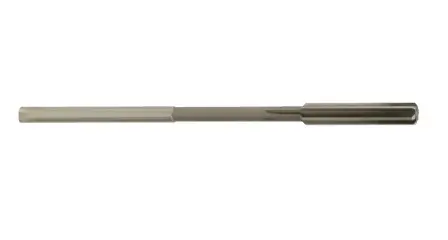
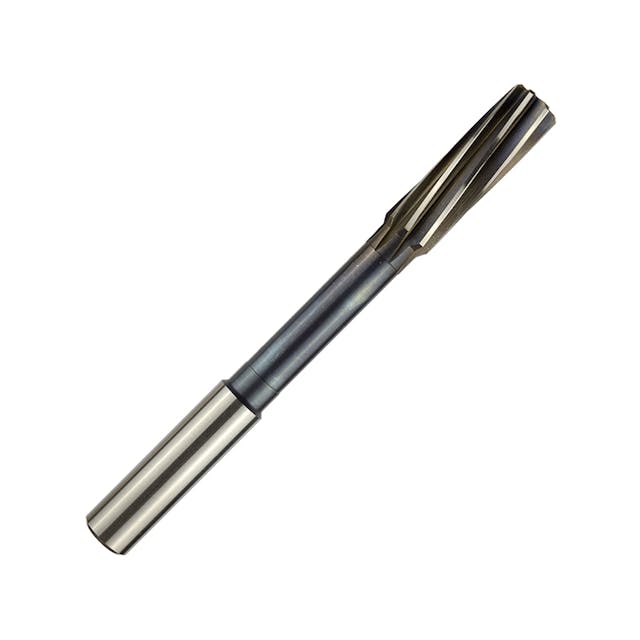
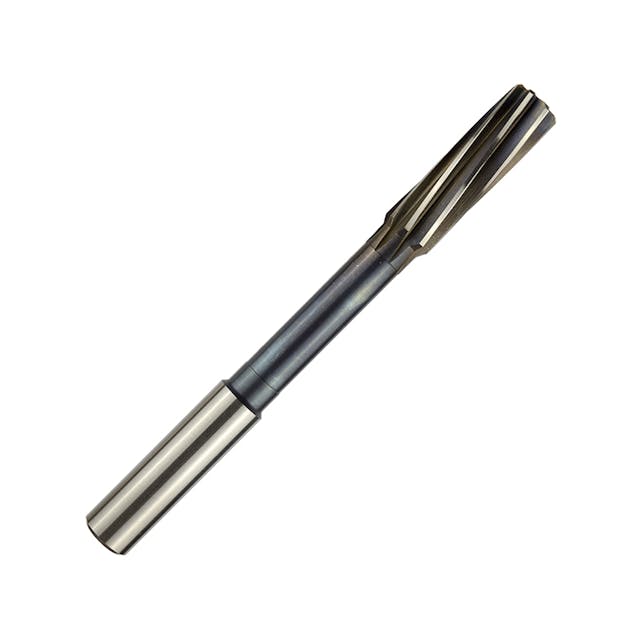
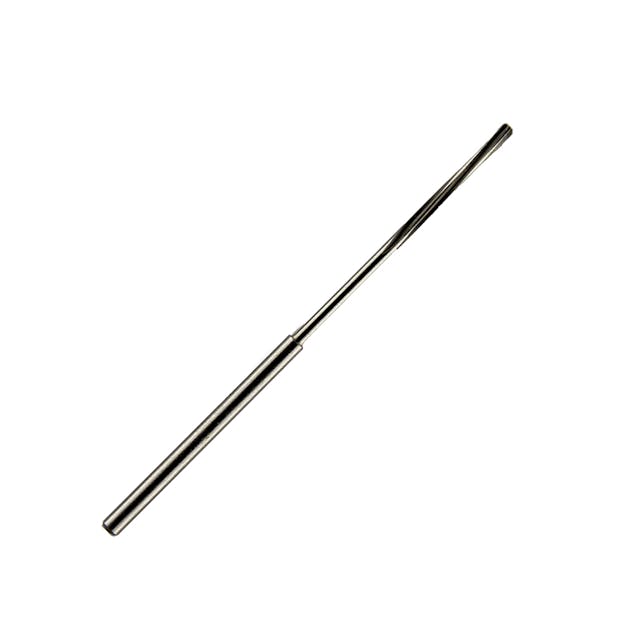
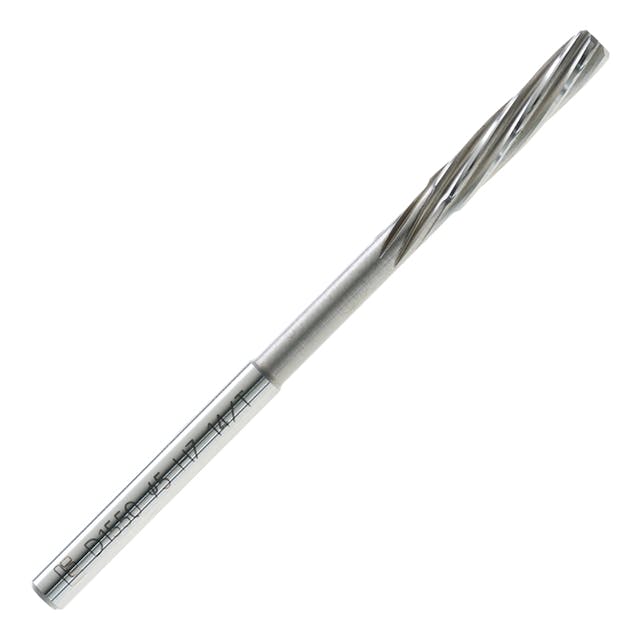
Standard precision HSS-E (M35 Cob) straight shank Reamer.
Left hand spiral flute, right hand cutting, DIN 212-B
Tolerance :
D = H7

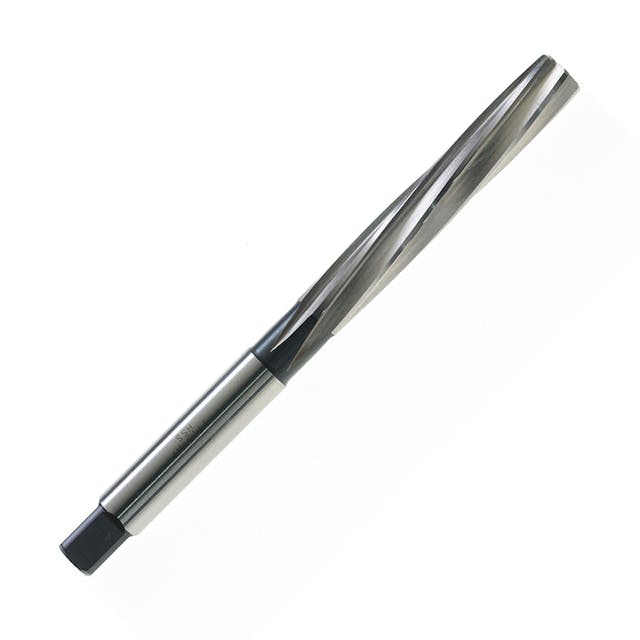
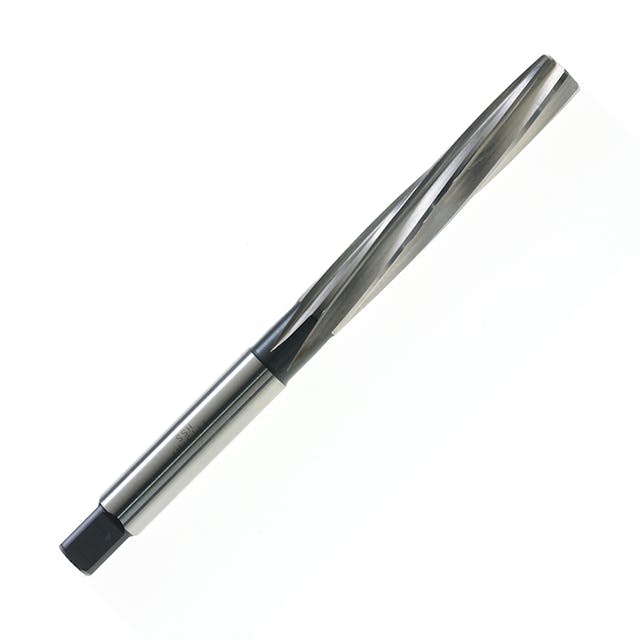
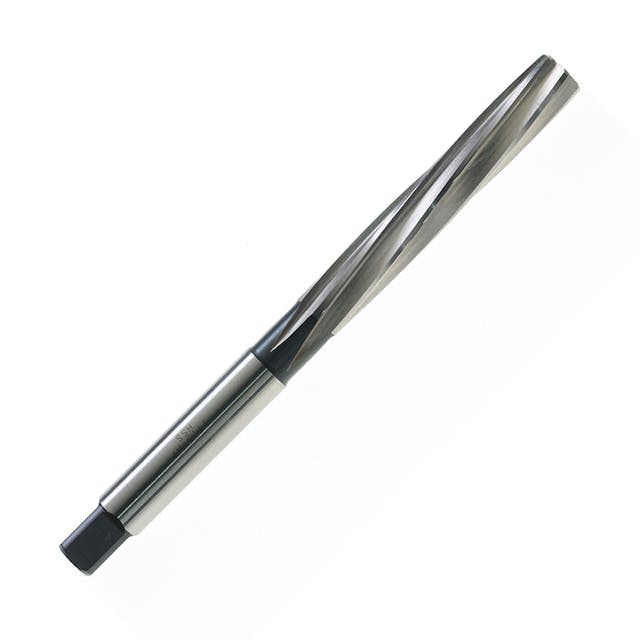
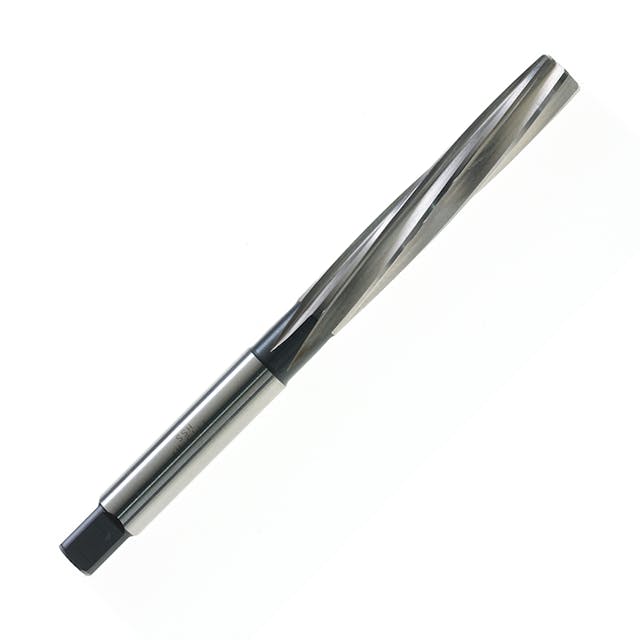

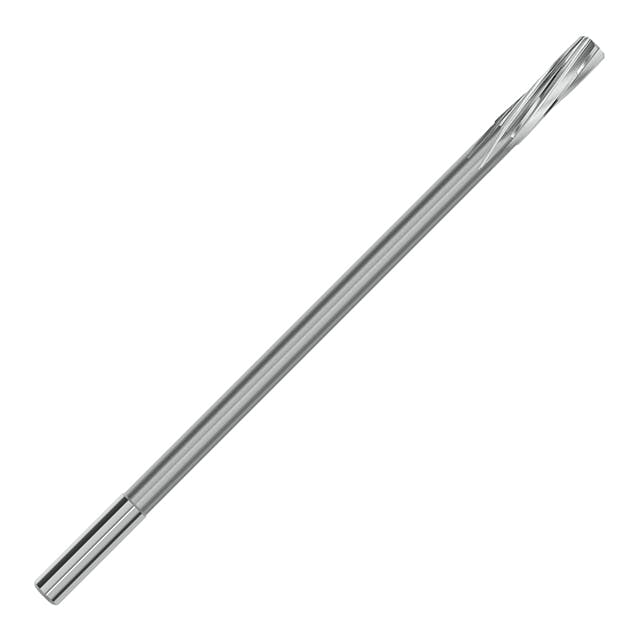
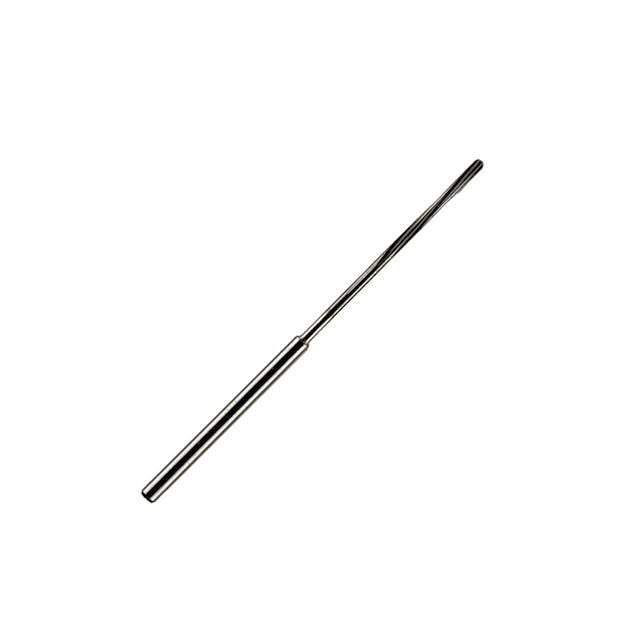
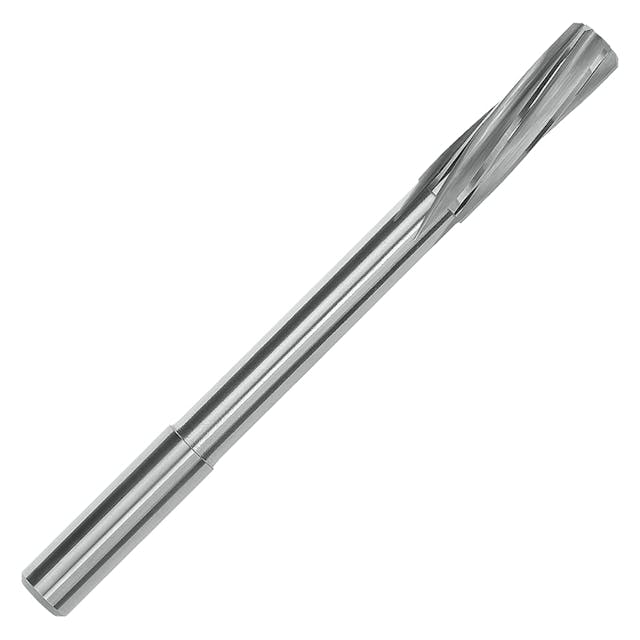
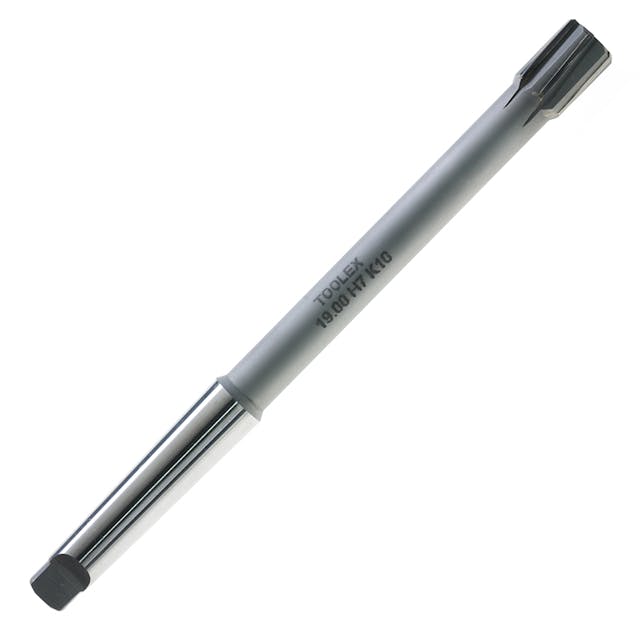
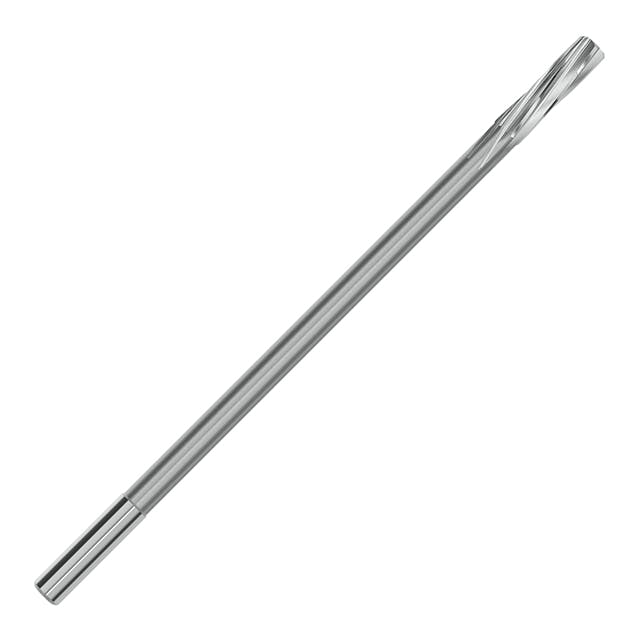
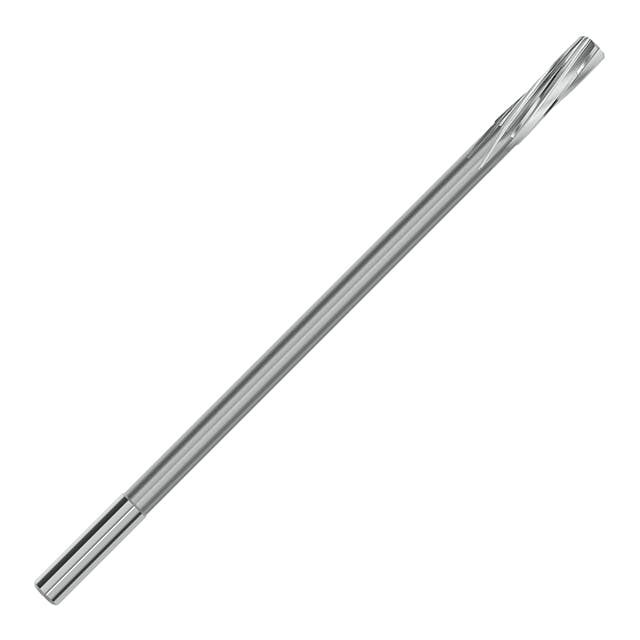
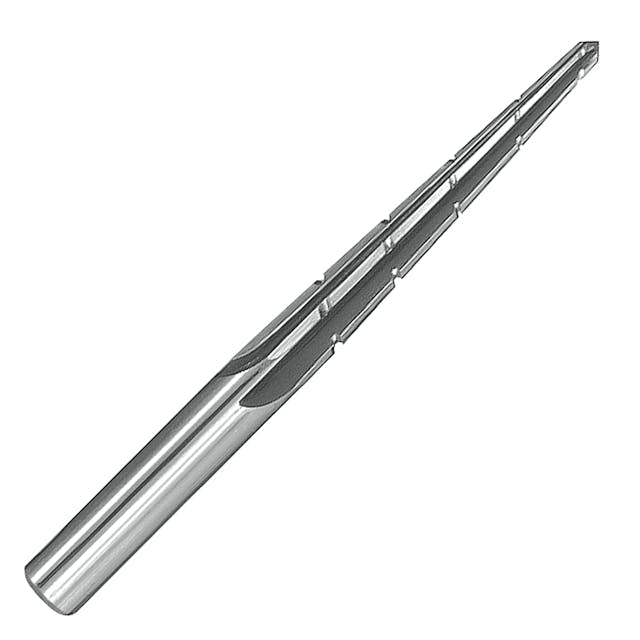
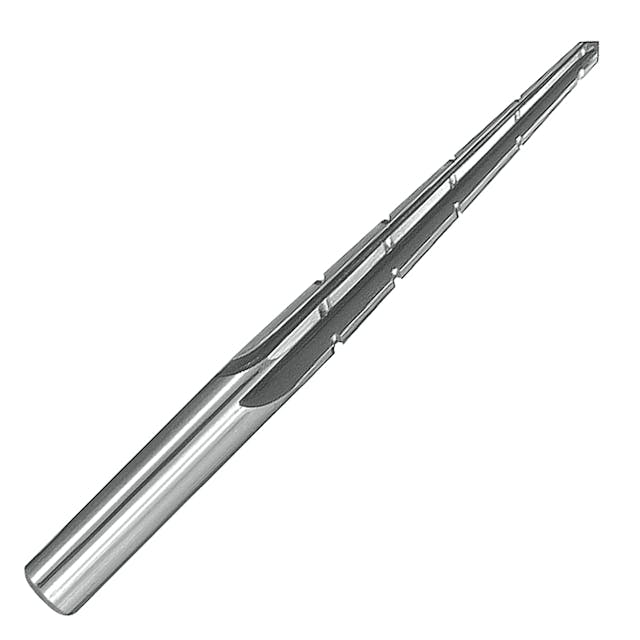
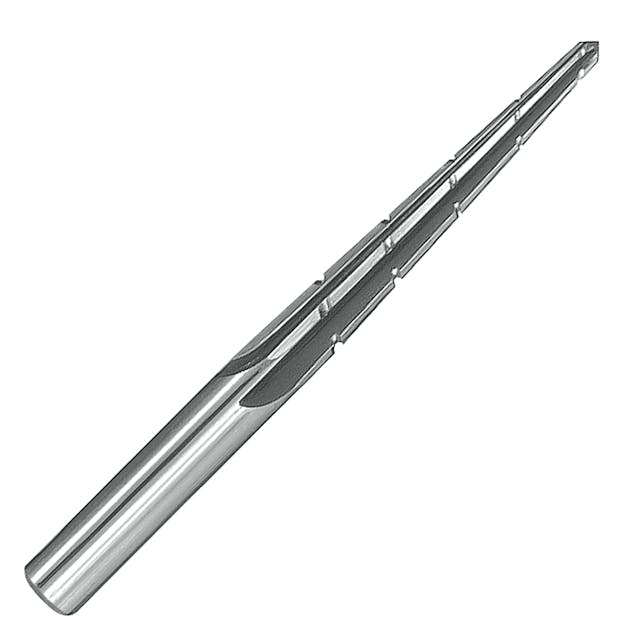
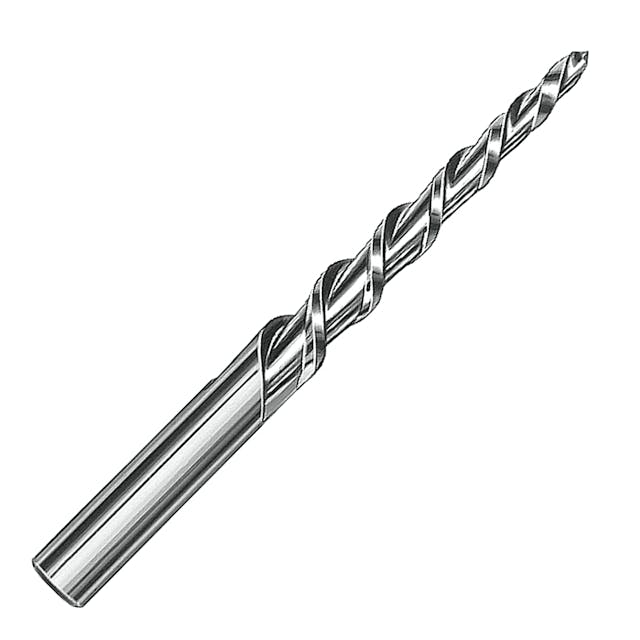
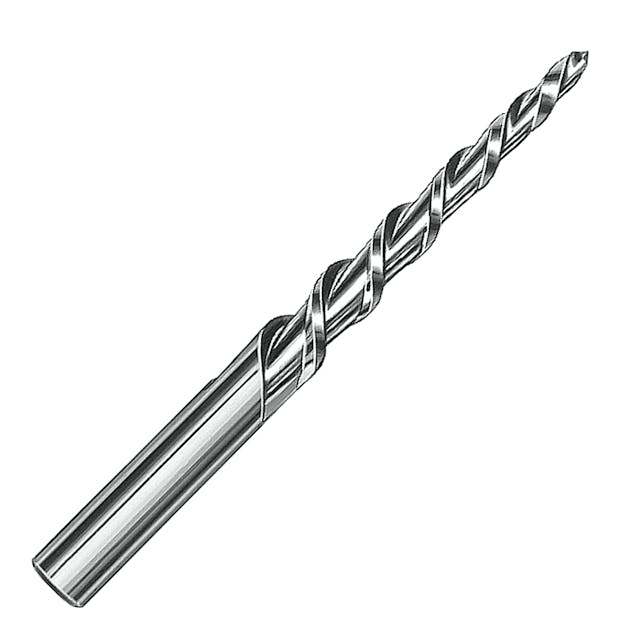
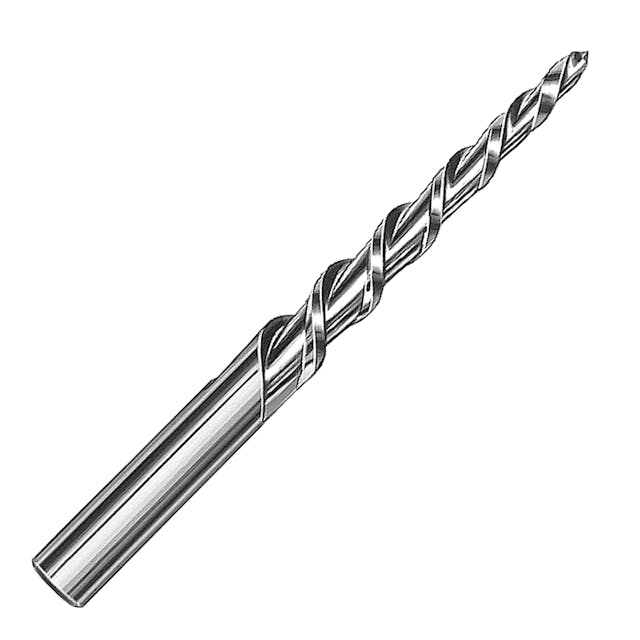
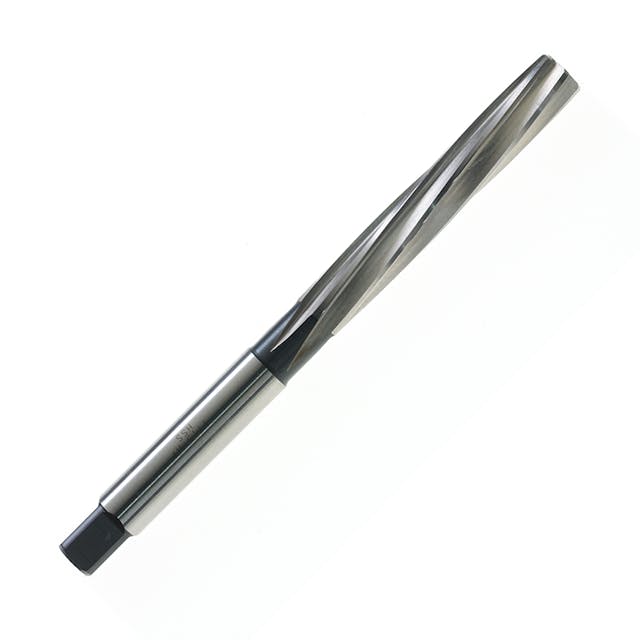
A reamer is a rotary cutting tool used in the process of widening an existing hole / bore. They can be used on a lathe, milling machine, a drill or by hand using a wrench. They are used to widen an existing hole / bore by a small amount to leave a smoother interior wall or to meet a certain tolerance.
You cannot use a reamer to make the hole, the hole would need to be pre-drilled and finished with a reamer. When creating a hole / bore reamers are used to finish to an exact size.
A reamer is a multi-flute rotary cutting tool used to enlarge and finish a hole that has already been drilled, to a precise diameter and with a high-quality surface finish. It is not a hole-making tool in the primary sense, it is more a hole-finishing tool and this distinction matters in practice.
A drill produces a hole by removing large volumes of material rapidly. The resulting hole is characterised by a rough surface, some degree of taper and a diameter that is slightly larger or smaller than the drill nominal so typically within H12 to H10 tolerance (several hundredths of a millimetre). For clearance holes, dowel holes that do not need precise fits, or holes that will be further processed this is perfectly acceptable.
When a hole needs to accept a close-tolerance pin, shaft or bearing where the fit is H7 or tighter (commonly 0.006–0.012mm of total tolerance on small diameters) and where the bore surface must be smooth enough to provide a sealing or guiding function as drilling alone is not adequate. The reamer is used to take a small finishing cut, typically 0.1–0.3mm on diameter from the drilled size, removing the rough walls left by the drill and producing a hole that is accurately on size and cylindrically true.
The fundamental operating difference is that reamers operate at lower cutting speeds than drills (typically one-third to half of the drilling speed for the same material) and at higher feed rates per revolution than might be expected. Feeding too slowly causes rubbing rather than cutting which generates heat and degrades the reamed surface.
There are a few factors to consider when selecting the right reamer for your job such as:
Diameter
Acceptable tolerance
Length of the hole / bore
Material being machined
How you are holding the reamer
Reamers come in a wide variety of geometries lengths and diameters and can be supplied to suit almost any application.
Hand reamers: used with a tap wrench and used by hand rather than on a machine
Chucking / Machine reamers: used on milling machine, lathe or a drill.
Taper shank reamers: a reamer with a morse taper shank held in a morse taper adapter.
Straight shank reamers: a reamer with a round shank usually held in a drill chuck, collet chuck or sidelock toolholder.
Spiral flute reamer: used to pull the swarf (material chips) out of the hole making them ideal for blind holes.
Left hand spiral flute reamer: used to push the swarf (material chips) through the hole making them ideal for through holes.
Straight flute reamers: used on softer materials such as cast iron, bronze and brass due to the soft cutting geometry they can be used in through and blind holes.
The term tolerance is used a lot in the engineering sector. Tolerance is the range of variation allowed when trying to achieve a specific size. No cutting tool can produce a perfectly sized hole and will usually have a deviation +/- of a few microns.
Tolerance will give you the min or max size the tool will achieve e.g. if the finished diameter is 12mm and the acceptable tolerance is - 0.003 and + 0.003 the acceptable diameter would be between 11.997mm and 12.003mm.
Each manufacturer will be able to advise on the tolerances for their reamers and it is always a good idea to check with them if you have any queries.
This depends on your machine set up. In most cases you can bore a hole and finish to a desired size and tolerance, although this is a slower process. Boring is usually done on a lathe using a toolholder and carbide insert. This means the workpiece would need to be finished on the lathe.
Reaming is a quicker process as a larger area of the tool is in contact with the workpiece. Reamers are available in a wide range of materials, lengths, diameters and coatings and can usually be offered to finish any hole / bore size. Boring tools can be limited on length and diameter whereas reamers are available in much wider range.
The three materials represent an ascending order of hardness, wear resistance, heat resistance, and cost — with trade-offs at each step.
HSS (High-Speed Steel) Reamers have been the standard reamer material for many decades. It machines well, can be reground multiple times, is tough enough to withstand minor misalignment without fracturing and is priced accessibly. Suitable for most carbon and alloy steels, aluminium, brass, cast iron and plastics at standard cutting speeds. The limitation is that HSS softens at higher temperatures > above approximately 600°C the hardness drops rapidly so cutting speed is capped.
HSSE (HSS with 5–8% Cobalt / M35 grade) Reamers retain hardness at higher temperatures than standard HSS, allowing higher cutting speeds and better performance in stainless steel, heat-resistant alloys and harder steels. Cobalt also improves wear resistance so HSSE reamers last longer per hole in abrasive materials. The RE-AL AcuRea variant within the HSSE section adds a hard nano chrome multi-layer coating, providing a harder surface layer and further improving wear resistance, with a stated diameter tolerance of ±0.0015mmthat is tighter than the standard HSSE ISO H4 tolerance. HSSE is the correct choice when reaming stainless steel or when standard HSS wear rate is too high for the production volume.
Solid Carbide Reamers are substantially harder and more wear-resistant than any HSS grade, allowing significantly higher cutting speeds and far longer tool life in production reaming. Carbide reamers are the standard in CNC production environments where cycle times and consistent hole size over thousands of holes matter. They are also the only practical choice for reaming very small diameters (the carbide range starts at 0.200mm - finer than HSS), for very hard materials and for abrasive composites and ceramics. The trade-off is brittleness as carbide reamers must be used on rigid machines with minimal runout and are not suitable for manual use or flexible setups where lateral loads occur. They are also more expensive per tool than HSS though total cost-per-hole in production is typically lower due to longer life.
Here's our guide on how to select the correct reamer for your needs:
HSS reamers for general manual and CNC use on common materials
HSSE reamers for stainless steel, higher volumes
where HSS life is insufficient > carbide reamers for CNC production, very small diameters and difficult materials.
The RE-AL AcuRea reamers within our HSSE range carry a multi-layer nano chrome hard surface coating.
This coating serves two functions:
It increases the surface hardness of the cutting edges and flute surfaces beyond that of the underlying cobalt-steel substrate, reducing wear rate
The smooth, hard surface reduces friction between the reamer and the workpiece which improves surface finish in the reamed hole and helps prevent chip adhesion
The tolerance specification of ±0.0015mm is the diameter tolerance of the reamer itself and not the hole tolerance. It means the reamer's own diameter is held to within 1.5 micrometres of nominal. This is tighter than the standard ISO H4 tolerance (which allows up to +0.003mm above nominal on small diameters) used for the standard HSSE reamers.
Why does reamer diameter tolerance matter? The reamed hole diameter is determined by the reamer's diameter plus a small amount of springback and any floating or lead factors. A reamer with a tighter diameter tolerance produces a more predictable hole diameter, reducing the need to select reamers from a batch to hit a specific fit class. For production work where hole-to-shaft fit must be consistently within a narrow H7/p6 or H7/k6 fit range across many components, the AcuRea's tighter ground diameter is a practical advantage.
Two shank types are available across the reamer range: straight shank reamer and Morse taper shank reamer.
Straight shank reamers have a parallel cylindrical shank that is clamped in a collet chuck, ER chuck or floating reamer holder. This is the standard for CNC machining centre use as the machine's spindle uses ER collets or hydraulic chucks that clamp on the parallel shank. Straight shank reamers constitute the majority of our HSSE range.
Morse taper shank reamers have a self-holding tapered shank that seats directly into a matching Morse taper socket in a drilling machine spindle, a Morse taper arbor or a tailstock on a lathe. The taper clamps by friction when driven in and is released by a drift. Morse taper reamers are the traditional choice for manual and semi-manual operations such as drilling machines, radial drills and lathes because the taper provides positive drive without slipping and is quick to change without a chuck key or collet.
The reamer range covers an exceptionally wide diameter span with very fine steps through the smaller sizes.
The carbide reamer range starts at 0.200mm and steps in 0.005mm increments through the sub-millimetre range providing a reamer for every 5-micrometre increment from 0.200mm to 0.600mm, then 0.010mm increments above that. This granularity is necessary because a 0.200mm hole and a 0.210mm hole are entirely different features requiring entirely different tools.
The HSSE reamer range starts at 0.600mm, also with 0.010mm steps through the fine sizes and then 0.005mm steps through the range where tight fit tolerances demand in-between sizes (the filter shows diameters like 3.975mm, 3.990mm, 4.000mm, 4.010mm - in 10-micrometre and 15-micrometre steps around nominal sizes).
The HSS reamer range starts at 1.000mm in 0.1mm steps at the small end, transitioning to finer steps (0.01mm and 0.005mm) around common engineering sizes.
The reason for these fine increments is the nature of precision reaming. If you are reaming to an H7 tolerance in a 10mm bore then the tolerance band is 0.015mm total. To reliably hit this band the reamer diameter must be selected to suit the specific fit required and nominal H7 reamers are not the only option. For a tighter fit (e.g. H6) a reamer at the lower end of the H7 band is needed.
The pre-drill size must leave the correct amount of material for the reamer to remove. Too much material creates excessive cutting forces that may deflect the reamer and produce an oversize, bell-mouthed or tapered hole. Too little material means the reamer rubs rather than cutting, generating heat and leaving a poor surface finish.
The standard pre-drill allowance for machine reaming is approximately 0.1mm on diameter for holes up to 6mm, increasing to approximately 0.2 to 0.3mm on diameter for holes in the 6 to 20mm range and up to 0.5mm for larger bores. These are guidance figures as material hardness affects the optimal allowance, with harder materials generally benefiting from a slightly smaller stock removal to reduce reamer deflection under cutting force.
In practice for a 10mm H7 reamed hole, drill to 9.8mm, then ream to 10mm H7. For a 6mm H7 reamed hole, drill to 5.9mm, then ream to 6mm H7. For H6 or tighter tolerance, consider adding an intermediate boring or core drilling pass to ensure concentricity before reaming, since a drill tends to follow the axis of the pre-drilled hole rather than the programmed axis & if the drilled hole has positional error, the reamed hole will replicate it.
Reaming is a finishing operation and is not about material removal rate. The cutting speed and feed interact to determine chip formation, heat generation and the surface finish.
The universal rules are:
Cutting Speed
Use approximately one-third to half of the speed you would use for drilling the same material with the same tool material. Running a reamer at drilling speed generates excessive heat, accelerates wear and typically produces oversize holes due to thermal expansion of the reamer. For HSS reaming/HSSE reaming steel, typical surface speeds are 6-12 m/min. For carbide reaming steel, 15-30 m/min. Aluminium can be reamed at higher speeds (carbide reamers up to 60-80 m/min).
Feed Rate
Use a feed per revolution higher than might be expected, typically 0.05-0.15mm/rev for small diameters, increasing to 0.20-0.50mm/rev for larger diameters. Feeding too slowly (too fine a feed) causes the reamer to rub rather than cut, generating heat without effective cutting and produces a smeared rather than cleanly cut surface.
Coolant
Always use cutting fluid when reaming steel and stainless steel, flood coolant or neat cutting oil for blind holes. The fluid lubricates the land (the margin behind the cutting edge), which contacts the bore wall and governs the final hole size and surface finish. Dry reaming of steel produces poor finish and rapid wear. Aluminium can sometimes be reamed dry or with minimal lubrication but benefits from flood coolant at production rates.
Withdrawal
Always withdraw the reamer at the same rotational direction as cutting (do not reverse the spindle before withdrawal) unless the machine program specifically accounts for this. Reversing the spindle on withdrawal with a right-hand cutter will cause the non-cutting lands to mark the bore surface.
HSS reamers & HSSE reamers can be reground on specialised tool and cutter grinders. Regrinding is performed on the face (the leading face of each flute) rather than on the outer diameter. Regrinding the OD would reduce the reamer diameter, changing its size classification. Regrinding the face restores the cutting edge geometry and removes wear without affecting diameter significantly.
Whether regrinding is economically worthwhile depends on the reamer size and cost. Small-diameter reamers (below approximately 8mm) are rarely worth regrinding as the cost of grinding labour exceeds the cost of a new tool. Larger-diameter reamers, particularly in cobalt or in special sizes become worthwhile to regrind once the per-tool cost is high enough.
Solid carbide reamers can also be reground on diamond grinding machines but the economics are similar to the above with only larger diameters justifying the grinding cost. Carbide is ground with diamond wheels and requires coolant throughout the grinding process to prevent thermal cracking off the substrate.
If a carbide reamer has chipped (rather than simply worn), regrinding may not fully restore it because a chip from the cutting edge leaves a concave relief that may not be completely removed without a large amount of material removal, potentially taking the reamer below the required diameter.