




Soluble Cutting Oils & Coolants
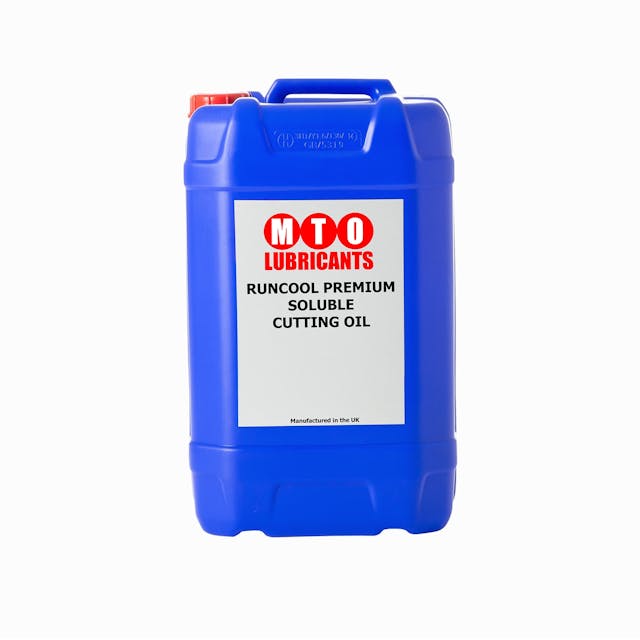
MTO Runcool Premium Semi-Synthetic Cutting Fluid
MTO Runcool Premium Semi-Synthetic Cutting Fluid
- Compatible with most water qualities up to 400ppm calcium carbonate
- Highly resistant to bacterial and fungal degradation
- Excellent corrosion inhibition to ferrous metals
- Chlorine, formaldehyde, nitrite and phenol free formulation for optimum operator acceptability
- Extremely low foaming tendency
£116.66 excl. VAT
£139.99 incl. VAT
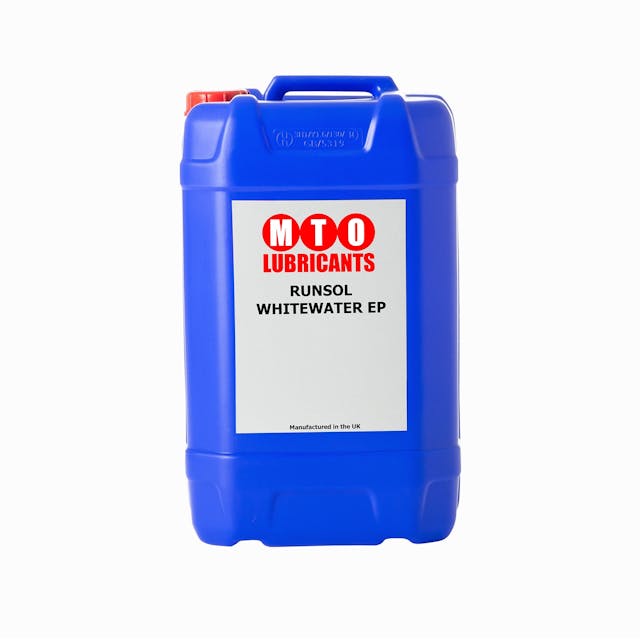
MTO Runsol Whitewater EP Water Soluble Cutting Fluid
MTO Runsol Whitewater EP Water Soluble Cutting Fluid
- High oil content.
- Exceptional cooling properties.
- Good anti-corrosion inhibition to ferrous metals.
- EP additives ensure good tool cutting and high quality surface finish.
- Boron, formaldehyde, nitrite and phenol free formulation for optimum operator acceptability.
MTO Runcool 431AF Semi-Synthetic Cutting Fluid
MTO Runcool 431AF Semi-Synthetic Cutting Fluid
- Contains specially developed silicone-free anti-foam additives to overcome foaming in high-pressure systems using soft or de-ionised water.
- Forms a translucent micro emulsion in most waters.
- Compatible with most water qualities up to 400ppm calcium carbonate.
- Highly resistant to bacterial and fungal degradation, giving freedom from bad smells or slimy deposits.
- Offers good corrosion inhibition to ferrous metals.
- Good resistance to contact corrosion thus allowing work pieces to be stacked without staining.
- Chlorine, nitrite, phenol and formaldehyde free and based on highly refined mineral oil, thus giving optimum operator acceptability.
- Creates minimal sticky residues that can easily be washed away with water.
MTO Runcool Ultra Semi-Synthetic Cutting Fluid
MTO Runcool Ultra Semi-Synthetic Cutting Fluid
- Outstanding lubricity and extreme pressure properties.
- Based on highly developed synthetic ester technology.
- Chlorine-free.
• Free from secondary amines, nitrites and phenols for the most stringent health and safety requirements. - Low staining potential on aluminium and its alloys.
- Widely used for aerospace applications.
- Forms a stable milky emulsion in waters up to 400ppm CaCO3 hardness.
- Outstanding resistance to bacterial and fungal degradation.
- Good rejection of tramp oil.
- Low foaming characteristics, achieved with only silicone free anti-foams.
- Found to be particularly effective in preventing rusting when machining cast iron.
MTO Runcool ECO 4779 Semi Sytnthetic Cutting Fluid For Hard Water
A semi-synthetic medium to hard water high performance coolant.
Benefits
- Outstanding sump life
- Superior corrosion protection
- Multi-metal compatible
- Medium-hard water tolerant
- Extremely hard water tolerant
- Excellent tramp oil rejection
- Low foaming
- Chlorine, biocide free
- High operator acceptance
- Clear running on cast iron
- Non-staining on aluminium alloys
£149.00 excl. VAT
£178.80 incl. VAT
MTO Runcool ECO 2425
RUNCOOL ECO 2425 is a biocide-free, soft to medium water, high lubricity micro-emulsion coolant. This chlorine free metalworking fluid will perform extremely well on multi-metal applications and is machine tool friendly with extremely low foaming properties
£113.66 excl. VAT
£136.39 incl. VAT
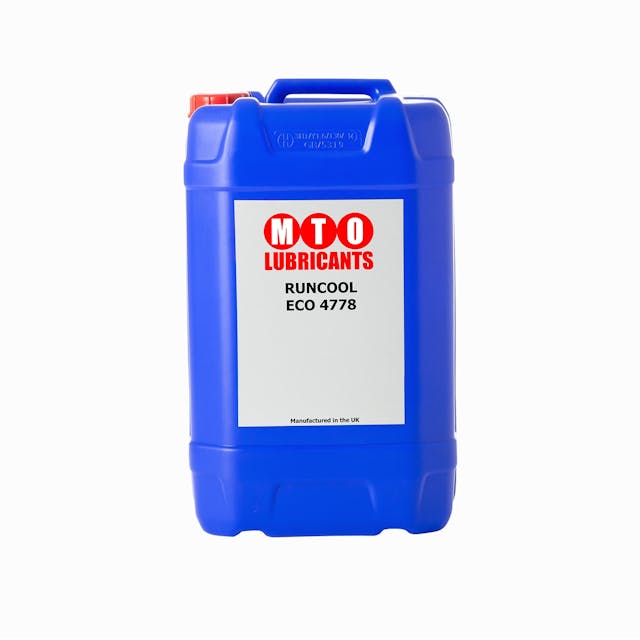
MTO Runcool ECO 4778 Semi Sytnthetic Cutting Fluid For Soft Water
MTO Runcool ECO 4778 Semi Sytnthetic Cutting Fluid For Soft Water
- Outstanding sump life
- Superior corrosion protection
- Multi-metal compatible
- Medium – soft water tolerant
- Excellent tramp oil rejection
- Low foaming
- Chlorine, biocide free
- High operator acceptance
- Clear running on cast iron
- Non-staining on aluminium alloys
£119.01 excl. VAT
£142.81 incl. VAT
£107.11excl. VAT
£128.53incl. VAT
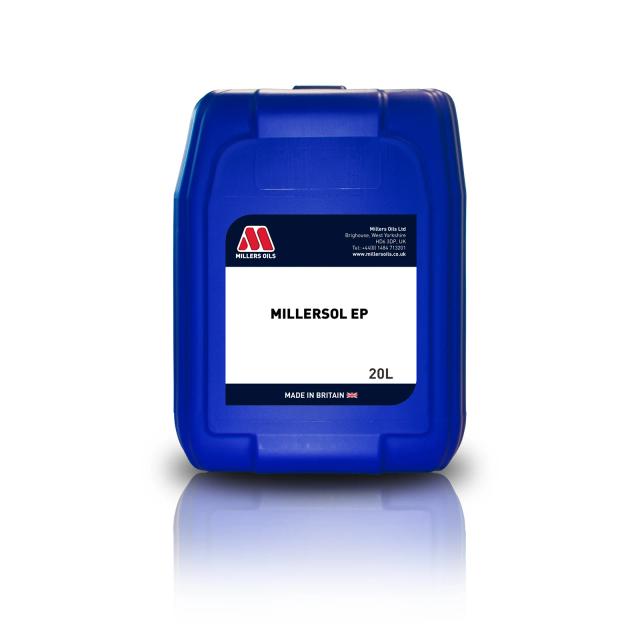
Millersol EP Semi-Synthetic Metalworking Fluid (Millers Oils)
Millersol EP Semi-Synthetic Metalworking Fluid (Millers Oils)
• Low-foaming to provide consistent lubrication and heat removal
• EP additives ensure excellent cutting performance and surface finish even in very arduous applications
• Robust formulation extends sump life, resulting in both economical fluid consumption and reduced down-time
• Formaldehyde-free, ensuring minimised hazard labelling for operator safety and audit compliance
Millersol EP is a semi-synthetic, formaldehyde-free metalworking fluid designed for very arduous applications where EP additives are required.
Millersol EP is recommended for use on a variety of steel and aluminium alloys as well as yellow metals.
£158.17 excl. VAT
£189.80 incl. VAT
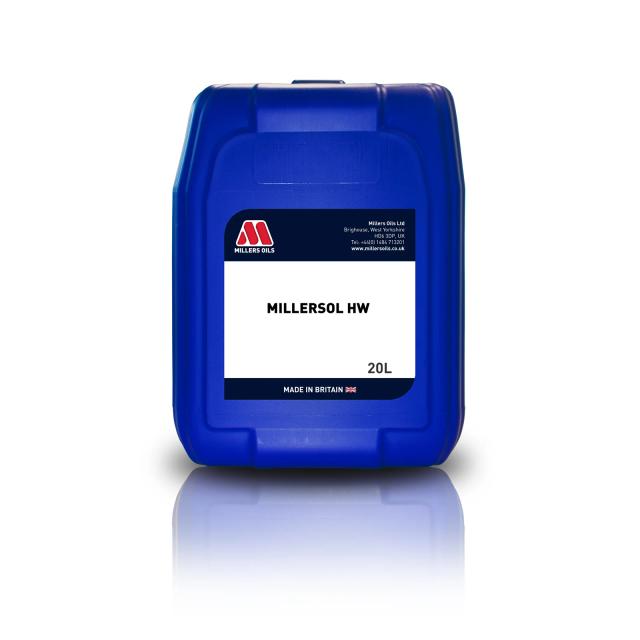
Millersol HW Semi-Synthetic Metalworking Fluid For Hard Water Applications (Millers Oils)
Millersol HW Semi-Synthetic Metalworking Fluid For Hard Water Applications (Millers Oils)
• High level of lubricity additives ensures excellent cutting performance and surface finish
• Low foaming formulation and excellent emulsion stability in hard water areas provides consistent lubrication and heat removal, even in high pressure through-spindle coolant systems
• Robust formulation extends sump life, resulting in both economical fluid consumption and reduced down-time
• Chlorine-free and formaldehyde-free, ensuring minimised hazard labelling for operator safety and audit compliance
Millersol HW is a semi-synthetic, formaldehyde-free metalworking fluid, designed for severe machining operations even in hard water areas.
Millersol HW is recommended for use on ferrous alloys, aluminium alloys and yellow metals.
£168.09 excl. VAT
£201.71 incl. VAT
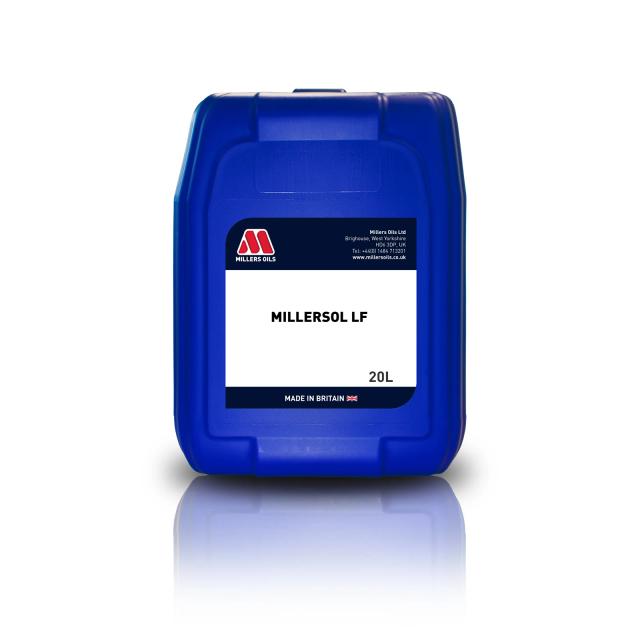
Millersol LF Semi-Synthetic Metalworking Fluid (Millers Oils)
Millersol LF Semi-Synthetic Metalworking Fluid (Millers Oils)
• Extremely low-foaming even in high pressure systems and soft water areas, to provide consistent lubrication and heat removal
• High level of lubricity additives ensures excellent cutting performance and surface finish
• Robust formulation extends sump life, resulting in both economical fluid consumption and reduced down-time
• Chlorine-free and formaldehyde-free, ensuring minimised hazard labelling for operator safety and audit compliance
Millersol LF is a semi-synthetic, formaldehyde-free metalworking fluid, designed for severe machining operations where a low foaming product is required.
Millersol LF is recommended for use on ferrous alloys including stainless steel and titanium, aluminium alloys and yellow metals.
£166.69 excl. VAT
£200.03 incl. VAT
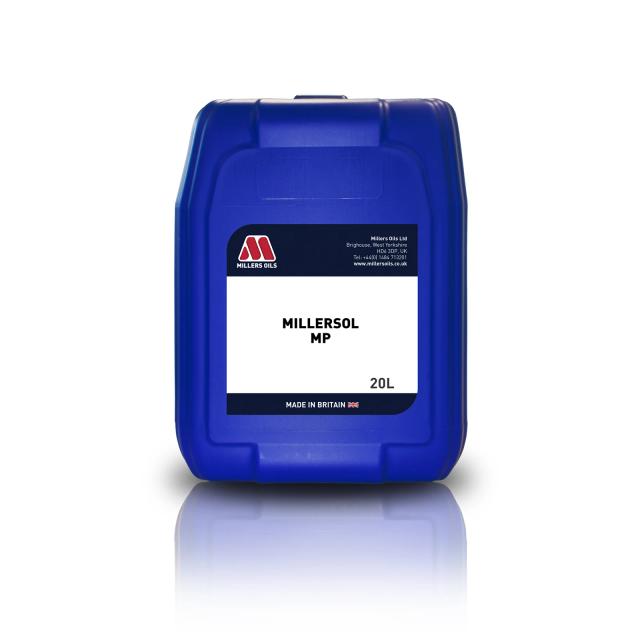
Millersol MP Low Oil Semi-Synthetic Metalworking Fluid (Millers Oils)
Millersol MP Low Oil Semi-Synthetic Metalworking Fluid (Millers Oils)
• Optimised lubricity and cooling properties ensure quality work piece finish and longer tool life
• Low foaming formulation provides consistent lubrication and heat removal in both hard and soft water
• Robust formulation extends sump life, resulting in both economical fluid consumption and reduced down-time
• Multi-metal compatibility allows product rationalisation for subcontractor flexibility as well as simplified ordering and stock holding
• Chlorine and formaldehyde-free formulation ensures minimised hazard labelling for operator safety and audit compliance
Millersol MP is a semi-synthetic, low oil formaldehyde-free metalworking fluid, designed to perform a wide range of cutting and grinding operations across a variety of materials.
Millersol MP is recommended for use on cast iron, ferrous alloys, aluminium alloys, yellow metals and glass.
£144.17 excl. VAT
£173.00 incl. VAT
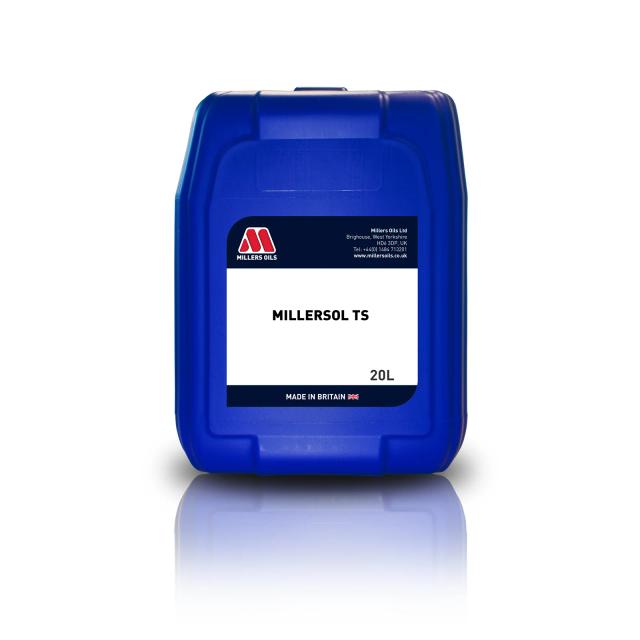
Millersol TS Soluble Metal Working Fluid (Millers Oils)
Millersol TS Soluble Metal Working Fluid (Millers Oils)
• High level of oil and lubricity additives ensures excellent cutting performance and surface finish
• Tight emulsion results in stable formulation for extended sump life, resulting in both economical fluid consumption and reduced down-time
• Formaldehyde-free, for minimised hazard labelling for operator safety and audit compliance
• Free from chlorine, zinc and heavy metals
Millersol TS is a traditional soluble metalworking fluid with high oil content for enhanced lubricity and corrosion protection during the machining of both ferrous and non-ferrous metals. Millersol TS is free from formaldehyde-release biocides.
Millersol TS is recommended for use on ferrous alloys, aluminium alloys and yellow metals.
£145.99 excl. VAT
£175.19 incl. VAT
Frequently Asked Questions
A water-based cutting fluid (also called a soluble oil, cutting coolant or metalworking fluid) is a concentrate that is mixed with water before use to form the working fluid applied at the cutting zone during machining. The resulting emulsion or solution performs several simultaneous functions that neither water nor oil alone can provide.
Cooling is the primary function most operators focus on. The cutting process generates heat through plastic deformation of the workpiece material and friction between the tool and chip. This heat degrades the cutting edge, causes thermal expansion that affects dimensional accuracy and can discolour or structurally alter the workpiece surface. Water has a high specific heat capacity and high heat of vaporisation, making water-based fluids far more effective at absorbing and removing heat than straight oils. This is why water-based fluids are the preferred choice for most high-speed machining operations because they keep the cutting zone, tool and workpiece temperature under control far more effectively than oil alone.
Lubrication reduces friction between the cutting tool and the workpiece, and between the tool and chip. This reduces cutting forces, extends tool life and improves surface finish. The oil phase in the emulsion provides this lubrication and this is why products are described as "semi-synthetic" (part oil, part synthetic chemicals) or "soluble oil" (higher oil content). Extreme pressure (EP) additives go further, providing chemically reactive protection at the very high pressure and temperature contact zones that arise during heavy cuts.
Corrosion inhibition protects the machined part, the machine tool's ground and scraped surfaces and the coolant system itself from corrosion during and after machining. The alkaline nature of modern cutting fluids, combined with corrosion inhibitor additives provides this protection.
Chip flushing (the physical flow of coolant through the cutting zone) carries chips away from the cutting area, preventing re-cutting and tool jamming.
These three terms describe the fundamental chemistry of the cutting fluid concentrate and define the balance between oil content and synthetic additive chemistry.
Soluble oils (also called emulsifiable oils or conventional cutting fluids) have a high mineral oil content (typically 50-80% of the concentrate). When mixed with water they produce a milky white emulsion, which is the classic appearance of traditional machine shop coolant. The high oil content delivers excellent lubrication, good corrosion inhibition and compatibility with a wide range of materials. MTO Runsol Whitewater EP (RSWHEP) is the soluble oil in this range, it has "high oil content" with exceptional cooling and EP additives.
Semi-synthetic fluids contain a reduced mineral oil content, typically 5-30%, and a higher proportion of synthetic additives, emulsifiers and performance chemicals. They form a translucent or milky micro-emulsion rather than an opaque white emulsion. Semi-synthetics generally offer better cooling than soluble oils (the lower oil content allows better heat transfer), better biostability (less oil means less food source for bacteria), cleaner sump conditions, better visibility of the workpiece through the coolant and lower consumption rates as they are more concentrated. Most of the MTO Runcool range and the Millers Oils Millersol range are semi-synthetics.
Synthetic fluids contain no mineral oil at all, they are entirely chemistry-based formulations in water. They typically offer the best cooling performance and the cleanest sump operation, but may have lower lubrication performance and narrower material compatibility than semi-synthetics unless specifically engineered. Runcool Ultra's description of being "based on highly developed synthetic ester technology" places it at the high end of semi-synthetic/synthetic performance.
The practical difference for the user is that semi-synthetics are the dominant choice in modern machine shops for general machining because they balance all performance requirements, whereas soluble oils remain preferred where maximum lubrication is the priority (heavy turning, tapping, deep-hole drilling) and finally, synthetics suit high-speed operations where cooling dominates.
EP stands for Extreme Pressure. EP additives are reactive chemical compounds that are typically based on sulphur, phosphorus, or chlorine chemistry, though chlorine-free formulations are now standard for health and environmental reasons - that provide protection specifically in the high-pressure, high-temperature contact zone between the cutting tool's rake face and the chip.
Under normal machining conditions the lubricant film between the cutting tool and workpiece prevents metal-to-metal contact. Under severe cutting conditions (heavy depth of cut, low cutting speed, difficult materials such as stainless steel and hardened steel, tapping, threading, broaching, and gear cutting) the pressure at the contact zone exceeds the load-bearing capacity of the oil film alone. Metal-to-metal contact occurs, generating intense localised heat and causing tool wear, welding of the chip to the tool face and poor surface finish.
EP additives chemically react with the metal surface at these extreme contact zones to form a thin, low-shear-strength protective layer that is typically metal sulphide or metal phosphate compounds. This layer prevents direct metal-to-metal welding and shears preferentially, protecting the tool and workpiece at pressures the oil film alone cannot manage.
Products with EP additives in this range are MTO Runsol Whitewater EP and Millersol EP from Millers Oils. MTO Runcool Ultra achieves its EP performance through synthetic ester technology rather than traditional additive chemistry. The ECO series products (2425, 4778, 4779) use high lubricity chemistry that achieves EP-like performance without traditional EP additives which is a significant advantage for biocide-free and chemically conservative formulations.
Water hardness refers to the concentration of dissolved calcium and magnesium salts in the mains water supply. In the UK, water hardness varies significantly by region: the south-east and Midlands typically have very hard water (above 300mg/L as CaCO3); Scotland, Wales and parts of northern England have soft water (below 100mg/L).
The mineral salts in hard water interact with the emulsifiers in cutting fluid concentrate. In hard water these interactions can destabilise the emulsion causing it to split (the oil and water separate, leaving a greasy floating layer and a watery base), form scum on the sump surface, produce excessive foam and deposit calcium soap residues (known as "hard water scum") on machine surfaces, filtration systems and workpieces.
All products in this range state their water compatibility as a key selection criterion:
All MTO Runcool products state compatibility to 400ppm CaCO3 & this covers the vast majority of UK mains water supplies, including most hard water areas
MTO Runcool ECO 4778 is specified for soft to medium water. Using it in a hard water area will cause emulsion instability and reduced sump life
MTO Runcool ECO 4779 is specifically developed for medium to hard water & it is the ECO choice for hard water regions
Millersol HW (Hard Water) is the Millers Oils product specifically engineered for emulsion stability and low foaming in hard water, with the description "Low foaming formulation and excellent emulsion stability in hard water areas... even in high pressure through-spindle coolant systems."
To determine your water hardness:
Your water supplier should openly publish this information, or alternatively a simple test strip (refractometer compatible strips are available) will give a reading. As a rule of thumb, if the kettle elements and tap fittings in the workshop develop a white calcium scale readily, the water is hard and a hard-water-tolerant formulation is the correct choice.
Biocides are chemical additives (typically formaldehyde-releasing agents, isothiazolinones or other antimicrobial compounds) added to cutting fluids to kill the bacteria and fungi that colonise the sump and degrade the coolant. Without biocides, bacterial growth produces malodorous by-products (the characteristic "Monday morning smell" of a neglected sump), breaks down the emulsion, reduces the pH of the fluid and produces health risks from aerosolised bacterial toxins (endotoxins) and dermatitis-causing compounds.
Traditional cutting fluids rely on biocides as a primary line of defence against microbial contamination. The ECO range products (MTO Runcool ECO 2425, ECO 4778 & ECO 4779) are described as biocide-free. This means they achieve microbial resistance through formulation chemistry alone, without adding dedicated biocide compounds.
The advantages of biocide-free formulations are significant:
No biocide-related COSHH (Control of Substances Hazardous to Health) obligations for the biocide compounds themselves. Biocides are regulated substances with specific occupational exposure limits and labelling requirements
No risk of biocide resistance developing in the microbial population over time
Reduced environmental impact on waste disposal, as many biocides have aquatic toxicity.
The ECO 2425 and ECO 4778/4779 products achieve their biostability through a combination of high-lubricity synthetic chemistry, alkalinity control and carefully selected emulsifier systems that resist microbial attack without relying on toxic kill chemicals. The trade-off is that they may require more careful sump management (maintaining correct concentration with a refractometer, ensuring sump cleanliness, and controlling tramp oil contamination (which is a primary food source for bacteria)) than a biocide-containing fluid managed less carefully. The "excellent tramp oil rejection" attribute listed for all ECO products directly addresses this by rapidly separating and rejecting tramp oil from the coolant sump, the primary bacterial food source is removed.
These terms refer to specific chemical compounds historically present in cutting fluid formulations that are now regulated, restricted, or considered undesirable from a health and environmental standpoint.
Chlorine-containing EP additives: chlorinated paraffins and chlorinated fatty acids were widely used as extreme pressure additives in cutting fluids because they are effective and inexpensive. However, they produce dioxins and chlorinated compounds on thermal degradation, are persistent environmental pollutants and have skin sensitisation potential. UK REACH and COSHH regulations place restrictions on chlorinated paraffins. All products in this category are described as chlorine-free!
Formaldehyde & formaldehyde-releasing biocides: formaldehyde is a potent preservative and biocide. In cutting fluids it was used directly or released from compounds such as triazines (MBT), oxazolidines, and morpholine derivatives. Formaldehyde is a known human carcinogen (IARC Group 1) and a common cause of occupational contact dermatitis and respiratory sensitisation. Its use is restricted in metalworking fluids under EU Biocide Regulations and COSHH. Products that are "formaldehyde-free" or use formaldehyde-free biocides (or no biocides) carry a lower health hazard classification, require fewer hazard warning labels and simplify COSHH assessments. Millersol EP and Millersol HW both specifically state "formaldehyde-free, ensuring minimised hazard labelling for operator safety and audit compliance."
Nitrites: used historically as corrosion inhibitors. Nitrites can react with secondary amines (also present in some older formulations) to form nitrosamines, which are potent carcinogens. All products in this range are nitrite-free and most are also free from secondary amines.
Phenols: traditional biocides and preservatives with significant toxicity and environmental persistence. All products are phenol-free.
The combined description "chlorine, formaldehyde, nitrite and phenol free" that appears across the Runcool range is in practice the modern baseline for a compliant, operator-friendly cutting fluid & it represents the removal of the historically problematic chemistry that drove occupational illness in the machining industry.
Tramp oil is lubricating oil, hydraulic oil or slideway oil that enters the cutting fluid sump from machine tool lubrication systems. On any machine tool with slideways, headstock bearings, gearboxes or hydraulic circuits, small quantities of lubricating oil inevitably drip or are flung into the coolant reservoir during normal operation. On machines with separate lubrication and coolant circuits this is unavoidable and it is the source of tramp oil contamination.
Tramp oil causes several problems in the coolant sump:
It floats on the surface of the coolant and forms a surface film that reduces oxygen transfer into the sump. Low oxygen conditions (anaerobic conditions) favour the growth of sulphur-reducing bacteria because these organisms are responsible for the most aggressive and malodorous sump degradation
It stabilises as a component of the emulsion at higher concentrations, diluting the cutting fluid's effective concentration, reducing lubrication and corrosion protection performance and causing emulsion instability
It promotes foam by interacting with the emulsifiers in the cutting fluid
It coats machine surfaces, workpieces and chip conveyors with an oily film.
A cutting fluid with "excellent tramp oil rejection" is formulated so that tramp oil does not emulsify into the coolant, instead it rises to the surface and forms a distinct, separable layer that can be skimmed off with a belt or disc skimmer. This self-cleaning property dramatically extends sump life and reduces the bacterial load in the sump.
Water-based cutting fluids are concentrates that must be diluted with water before use. The dilution ratio determines the concentration of the working fluid in the sump, which in turn determines lubrication, cooling, corrosion protection and sump life performance.
The correct mixing procedure is always to add concentrate to water but never the reverse. Adding water to a neat concentrate can cause the emulsion to crash (invert) and result in an unstable, oily mixture that does not properly re-emulsify. The phrase "add concentrate to water" is universal for all emulsifiable cutting fluid products.
Typical working concentrations for semi-synthetic and soluble cutting fluids are between 5% and 10% concentrate (i.e., 1 part concentrate to 19-9 parts water). The specific concentration depends on the application:
General machining of steel and cast iron: 5-7% is typical for most semi-synthetic products
Heavy machining, grinding or difficult materials: 8-10% to increase lubrication and corrosion protection
Aluminium machining: some formulations perform better at slightly lower concentrations but always check the product's technical data sheet first.
Concentration is measured in the field with a refractometer (an optical instrument that measures the refractive index of the emulsion and converts it to a concentration reading using the product-specific refractometer factor). Each cutting fluid has its own factor (stated in the TDS), so a reading from a refractometer must be multiplied by that factor to give the true concentration. Regular concentration checks (at least weekly on active sumps) allow top-up to maintain concentration within the recommended range.
Do not mix different cutting fluids in the same sump. Different emulsifier systems can be incompatible, causing emulsion splitting, foam or accelerated degradation. When switching products, drain and clean the sump fully before charging with the new fluid.
Sump life is not determined by a fixed time interval (it depends on the fluid formulation, the intensity of use, water quality, tramp oil loading, contamination management and concentration maintenance). A well-maintained sump with a good semi-synthetic fluid in a clean machine shop environment can last six months to over a year. A poorly managed sump in a contaminated environment may fail within weeks.
The indicators that a sump requires changing are:
pH below 8.5: Cutting fluids are intentionally alkaline (pH typically 8.5–9.5 when in use) as the alkalinity provides both corrosion protection and suppression of bacterial growth. A falling pH indicates bacterial activity and acid production. pH should be checked weekly with indicator paper or a meter
Concentration drift despite top-up: if the concentration continues to fall even when concentrate is added at the correct rate, it indicates emulsion instability and possible microbial breakdown of the emulsion
Persistent malodour: the "rotten egg" smell of hydrogen sulphide indicates sulphate-reducing bacteria. The "sour" or "garbage" smell indicates general bacterial overgrowth
Visible degradation: emulsion splitting, free oil floating in quantities beyond normal tramp oil levels, slimy deposits ("bio-slime") on machine surfaces or in the sump
Corrosion on workpieces or the machine: indicating loss of corrosion inhibitor protection.
The Runcool ECO range and Millersol products specifically highlight "outstanding sump life" as a product benefit reflecting their biocide-free or biocide-minimised formulations, tramp oil rejection, and emulsion stability. These properties extend usable sump life compared to less robust formulations, reducing fluid consumption and disposal costs. When change is required, the sump should be fully drained, cleaned and disinfected before charging with fresh fluid.