




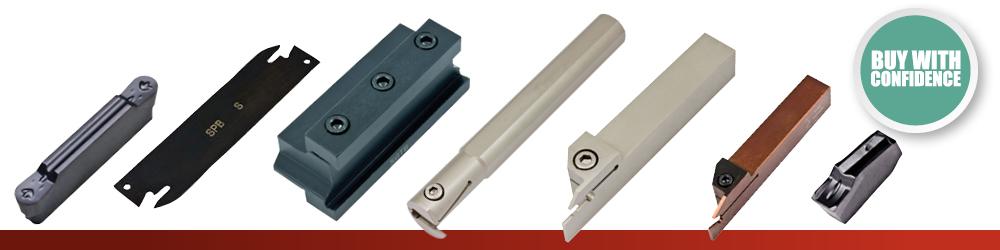
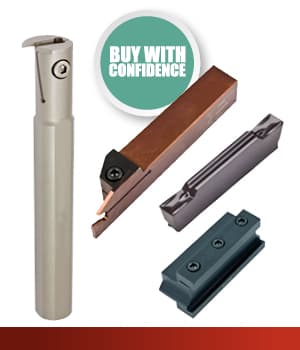
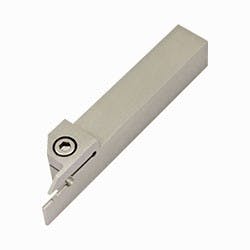
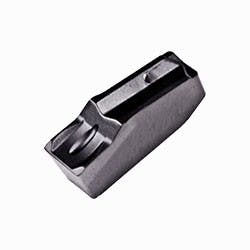

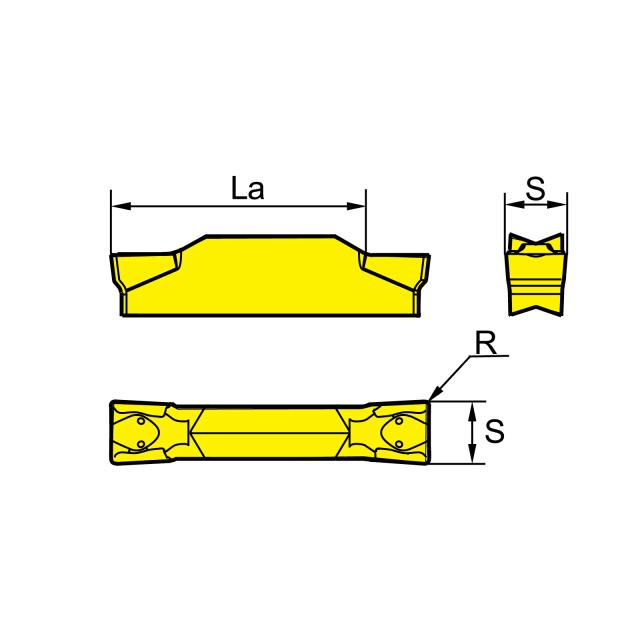
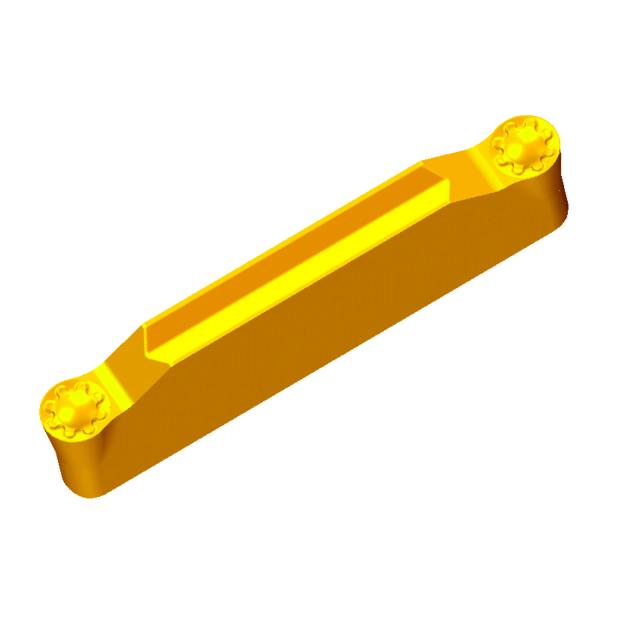
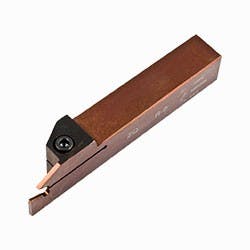
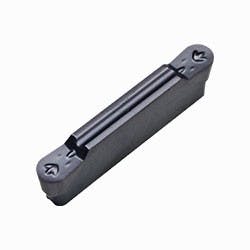

Parting Blade With 10 Inserts

Tool Holders:
Parting Off Inserts:
PVD Coated
Grade UM25 (M25, P35 + PVD NaCo3) Suitable For Steel, Stainless And General Use On A Wide Range Of Materials.
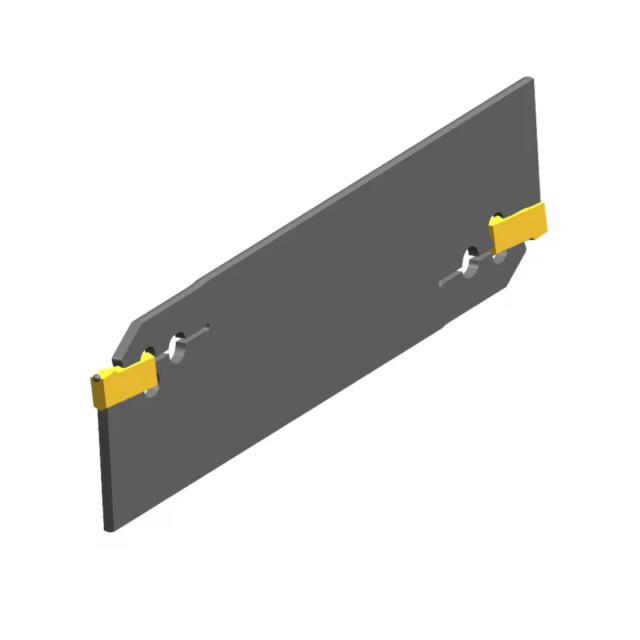
H100 Series Parting Off Blade - Horn
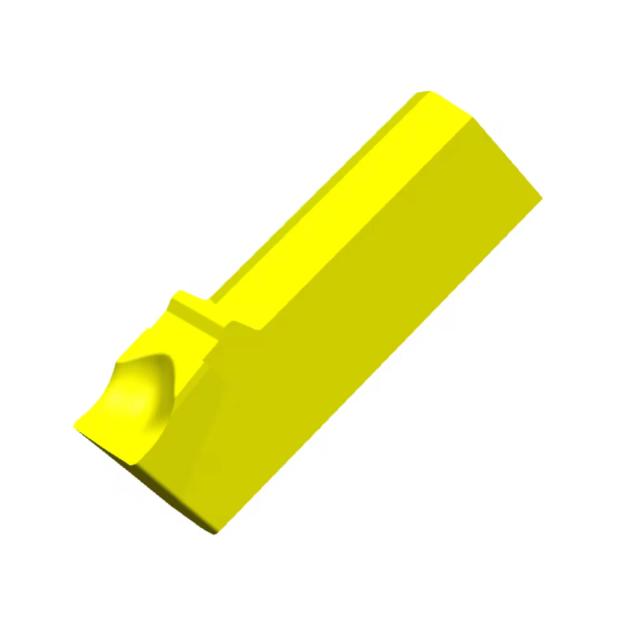
S100 Series Neutral Parting Off Insert - Horn
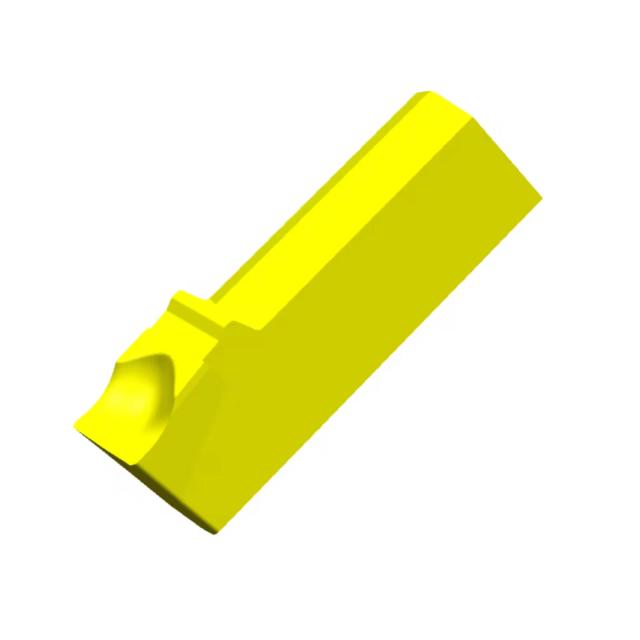
S100 Series Right Hand Parting Off Insert - Horn
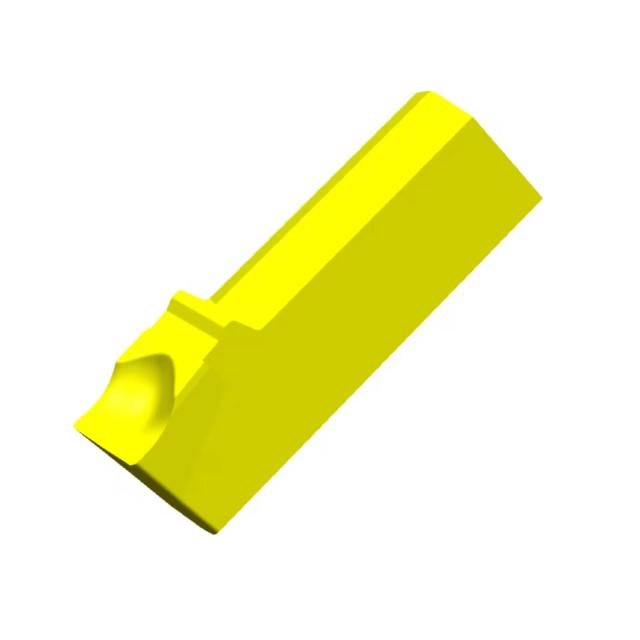
S100 Series Left Hand Parting Off Insert - Horn
Parting off and grooving are related lathe operations that use similar insert geometries but serve distinct purposes and the tooling (while closely related) is not always interchangeable.
Parting off (also called cut-off) is the operation of severing a completed component from the bar stock or from a workpiece held in the chuck. The tool plunges radially into the workpiece until it breaks through, separating the part. The insert must therefore cut all the way to centre (or near-centre), meaning the tool must reach the full radius of the workpiece. Key concerns are rigidity, vibration resistance and the ability to cut right to the centreline without the tool binding in the groove.
Grooving is the machining of a defined slot or channel (a recessed feature) in the workpiece without necessarily cutting through. Grooves are machined for circlip seats, O-ring grooves, undercuts for threading or grinding clearances and decorative or functional form features. The tool plunges to a defined depth and then either withdraws or traverses axially to widen the groove.
In practice, the same insert style is used for both operations because the MGMN family of inserts fits both the MGEHR external grooving/parting toolholders and the MGIVR internal grooving tools. The MGEHR holders are explicitly described as "suitable for external grooving, turning and parting off", thus confirming its dual use.
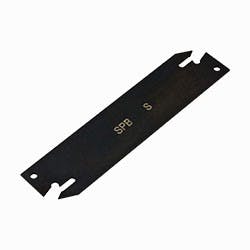
The distinction matters when selecting parting blades (SPB-S series): these are narrow, high-reach blades specifically engineered for deep parting on large-diameter workpieces, whereas a standard MGEHR holder is more compact and suited to both shallow grooving and parting on moderate diameter work.
The AP series inserts and their associated SPB-S blades and ZQ-R holders are dedicated parting inserts because their geometry is specifically optimised for the parting-off operation rather than general grooving.
The category contains toolholders/blades and inserts across three brands, organised as follows:
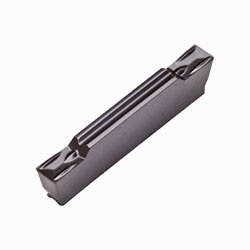
AP series (parting inserts): PVD-coated carbide grade UM25 (ISO M25/P35 + NaCo3 PVD), three widths: AP200 (2.2mm), AP300 (3.1mm), AP400 (4.1mm). These are dedicated parting inserts with a cutting data sheet available
MGMN-UP25 series (grooving inserts): TiALN PVD-coated, grade UP25, six widths from 1.5mm to 5mm, corner radii from 0.15mm to 0.8mm. Fit MGEHR and MGIVR toolholders. Two cutting edges per insert.
MRMN-UP25 series (full-radius grooving inserts): TiALN PVD-coated, grade UP25, full radius geometry in 2mm, 3mm and 4mm widths. Fit MGEHR and MGIVR toolholders. Two cutting edges.
ZT*D-MG series (ZCC-CT grooving inserts): coated carbide double-edged inserts for ZCC-CT toolholders, wide range of material-specific grades.
ZR*D-MG series (ZCC-CT profiling inserts): full-radius coated carbide double-edged inserts for ZCC-CT toolholders.
MGEHR series (external grooving/parting toolholders): steel, right-hand, shanks from 6×10mm to 32×32mm, insert widths 1.5mm–6mm, max groove depths 11.5mm–23mm depending on size.
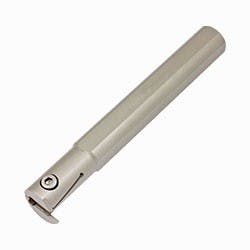
MGIVR series (internal grooving toolholders): steel, right-hand, for bores from 20mm minimum, shank diameters 16mm and 20mm, cutting widths 1.5mm–4mm, groove depths 4–6mm.
I-QE**R/L series (ZCC-CT internal grooving tools): for groove turning and profiling, right and left hand, max groove depth 13mm.
SPB-S blades: steel parting blades for AP inserts, 26mm or 32mm height, 110mm or 150mm length, in widths for AP200/AP300/AP400 inserts
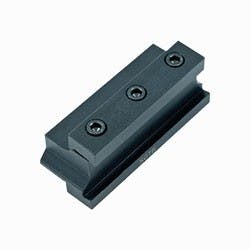
SGTBN parting blocks: steel parting blade holders accepting SPB-S style blades, for 16mm, 20mm and 25mm toolpost sizes, blade heights 26mm or 32mm
ZQ-R integral parting tools: solid steel toolholders for AP inserts, available in 16mm, 20mm, and 25mm shanks.
The MGEHR naming convention encodes all the key dimensions needed to match the toolholder to your lathe toolpost and the groove you need to cut:
MGEHR [HxB] - [W]
Where HxB is the shank cross-section (height × width in mm) and W is the insert width (which sets the groove width) in mm.
For example: MGEHR2020-3 = 20mm × 20mm shank, 3mm insert width.
The shank size must match the toolpost pocket on your lathe. Common sizes for manual lathes:
Shanks of 16×16mm suit lathes with 16mm toolpost pocket height (hobby/small centre lathes)
Shanks of 20×20mm are the most common for medium-capacity manual lathes
Shanks of 25×25mm suit larger manual lathes and smaller CNC turning centres
Shanks of 32×32mm suit larger CNC turning centres and heavy-duty manual lathes.
Very small shanks (6x10, 8x10, 10x10) are available for miniature lathes and CNC Swiss-type machines and these accept 2mm inserts and have a maximum groove depth of 11.5–14.5mm.
Once you have identified the correct shank size, select the groove width that matches the feature you are cutting. The MGEHR range covers insert widths of 1.5mm, 2mm, 2.5mm, 3mm, 4mm, 5mm, and 6mm. The maximum groove depth increases with insert width so a 2mm insert in a 20×20mm shank gives a maximum depth of 14.5mm, while a 5mm insert in the same shank gives 19mm maximum depth. Always verify the maximum groove depth column on the product page before ordering to ensure it accommodates the required groove depth for your application.
Both MGMN and MRMN are the same insert platform (same seat geometry, same MGEHR/MGIVR toolholder compatibility), but differ in their cutting edge profile:
MGMN inserts have a flat-bottom groove geometry. The insert tip is essentially square-shouldered, producing a groove with a flat base and defined side walls. The corner radius on MGMN inserts is small (0.15mm-0.8mm depending on width) and just enough to provide some edge strength. MGMN is the correct choice for dimensionally accurate rectangular grooves (circlip seats, O-ring grooves, snap ring grooves) where the base width is a controlled dimension. General parting-off where a clean perpendicular cut face is required. Grooving to a specific width with both side walls controlled.
MRMN inserts have a full-radius profile where the insert tip is a complete semicircle with a radius equal to half the insert width. A 2mm MRMN insert produces a 1mm radius round-bottomed groove; a 3mm insert produces a 1.5mm radius, etc. MRMN is the correct choice for: Bead-form grooves (decorative work, round-groove form features). Undercut reliefs that require a radiused base. Profile turning where a specific convex or concave form feature is required. Situations where a stress-concentrating sharp corner at the groove base would be undesirable as the full radius distributes stress at the base of the groove.
Both series in grade UP25 (TiALN PVD coated) are compatible with steel, stainless steels, cast iron, and high-temperature alloys. Both offer two cutting edges per insert and each insert can be turned end-for-end when the first edge wears, halving the cost per cutting edge.
The grade designation UM25 describes both the carbide substrate classification and the coating on the AP series parting inserts:
UM25 decodes as a dual-classification grade combining ISO M25 and P35 performance capability with a PVD NaCo3 (Nano-Coating) hard coating applied by Physical Vapour Deposition:
ISO M25 indicates suitability for machining stainless steels and other austenitic materials. M-grade materials are typically work-hardening, gummy and prone to built-up edge. M25 sits in the middle of the M-grade range covering both medium-duty and slightly heavy cutting.
P35 indicates suitability for steel machining at the heavier end of the medium-cutting range. P35 is robust enough to handle interrupted cuts harder steels, and more challenging conditions within the steel group.
PVD NaCo3 coating is a physical vapour deposition hard coating that provides high surface hardness, low friction and heat resistance at the cutting edge. PVD coatings are applied at lower temperatures than CVD coatings, meaning they can achieve sharper cutting edges which is beneficial for parting where a sharp edge is important to prevent deflection and chatter.
In practical terms, AP inserts in grade UM25 are described as suitable for steel, stainless steel, and general use on a wide range of materials — making them appropriate for a general workshop cutting mild steel, EN8, stainless grades 303/304/316, and similar materials. A cutting data sheet is available (linked on the product page) providing recommended speeds and feeds.
The SPB-S / SGTBN system is a two-component parting blade arrangement that provides a narrow, high-reach parting capability suited to cutting on larger-diameter workpieces where a compact MGEHR holder would not reach deep enough to part off.
The SGTBN parting block is the toolpost-mounted component where a rigid steel block that clamps into the lathe's toolpost and holds the parting blade at the correct height and angle. It is selected by toolpost size (16mm, 20mm or 25mm) and by the blade height it accepts (26mm or 32mm).
The SPB-S parting blade slides into and is retained by the SGTBN block. The blade is a long, thin steel blade with the AP-style insert pocket at the cutting end. Selection parameters for the blade are:
Height (26mm or 32mm) which must match the SGTBN block and defines the blade's rigidity cross-section. 32mm height blades are stiffer and suit heavier cuts or larger lathes.
Length (110mm for 26mm height, 150mm for 32mm height) determines the maximum parting depth (approximately half the blade length is the usable reach from the workpiece centre).
Insert size (AP200, AP300, AP400) the blade is machined to accept only the specific insert width it is designated for. Selecting a 26mm height SPB-226-S, for example, accepts only AP200 (2.2mm) inserts.
The narrower inserts (AP200, AP300) minimise material wastage and reduce cutting forces and the AP400 (4.1mm) provides a more robust insert for harder materials.
The insert is removed and replaced using a flathead screwdriver or an insert extractor tool so no special tooling is required for insert changes.
For a typical 20mm toolpost lathe, a complete parting set-up using this system would be: SGTBN2026 block + SPB-326-S blade + AP300UM25 inserts.
The MGIVR series is a boring-bar-style internal grooving tool for machining grooves inside bores with features such as internal circlip grooves, O-ring seats, locking ring grooves and internal undercuts. Unlike an external MGEHR holder which sits directly in the toolpost, the MGIVR is a cylindrical shank tool that is mounted in a boring bar holder or a dedicated boring bar clamp.
The key selection dimensions are the minimum bore diameter the tool can enter, the shank diameter, the cutting width (which sets the groove width) and the maximum groove depth:
MGIVR2016 variants: 16mm shank diameter, 20mm minimum bore. Available in 1.5mm, 2mm, and 2.5mm cutting widths with maximum groove depths of 4mm, 4mm and 6mm respectively.
MGIVR2520 variants: 20mm shank diameter, 25mm minimum bore. Available in 1.5mm, 2mm, 2.5mm, 3mm, and 4mm cutting widths with groove depths of 4-6mm.
The key constraint is that the minimum bore diameter must be larger than the shank diameter to allow the shank to enter the bore with clearance for the insert to cut on the bore wall. A 16mm shank tool entering a 20mm bore leaves only 2mm clearance each side so it's adequate but tight, meaning chip evacuation and coolant access require attention.
Both series accept MGMN and MRMN style inserts (flat-bottom or full-radius geometry), identical to those used in the MGEHR external holders. This means a workshop can stock a single set of inserts to serve both external and internal grooving operations across all toolholders in this range.
The ZQ-R is a one-piece integral steel parting toolholder for AP style inserts. Unlike the SPB-S blade and SGTBN block system (which is a two-component arrangement where a separate blade slots into a separate block) the ZQ-R is a single solid steel body with the AP insert pocket machined directly into the shank.
The ZQ-R is available in three shank sizes: 16×16mm, 20×20mm and 25×25mm. All three accept AP300 style inserts (3.1mm width) (the -03 designation in the SKU indicates the AP300 insert compatibility).
The integral design offers superior rigidity compared to a blade-and-block arrangement because there is no blade-to-block interface that could flex or shift under cutting load.
This makes the ZQ-R preferable when:
The machine tool is particularly rigid (CNC turning centres or heavy manual lathes) and the operator wants to maximise the stiffness of the parting system
Parting is performed at higher speeds or feed rates where blade vibration could be a concern
The compact, direct-mount form is preferred over the larger footprint of a blade-and-block assembly.
The trade-off is reach: the integral ZQ-R has a fixed geometry and cannot be extended to reach larger diameters the way a long SPB-S blade can. For parting off large-diameter workpieces, the blade-and-block system is the appropriate choice. For moderate-diameter parting in a rigid machine, the ZQ-R provides a clean, compact, highly rigid solution.