




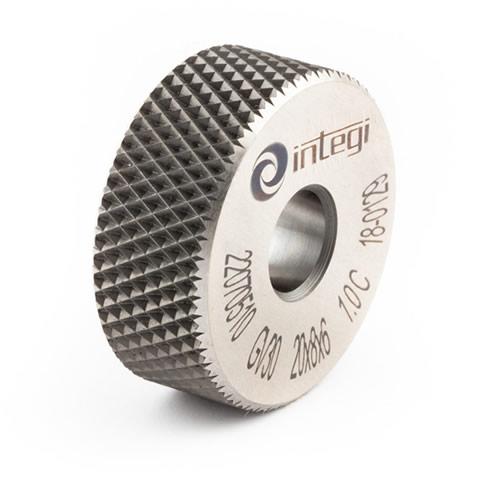
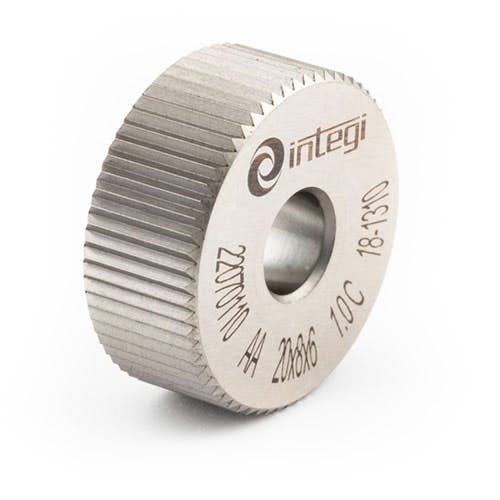
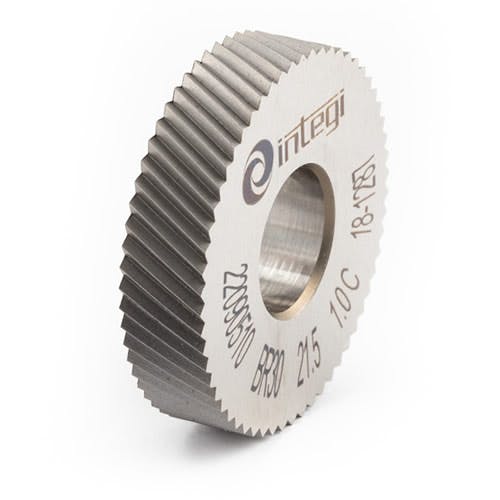
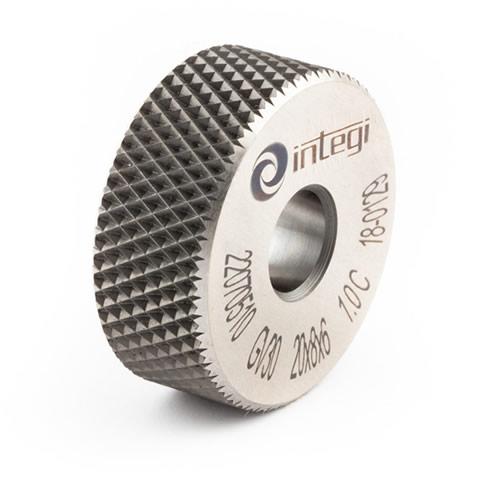
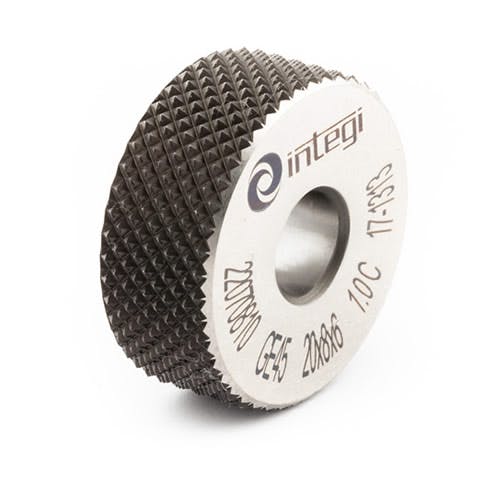
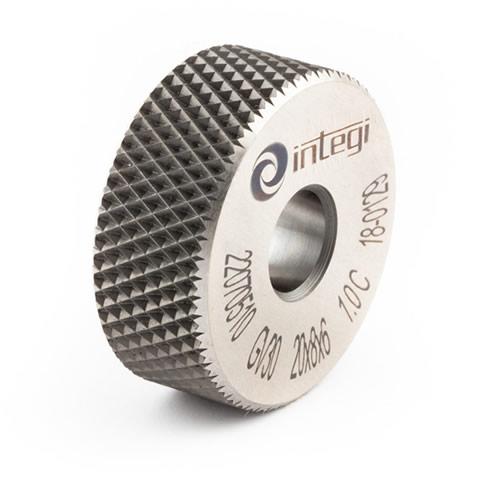
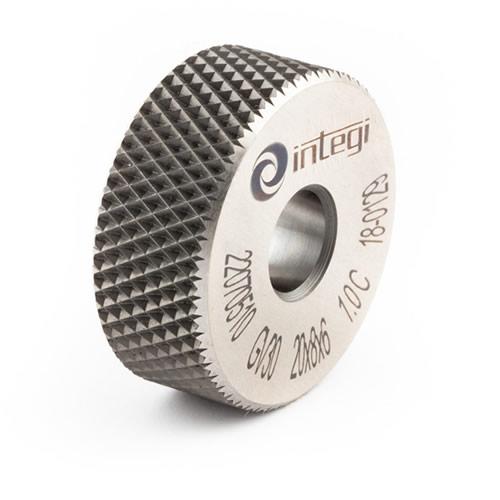
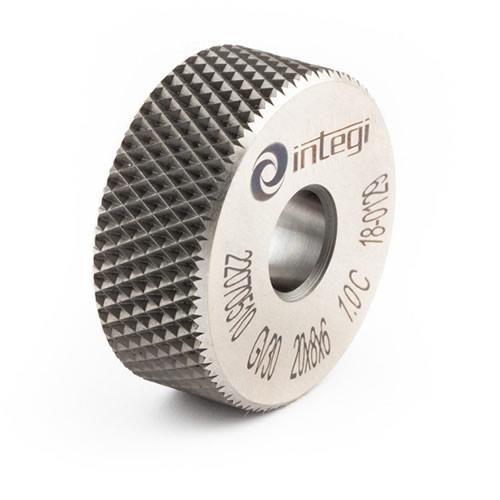
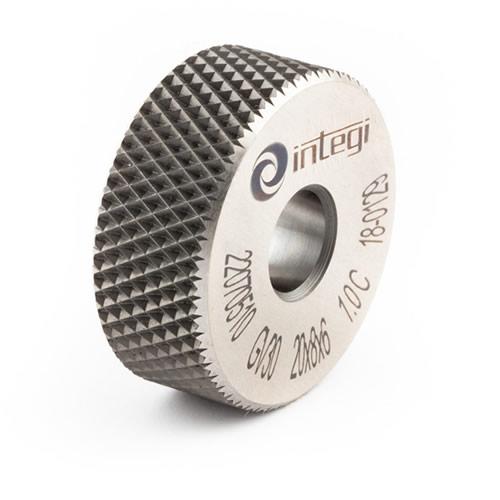
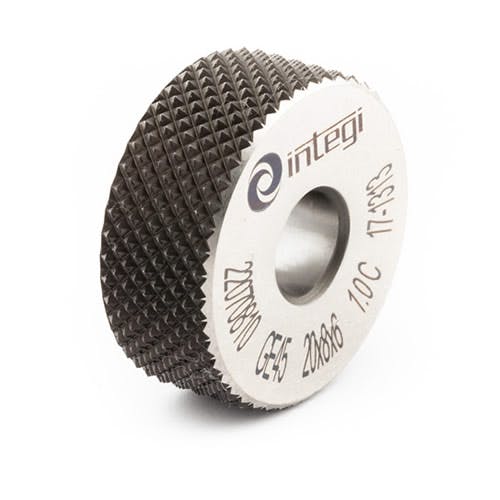
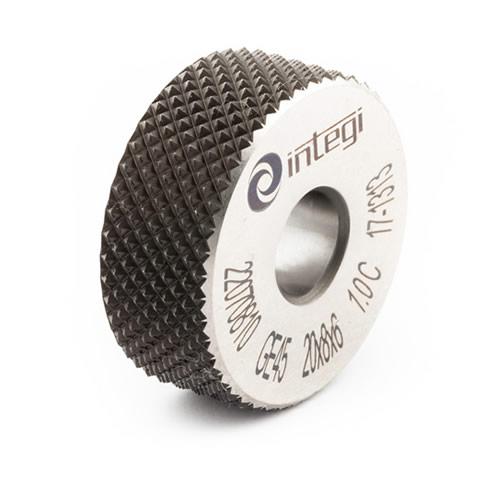
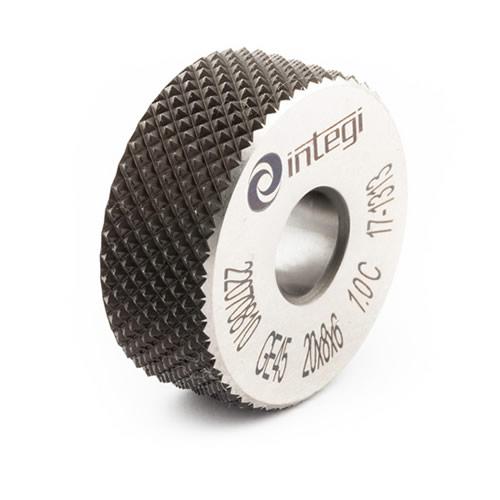
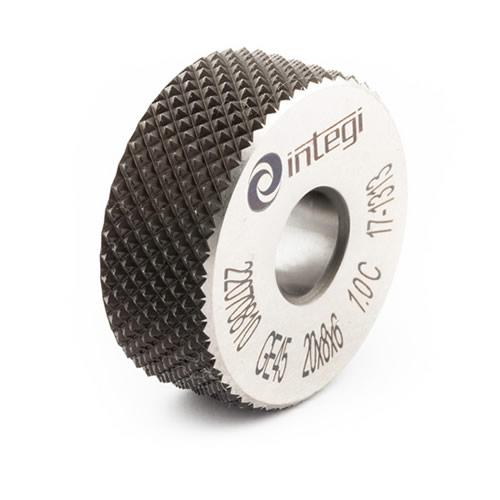
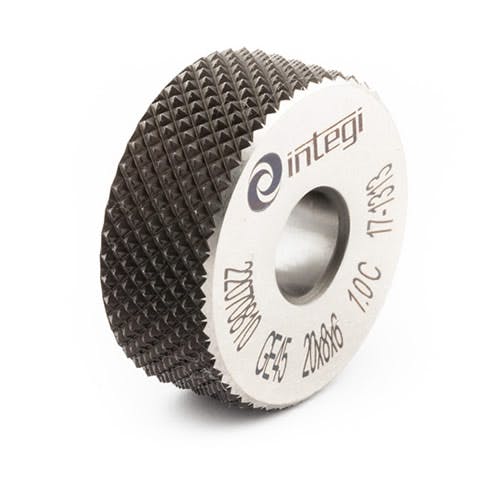
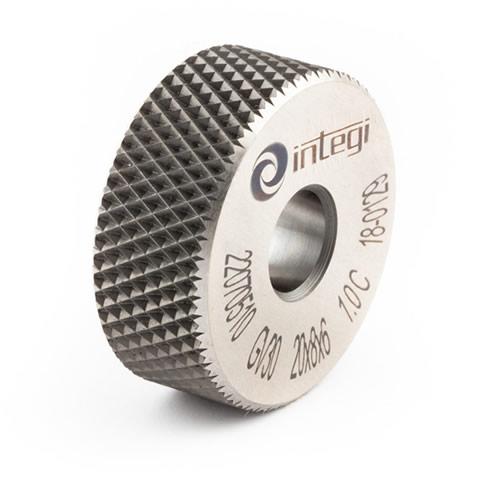
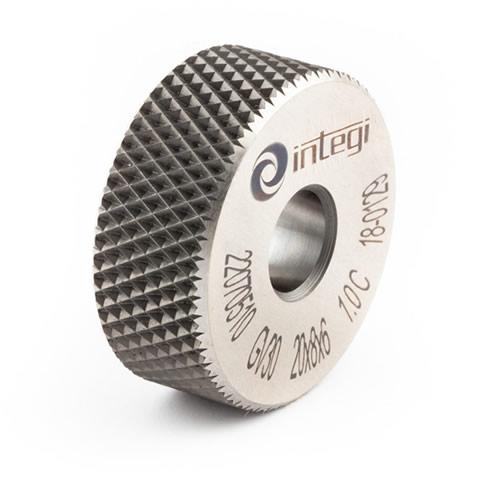
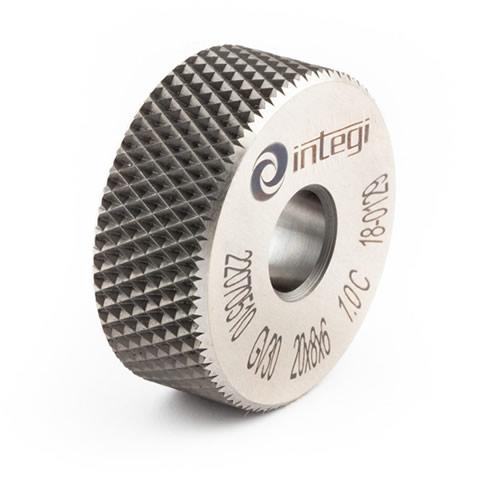
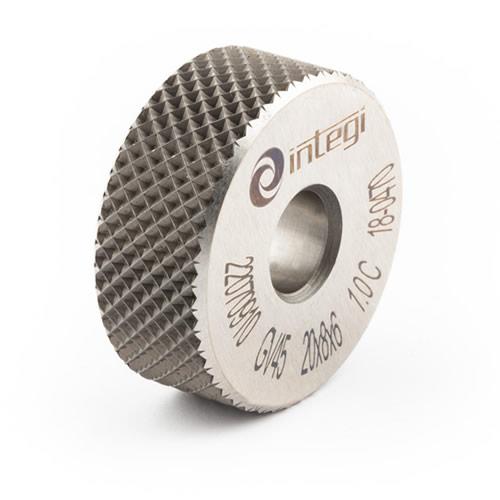
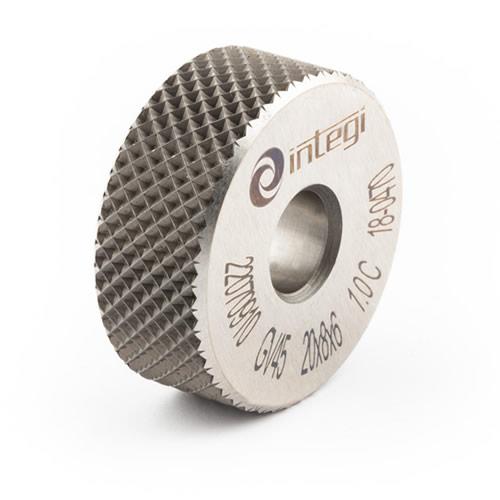
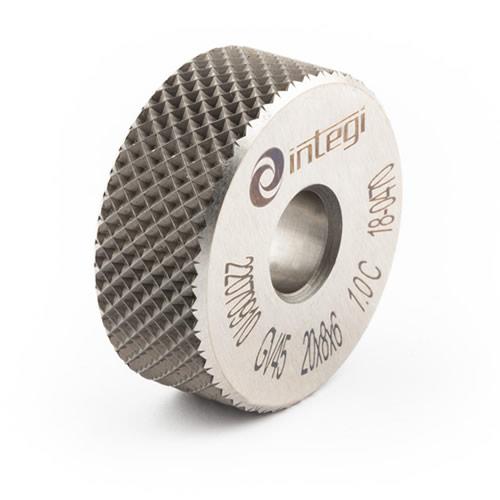
A knurling wheel is a hardened cylindrical cutting or forming tool with a serrated profile ground around its circumference. It is mounted in a knurling toolholder and pressed against a rotating cylindrical workpiece on a lathe to produce a knurled pattern such as a textured surface of raised ridges or diamonds that provides grip, decoration or a press-fit surface. The wheel's teeth indent or cut the workpiece material as the workpiece rotates, creating a repeating geometric pattern.
Our range contains over 1,000 knurling wheels, all manufactured by INTEGI (a specialist Spanish knurling and burnishing tool manufacturer). The wheels are made from HSSE (High-Speed Steel with 8% cobalt (HSS-E / HSS-Co8)) which provides the hot hardness and wear resistance needed to withstand the high contact pressures and friction of knurling. The 8% cobalt content increases the temperature at which the steel retains its hardness, preventing the wheel teeth from softening and wearing prematurely during continuous production knurling.
Each knurling wheel is defined by five key dimensions and parameters:
Diameter (the outer wheel diameter)
Width (the face width of the serrated section)
Bore (the centre hole that fits on the holder's pin or arbor)
Profile (the angle and direction of the serrations)
Pitch (the distance between successive teeth, in millimetres).
The product code encodes all of these, for example: KW2086-BL30HC means:
KW (knurling wheel)
20 (20mm diameter)
8 (8mm width)
6 (6mm bore)
BL30 (30° left-hand profile)
HC (HSS cobalt).
The pitch is selected as a variant within each series and the same wheel body is available with pitches from 0.4mm to 2.0mm.
The range is divided into two fundamental knurling methods and the wheel type determines which method is used:
Form knurling (form knurls): The wheel teeth are blunt, rounded or flat-tipped profiles that displace the workpiece material rather than cutting it. As the wheel is pressed into the rotating workpiece, the teeth push the material sideways and upward, cold-forming ridges from the existing material. No metal is removed, the material is simply redistributed. The result is a raised pattern where the knurled ridges stand above the original surface and the valleys between them are approximately at the original surface level.
Form knurling produces a stronger workpiece because the cold-working process work-hardens the material and no material is removed (the cross-section is maintained). Form knurling is the standard for general-purpose grip knurls on mild steel, aluminium, brass and other ductile materials.
Cut knurling (cut knurls): The wheel teeth have sharp, cutting-edge profiles that cut the workpiece material, removing metal to create valleys below the original surface. The ridges between the cut valleys remain at approximately the original surface level. Cut knurling produces chips (small fragments of removed metal) that must be cleared from the knurling zone.
The advantages of cut knurling:
Lower radial force: cutting requires less pressure than forming, reducing workpiece deflection on long or thin parts
Better results on hard materials that resist cold-forming (hardened steel, stainless steel)
Cleaner pattern definition on difficult materials
Less work-hardening of the workpiece.
The disadvantages: material is removed (reducing cross-section), chips must be managed and the pattern is cut (valleys below surface) rather than raised.
Pattern appearance: Form knurling produces a raised pattern (ridges above surface). Cut knurling produces a recessed pattern (valleys below surface). For functional grip, both are effective but the choice depends on material, workpiece rigidity and whether material removal is acceptable.
Our selection guidance: For ductile materials (mild steel, aluminium, brass) and general grip applications go for form knurls. For hard or stainless materials, thin/long workpieces prone to deflection or when low pressure is needed use cut knurls.
The range offers seven profile types, each producing a different knurl pattern. The profiles are defined by the tooth angle relative to the wheel axis and the direction of the serrations:
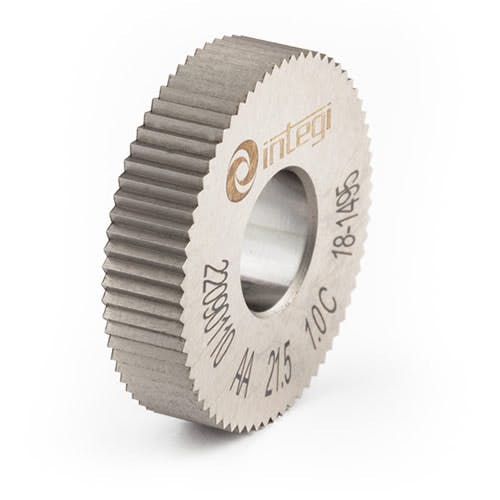
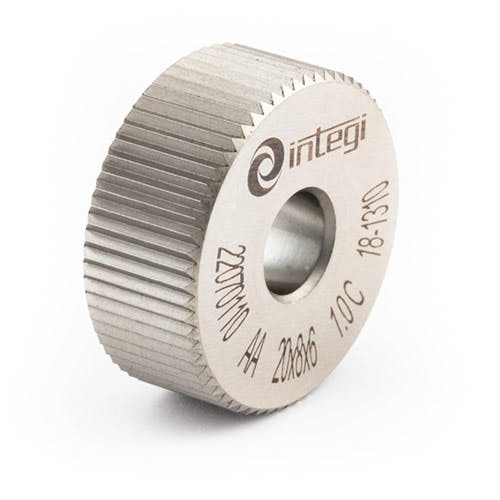
90° Straight (Form AA): The teeth run straight around the wheel circumference, perpendicular to the wheel axis (90°). When pressed against the workpiece, a single 90° straight wheel produces straight (circumferential) lines (parallel ridges running around the workpiece circumference). This is used for decorative rings, O-ring seating grooves or as one half of a diamond pattern (when paired with a second 90° wheel at a different angle). The "AA" designation is INTEGI's code for the 90° straight profile. The KW21558-AAHC and KW25108-AAHC series are 90° straight knurls.
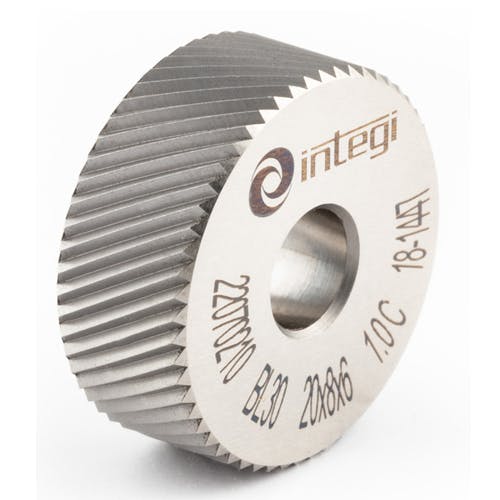
30° Left Hand (Form BL30): The teeth are angled at 30° to the wheel axis, slanting to the left (when viewed from the front). A single BL30 wheel produces diagonal lines slanting in one direction around the workpiece. Used alone for diagonal knurling or paired with a right-hand wheel to create a diamond pattern. The KW2086-BL30HC series is a 30° left-hand form knurl.
30° Right Hand (Form BR30): The mirror of BL30 with teeth angled 30° to the right. When a BL30 and BR30 wheel are used together (in a dual-wheel holder), they produce a diamond pattern due to the two opposing diagonal sets of lines cross to form diamond-shaped raised areas. This is the classic diamond knurl pattern seen on tool handles, knobs and thumb screws. The KW21558-BR30HC series is a 30° right-hand cut knurl.
30° Cross Down (Form GV30): A cross pattern variant at 30° where the teeth are arranged to produce a crossed pattern with a downward angle. The GV30 is used in combination with other profiles to produce specific cross patterns. The KW2086-GV30HC series is a 30° cross-down form knurl, priced higher than the single-direction profiles, reflecting the more complex tooth geometry.
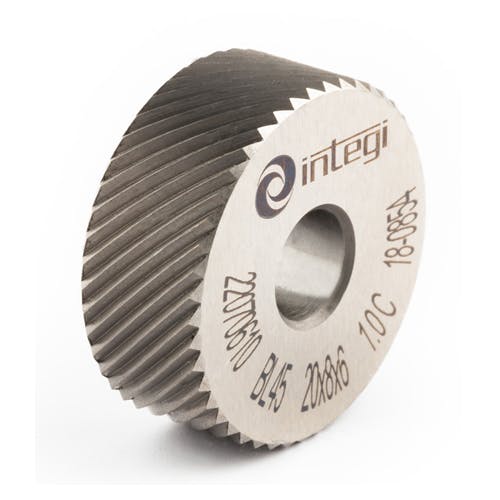
45° Left Hand (Form BL45): Same as BL30 but at 45° with a steeper diagonal angle producing wider diamond shapes when paired. The 45° angle produces a coarser, more visible diamond pattern than 30°. The KW2086-BL45HC series is a 45° left-hand form knurl.
45° Cross Up (Form GE45): A 45° cross pattern with upward angle (the complementary profile to GV45 for producing 45° diamond/cross patterns).
45° Cross Down (Form GV45): A 45° cross pattern with downward angle that can paired with GE45 to produce a fine diamond pattern at 45°.
Pattern summary:
Straight (single AA wheel)
Diagonal (single BL or BR wheel)
Diamond (paired BL+BR or GE+GV wheels).
The angle (30° vs 45°) determines the diamond aspect ratio where 30° produces elongated diamonds and 45° produces square diamonds. The diamond pattern is the most common functional grip pattern.
Pitch is the distance between successive teeth on the knurling wheel, measured in millimetres along the wheel axis. Our range offers 12 pitch options from 0.3mm to 2.0mm. Pitch determines the fineness or coarseness of the knurl pattern. so a smaller pitch produces a finer, tighter pattern and a larger pitch produces a coarser, more aggressive pattern.
Fine pitches (0.3mm-0.5mm): Very fine knurl patterns with closely-spaced teeth. Used for small-diameter workpieces, decorative fine knurling and applications where a subtle texture is needed. A 0.3mm pitch produces approximately 33 teeth per millimetre of wheel width which is classed as extremely fine. Fine pitches are used on small knobs, thumb screws, instrument components and small-diameter shafts where a coarse pitch would overwhelm the surface. Fine pitches require less force per tooth (smaller tooth profile) but more total teeth are in contact so the total force is distributed.
Medium pitches (0.6mm-1.0mm): The most commonly used range for general-purpose grip knurling. A 0.8mm or 1.0mm pitch produces a standard diamond pattern suitable for tool handles, control knobs and general mechanical grip surfaces. Medium pitches provide good grip without being too aggressive and work across a wide range of workpiece diameters. The 1.0mm pitch is a common "default" choice for medium-diameter workpieces (10-30mm).
Coarse pitches (1.2mm-2.0mm): Coarse, aggressive knurl patterns for large-diameter workpieces and heavy-duty grip applications. A 1.5mm or 2.0mm pitch produces large, prominent diamond teeth that provide maximum grip even with gloves or oily hands. Coarse pitches are used on large handwheels, heavy-duty handles and large-diameter shafts. On small workpieces, a coarse pitch may not complete a full number of teeth around the circumference, producing an uneven pattern.
Our pitch selection guidance: The pitch should be proportional to the workpiece diameter with finer pitches for small diameters and coarser pitches for large diameters. A common rule worth keeping in mind: the workpiece circumference divided by the pitch should yield a whole number (or close to it) to ensure the pattern tracks evenly around the circumference without a "run-out" mismatch where the last tooth doesn't align with the first. INTEGI holders feature "easy setting to the workpiece diameter by means of a graduated scale" to help achieve this alignment. For general-purpose grip on a 20mm diameter workpiece, a 0.8mm or 1.0mm pitch is typical. For a 50mm workpiece, 1.2mm or 1.5mm. For small 5mm workpieces, 0.4mm or 0.5mm.
Our knurling wheel range offers five wheel diameters:
10mm (300+ products): The smallest standard wheel. Used for small workpieces (3-50mm diameter) and compact knurling holders where space is limited. Small wheels have fewer teeth in contact with the workpiece, producing a lighter, more controllable knurling action. They are used on the INTEGI M8 series holders for workpiece diameters from 3mm to 100mm.
15mm (300+ products): A mid-small wheel for light-to-medium knurling. Used on compact holders for small-to-medium workpieces. The 15mm diameter provides more teeth in contact than 10mm, producing a smoother pattern.
20mm (300+ products): A general-purpose wheel diameter and the most commonly used for medium workpieces. The 20mm wheel fits the M10 and M11 series holders for workpiece diameters from 8mm to 200mm. The 20mm diameter provides a good balance between tooth count, holder clearance and knurling force.
21.5mm (100+ products): A specialised diameter used primarily with the 21.5x5x8 wheel format — this is a specific INTEGI standard dimension used in certain holder types. The 21.5mm diameter with 5mm width and 8mm bore is a standard INTEGI format for the MF21 and similar double-head holders.
25mm (600+ products): The largest and most common wheel diameter in our knurling wheel range. The 25mm wheel is used for medium-to-large workpieces and heavy-duty knurling. The larger diameter provides more teeth in contact, smoother pattern formation and better heat dissipation. The 25mm wheel fits the M10, M11 and MF21 series holders for workpiece diameters from 8mm to 300mm. The KW25108-AAHC (25x10x8) is a 25mm-diameter form knurl.
Our selection guidance: The wheel diameter should be proportional to the workpiece diameter and the holder capacity:
Small workpieces (3-10mm) use 10mm or 15mm wheels
Medium workpieces (10–30mm) use 20mm or 25mm wheels
Large workpieces (30–200mm+) use 25mm wheels.
The holder manufacturer specifies the compatible wheel diameter(s) and you must always match the wheel to the holder's "applicable wheel" specification.
Our knurling wheel range offers six wheel widths:
4mm (250+ products)
5mm (300+ products)
6mm (150+ products)
8mm (500+ products)
10mm (400+ products)
12mm (200+ products).
Width is the axial dimension of the serrated section and it determines how wide the knurled band on the workpiece will be.
Width selection: The wheel width should match or slightly exceed the required knurl band width on the workpiece. If the knurl needs to be 6mm wide on the part select a 6mm or 8mm wheel (the wheel can produce a band up to its own width). Knurling a band wider than the wheel requires multiple passes at different axial positions, which can produce visible joins.
Wider wheels (8-12mm): Provide a wider knurl band in a single pass, which is faster and produces a uniform pattern. However, wider wheels require more total knurling force (more teeth in contact) and require a more rigid setup to prevent workpiece deflection. The 8mm width is the most common in our range, balancing band width and force.
Narrower wheels (4-6mm): Produce a narrow knurl band with less total force meaning that they are suitable for thin workpieces, narrow grip bands and applications where a wide knurl is not needed. Narrow wheels are also used for O-ring groove knurling and decorative ring knurling. The 4mm width is common on the 10mm and 15mm diameter wheels for small workpieces.
Dual-wheel holders: When using a dual-wheel holder (like the M5 or MF21) for diamond knurling, both wheels should have the same width to produce a uniform diamond pattern. The holder's applicable wheel specification lists compatible width-bore combinations.
The bore is the centre hole of the knurling wheel and it fits on the pin or arbor of the knurling toolholder. Our knurling wheel range offers three bore sizes: 4mm (650+ products), 6mm (550+ products), and 8mm (550+ products).
Bore and holder compatibility: The bore must match the holder's pin diameter exactly, so for example a 6mm bore wheel fits a 6mm pin and an 8mm bore wheel fits an 8mm pin. Using a wheel with the wrong bore is not possible (too small won't fit; too large will be loose, producing eccentric rotation and uneven knurling). The bore-pin fit should be a smooth sliding fit that is tight enough to keep the wheel concentric but loose enough for the wheel to rotate freely on the pin during knurling.
Bore and wheel diameter relationship: Generally, larger wheel diameters use larger bores: 10mm and 15mm diameter wheels typically use 4mm bores, 20mm wheels use 6mm bores, 21.5mm and 25mm wheels use 8mm bores. This relationship ensures the wheel wall (the material between the bore and the serrated outer edge) is thick enough to provide structural strength.
The standard INTEGI dimension combinations are:
10x4x4 (10mm dia, 4mm width, 4mm bore)
15x4x4, 15×5×4, 15×6×4 (15mm dia, 4mm bore)
20x8x6, 20×10×6 (20mm dia, 6mm bore)
21.5x5x8 (21.5mm dia, 8mm bore)
25x8x8, 25x10x8, 25x12x8 (25mm dia, 8mm bore)
Pin material: INTEGI holders use hardened HSS bushings or carbide pins as the wheel axle. The pin must be harder than the wheel bore to prevent wear since the wheel rotates on the pin under high radial load, a soft pin would wear rapidly, creating play and producing uneven knurling. The M8 series uses carbide pins; the M10 and M11 use HSS bushings.
INTEGI uses a letter-based designation system to identify each knurl profile. The system encodes the tooth angle, direction, and pattern type:
AA / 90° Straight: "AA" designates a straight-toothed wheel with teeth at 90° to the wheel axis. Produces circumferential (straight) lines. Used alone for straight knurling or as one component of a pattern. The simplest and most common single-profile wheel.
BL30 / 30° Left Hand: "BL" = Buena Left (left-hand), "30" = 30° angle. Teeth slant to the left at 30°. Produces left-hand diagonal lines. The KW2086-BL30HC series.
BR30 / 30° Right Hand: "BR" = Buena Right (right-hand), "30" = 30° angle. The mirror of BL30 — teeth slant to the right. Produces right-hand diagonal lines and when paired with BL30, produces a 30° diamond pattern.
BL45 / 45° Left Hand: Same as BL30 but at 45°for a steeper diagonal angle. The KW2086-BL45HC series.
GE45 / 45° Cross Up: "GE" = cross upward, "45" = 45°. A cross-pattern profile with upward angle.
GV30 / 30° Cross Down: "GV" = cross downward, "30" = 30°. A cross-pattern profile with downward angle. The KW2086-GV30HC series.
GV45 / 45° Cross Down: Cross downward at 45°. Paired with GE45, produces a 45° diamond/cross pattern.
The "HC" suffix on all product codes stands for HSS Cobalt (the HSSE (HSS 8% cobalt) substrate) - Every wheel in the range is HC grade.
Pattern combinations: To produce a diamond pattern you need two wheels with opposing angles: BL30 + BR30 (30° diamond), or BL45 + BR45 or GE45 + GV45 (45° cross diamond). The INTEGI holders (M5, M11, MF21) are dual-head holders designed to carry two wheels simultaneously for diamond knurling. Single-head holders (M8, M10, M19) carry one wheel for straight or diagonal knurling.
The knurling wheel range, combined with the INTEGI holder range, covers workpiece diameters from 3mm to 300mm:
Small workpieces (3-50mm): The INTEGI M8 series single-head holder covers 3mm to 100mm workpiece diameter, using 10mm or 15mm wheels with 4mm bores. The smallest workpieces (3mm) require fine pitches (0.3-0.5mm) and small wheels (10mm diameter) to ensure enough teeth engage the small circumference. Our cut knurling sub-category lists workpiece diameter ranges including "3-50mm" and "3100mm".
Medium workpieces (8-200mm): The INTEGI M10 (single-head, for knurling up to a shoulder) and INTEGI M11 (double-insert) holders cover 8mm to 200mm workpiece diameter, using 20mm or 25mm wheels with 6mm or 8mm bores. This is the most common workpiece range for general knurling. The M10 features "adjustment of tool clearance angle by threaded studs integrated in the shank" and is "recommended for RAA type knurling" (straight knurling). The M11 is "recommended for RGE type knurling" (diamond/cross knurling) and features a "pivoting head for knurls self-centering."
Large workpieces (30-300mm): The INTEGI M19 (single-insert internal) covers 30mm to 200mm for internal knurling. The MF21 double-head holder covers 5mm to 250mm with adjustable head for left and right hand lathes. Our cut knurling sub-category also lists "8-300mm" and "4-250mm" / "5-250mm" ranges.
Pattern tracking: For the knurl pattern to track correctly around the workpiece circumference, the workpiece circumference must be divisible by the pitch (or close to it). INTEGI holders feature "easy setting to the workpiece diameter by means of a graduated scale" where the holder's head pivots to align the wheel at the correct angle for the workpiece diameter, ensuring the teeth mesh correctly around the circumference. This self-centring adjustment (on the M5 and M11 holders) is critical for producing a clean, even diamond pattern.
Internal knurling: The M19 holder is specifically designed for internal knurling (knurling the inside of a bore or tube) from 30mm to 200mm internal diameter. Internal knurling uses a single wheel on a reaching arm that enters the bore.
All knurling wheels in the range are made from HSSE — High-Speed Steel with 8% Cobalt (also written as HSS-E or HSS-Co8). The "HC" suffix on every product code confirms the cobalt grade.
HSSE properties: High-speed steel is an alloy steel containing tungsten, molybdenum, chromium, and vanadium, hardened to approximately 63-67 HRC. The addition of 8% cobalt increases the "red hardness" (the temperature at which the steel begins to soften). Standard HSS softens around 600°C whereas HSSE retains hardness up to approximately 670-700°C. This is important for knurling because the wheel-to-workpiece contact generates significant heat through friction and plastic deformation. Without cobalt the wheel teeth would soften and lose their profile after relatively few workpieces. The 8% cobalt extends wheel life significantly in production knurling.
Why HSS rather than carbide for knurling wheels?: Knurling wheels are subject to high impact and shock loading as each tooth engages and disengages the workpiece abruptly while the wheel rotates. Carbide, while harder, is brittle and would chip under the impact loading of knurling. HSS provides the toughness (resistance to chipping and cracking) needed for the cyclic impact of knurling teeth, while the cobalt addition provides adequate hardness and heat resistance. The wheel does not need the extreme hardness of carbide because it is forming or cutting relatively soft workpiece materials (mild steel, aluminium, brass). The primary failure mode is tooth wear, not inadequate hardness.
Re-sharpening: Knurling wheels can theoretically be re-sharpened (re-ground) when the teeth wear, but in practice this is rarely done because:
The complex tooth profile (especially diamond and cross profiles) requires specialist grinding equipment to reproduce accurately
Re-grinding reduces the wheel diameter, changing the diameter-pitch relationship and potentially affecting pattern tracking
The wheels are relatively inexpensive compared to the cost of specialist re-grinding.
Worn wheels are typically replaced. The wheel bore may also wear (the wheel rotates on the holder pin), and a worn bore cannot be reconditioned so the wheel must be replaced.
Wheel life: Life depends on the workpiece material, pitch and whether form or cut knurling is used. Form knurling produces more wear (higher contact pressure, material displacement) than cut knurling (lower pressure, material removal). Hard workpiece materials (stainless steel, hardened steel) wear wheels faster than soft materials (aluminium, brass). In production, wheel life is typically measured in thousands of workpieces for mild steel, dropping to hundreds for stainless.
Each knurling wheel is identified by a series code and a variant (SKU) code:
Series code format: KW[DIA][WIDTH][BORE]-[FORM]HC
KW = Knurling Wheel
[DIA] = Wheel diameter (10, 15, 20, 215 for 21.5, 25)
[WIDTH] = Wheel width (4, 5, 6, 8, 10, 12)
[BORE] = Bore diameter (4, 6, 8)
[FORM] = Profile designation (AA, BL30, BR30, BL45, GE45, GV30, GV45)
HC = HSS Cobalt substrate
Examples:
KW21558-AAHC = Knurling Wheel, 21.5mm diameter, 5mm width, 8mm bore, Form AA (90° straight), HSS Cobalt.
KW2086-BL30HC = Knurling Wheel, 20mm diameter, 8mm width, 6mm bore, Form BL30 (30° left hand), HSS Cobalt.
KW25108-AAHC = Knurling Wheel, 25mm diameter, 10mm width, 8mm bore, Form AA (90° straight), HSS Cobalt.
KW2086-GV30HC = Knurling Wheel, 20mm diameter, 8mm width, 6mm bore, Form GV30 (30° cross down), HSS Cobalt.
Variant (SKU) code format: [Series]-[PITCH][FORM]HC
The pitch is inserted between the series code and the form code.
KW21558-04AAHC = Series KW21558, pitch 0.4mm, Form AA, HC
KW21558-10AAHC = Series KW21558, pitch 1.0mm, Form AA, HC
KW2086-15BL30HC = Series KW2086, pitch 1.5mm, Form BL30, HC
"Cut-Knurls" vs "Form-Knurls": The product name indicates the knurling method. "Cut-Knurls Form AA" is a cutting-type wheel with AA (straight) profile. "Form-Knurls Form BL30" is a forming-type wheel with BL30 (30° left hand) profile. The form designation (AA, BL30, etc) is the same for both cut and form types with the difference being in the tooth tip geometry (sharp for cutting, rounded for forming).
Variant table: Each series page on our website shows a variant table with the pitch options. For the KW21558-AAHC series, 11 pitches are available (0.4, 0.5, 0.6, 0.7, 0.8, 1.0, 1.2, 1.5, 1.6, 1.8, 2.0mm). The product variant table allows selection of the exact pitch for the application.
Pricing structure: Pricing is primarily determined by the wheel dimensions (diameter, width, bore) and the profile complexity, not the pitch. All pitches within a series are the same price (or very close).
Knurling wheels do not operate independently, they must be mounted in a knurling toolholder that provides the mounting pin, the radial feed mechanism and the geometric alignment. The INTEGI holder range (available at Milo Tools) determines which wheels can be used and what patterns can be produced:
Single-head holders (M8, M10): Carry one wheel. Used for straight (AA) or single-direction diagonal (BL/BR) knurling. The M8 covers 3-100mm workpiece with 10mm or 15mm wheels (4mm bore). The M10 covers 8-200mm workpiece with 20mm or 25mm wheels and is designed for knurling up to a shoulder (the holder geometry allows the wheel to reach close to a workpiece shoulder). Features include "HSS bushing" (the wheel pin), "anti-wearing treatment of the tool surface" and "adjustment of tool clearance angle by threaded studs integrated in the shank." The M10 is "recommended for RAA type knurling" (straight/circumferential).
Double-head holders (M5, MF21): Carry two wheels simultaneously. Used for diamond knurling — one wheel cuts left-hand diagonals, the other right-hand, producing the diamond pattern in a single pass. The M5 covers 8-300mm workpiece with a "pivoting head for knurls self-centering" and "carbide pins." The MF21 covers 5-250mm with "adjustable head for left and right hand lathes." The M5 is "recommended for RGE type knurling" (diamond/cross pattern). Double-head holders are more expensive but produce diamond patterns in one operation.
Double-insert holder (M11): A specialised double-wheel holder with "pivoting head for knurls self-centering" for 8-200mm workpiece. "Recommended for RGE type knurling." Uses HSS bushings.
Internal knurling holder (M19): Designed for internal knurling (inside bores) from 30-200mm. Single-insert design with a reaching arm. "Recommended for RAA type knurling." Uses HSS bushing.
Holder-wheel compatibility: Each holder specifies its "applicable wheel" dimensions. The holder's pin diameter must match the wheel bore, and the holder's wheel seat must accommodate the wheel diameter and width. Always select wheels that match the holder's applicable wheel specification — for example, an M10 holder accepting 20x8x6 wheels requires wheels with KW2086 series dimensions. The graduated scale on the holder allows setting to the workpiece diameter, ensuring correct tooth engagement and pattern tracking.