




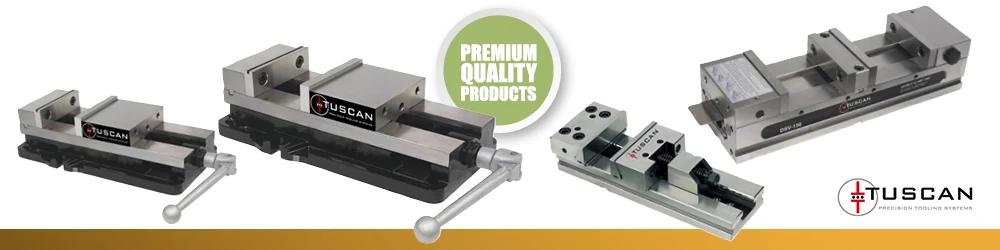
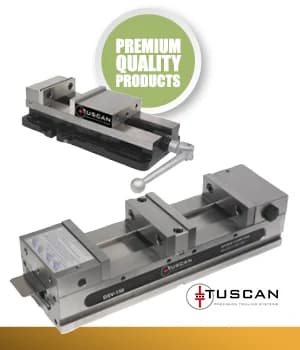
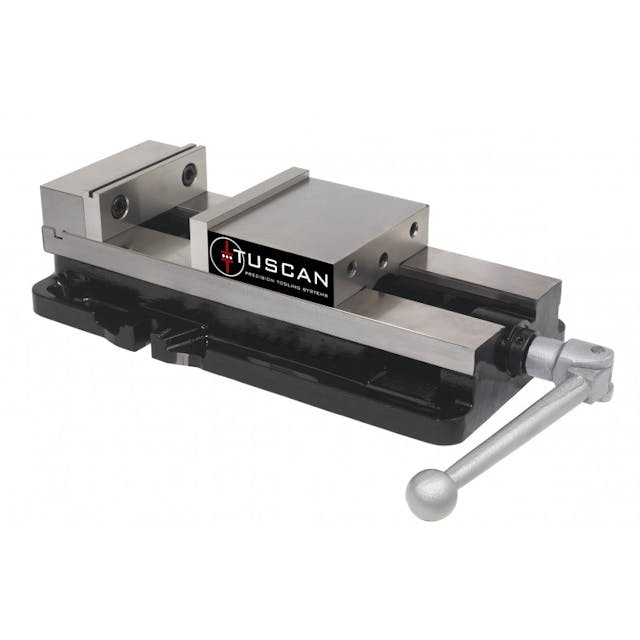
The Tuscan Single Station Vices are designed to withstand the pressure and force of CNC machining. With a built in anti-lift mechanism the vice ensures accurate and repeatable machining down to microns.
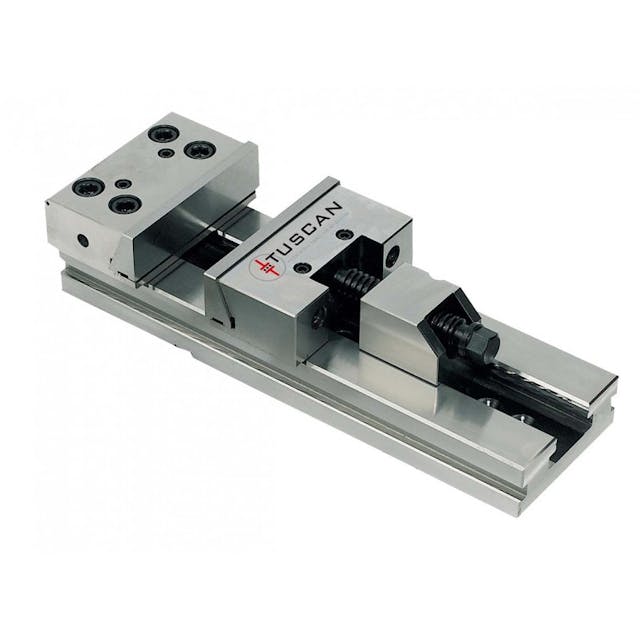
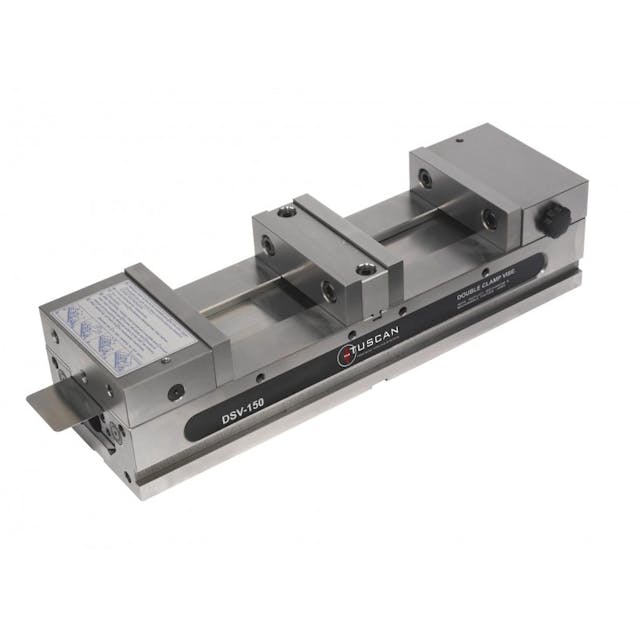
Designed with the combination of fixed and moveable jaws the Tuscan DSV series vice has the ability to hold multiple workpieces with the same clamping force. Hardened and ground, the DSV series ensures high accuracy and rigidity.

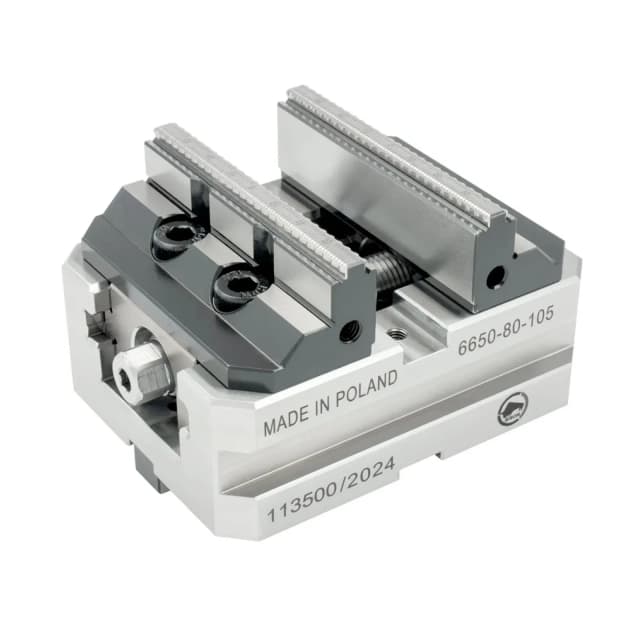
Bison Self-Centring Precision Vice
• Compact and symmetrical design makes this vice ideal for 5-axis machining centres.
• Features serrated jaws, using which reduces the area needed for holding the workpiece to only 3mm. That ensures better access to the workpiece from multiple angles and enables more complex machining operations. The advantage is reducing the machining cycle time, as well as the number of required machining operations and frequency of the tool exchanges.
• The vice can be mounted on the machine table with clamps and T-nuts or with Bison type 6589 quick-fix bases. The vice is also compatible with 52 mm and 96 mm quick-fix bases available on the market (size of the compatible base depends on size of the vice).
• Wide clamping range can be further increased by reversing the jaws.
• The vice jaws have serrated surfaces, which can bite in the raw or heat-treated material. Pre-stamping is not required.
• The jaws also have ground surfaces for clamping machined materials.
• The jaws allow for mounting side-stops.
• The operating screw is heat-treated for increased service time.
• The vices with 2-piece jaws allow for exchanging the hard top jaws with soft top jaws. The soft top jaws can be machined for clamping parts of irregular shapes.
• Self-centring clamping action distributes the clamping force between both jaws. The force is more evenly distributed across the area of the workpiece, minimizing the risk of damage or deformation.
Our machine vice range covers three categories, each suited to a different machining approach:
Single station vices are the standard CNC milling vice configuration with one workpiece clamped per vice per setup.
Two series are stocked: the SSV Single Station Machine Vice (Tuscan, FCD-60 ductile iron) in 100mm, 150mm and 200mm jaw widths & the MV Precision Modular Vice (stabilised and hardened alloy steel) in 100mm to 200mm jaw widths.
Both are designed for use in multiples on a single machine table.
Double station vices hold two workpieces simultaneously in a single vice body, doubling the parts-per-cycle count without requiring additional table space or setup time.
The DSV Double Station Vice (Tuscan, FCD-60 ductile iron) is available in 100mm and 150mm jaw widths.
5 Axis Vices are low-profile, self-centring vices designed specifically for simultaneous 5-axis machining where access to five sides of the workpiece is required. We stock two lines: the Tuscan self-centring 5-axis vice in 75mm and 125mm jaw widths and also the Bison self-centring precision vice series.
A single station machine vice holds one workpiece at a time. Every clamping action secures one part and every unclamping releases one part. It is the standard configuration for prototype work, first-off parts, small batch production and any situation where only one component is being machined per cycle.
A double station machine vice such as the Tuscan DSV series holds two workpieces simultaneously in a single body. The design uses a combination of fixed and moveable jaws arranged so that one clamping action clamps both parts at the same time with equalised clamping force. Critically the DSV is described as capable of clamping different size components in each station with the force equalisation mechanism distributing grip across both workpieces even when they are not identical in size. This is an important practical feature because batch production components rarely have zero dimensional variation.
The economic argument for double station vices is pretty straightforward: if a machine can hold two parts per cycle instead of one, cycle productivity doubles for the workholding element of the operation. On a machine running unmanned or lights-out, the benefit is compounded. The trade-off is higher cost per vice body and the need to plan toolpaths around the fact that the vice body is wider and longer than a single station equivalent.
The DSV series states a repeatability of ±0.015mm and is supplied with 18mm locating tenons for accurate repositioning!
Jaw lift is the tendency for the moveable jaw of a machine vice to rise vertically as clamping force is applied. It occurs because the clamping screw applies a horizontal force and the mechanical path through the vice jaw translates a component of this horizontal force into a vertical upward force on the jaw. When jaw lift occurs, the workpiece is pushed upward rather than remaining seated flat on the vice bed meaning the component is no longer resting on the parallels or the vice floor and its height position is indeterminate. The result is that the machined face is not parallel to the machine table and depth dimensions are incorrect.
The SSV Single Station Vice incorporates a built-in anti-jaw-lift mechanism. The design constrains the moveable jaw so that as the screw is tightened the jaw is simultaneously pulled downward into the vice bed rather than lifting. The workpiece is seated positively against the jaw bed, clamped both horizontally and pulled down. This is what enables the SSV to deliver machining accuracy described as "down to microns."
Anti-lift is a critical feature for any precision CNC milling vice. Without it components must be tapped down during clamping (a manual operation that adds time and introduces the risk of the operator forgetting), and even then, repeatability from part to part is compromised. A vice with a proper anti-lift mechanism allows the operator to clamp and rely on the part being correctly seated without any additional intervention.
Matched bed heights means that all vice bodies within a product family (regardless of jaw width) share the same distance from the machine table to the vice bed (the floor of the jaw opening where the workpiece sits). Both the SSV and MV series are described as having matched bed heights for multiple vice use.
The practical significance becomes clear when running two or more vices on the same table for a single machining operation. If two vices have different bed heights a workpiece spanning both vices (or a toolpath that must move from one vice to another) cannot be machined at a consistent Z-depth without recalculating offsets. More commonly the machine's work coordinate system is set once, using the vice bed as the Z-reference. If all vices on the table have the same bed height, the same Z-zero applies across the entire table. If bed heights vary, each vice requires its own Z-offset.
For production environments where multiple vices are used to maximise the number of parts per machine cycle, for example, four SSV100 vices across a 500mm table means matched bed heights are essential for a single-setup process.
Both are single-station machine vices for CNC milling but the body material and construction differ.
The SSV is manufactured from FCD-60 ductile iron. FCD-60 (sometimes written as GGG-60 or equivalent to EN-GJS-600) is a high-grade nodular/ductile cast iron with good tensile strength (approximately 600 N/mm²), excellent vibration damping and good machinability. It is the standard material for precision machine tool castings and vice bodies. The SSV is described as designed specifically to withstand the pressure and force of CNC machining with the anti-jaw-lift mechanism built in. Available in 100mm (max opening 153mm), 150mm (max opening 228mm) and 200mm (max opening 259mm) jaw widths.
The MV Precision Modular Vice is manufactured from stabilised and hardened alloy steel. Steel-body vices are typically harder and more dimensionally stable than cast iron at the mating surfaces meaning that the vice bed and jaw faces are harder, which in turn means they resist wear from workpiece loading and cleaning over many years of use.
The MV is described as having a parallelism of bed vice to base of 0.02/100mm which is a specified geometric accuracy. It comes supplied with a wrench, tenons & hold-down lugs and can be fitted to an optional swivel base. Also available in 100mm to 200mm jaw widths.
A standard machine vice holds a workpiece by its sides and allows access to the top face and two end faces. When a machining operation requires access to five sides of a workpiece (the top, two sides, and two ends in a single setup) a standard vice blocks three of those five faces and the part must be repositioned multiple times. Each repositioning introduces potential positional error and requires additional setup time.
A 5-axis machine vice is designed to hold the workpiece from below (clamping on the bottom of the part) and expose all five non-clamped faces for machining. The Tuscan 5-axis vice achieves this using a 45-degree dovetail jaw system. The workpiece has a matching dovetail feature machined into its base (a simple flat with two angled faces). The vice grips this dovetail from both sides simultaneously (self-centring action) with high clamping force of 13.5 kN at 60 Nm torque for the 75mm models, and 20.0 kN at 100 Nm torque for the 125mm models. The vice body is low-profile with a bed height of only 35mm (75mm models) or 41.5mm (125mm models) which maximises the Z-axis clearance above the machine table for tool access.
The key feature is that the dovetail grip requires a very small amount of the workpiece to be consumed because the vice holds on only a few millimetres of material at the bottom. This means the blank is almost fully accessible and material wastage is minimal. The serrated teeth on the jaw faces allow the vice to grip raw (un-machined) or heat-treated stock without requiring a pre-machined dovetail, though machining a matching dovetail into the blank bottom is the preferred approach for the highest accuracy.
Four variants are available and they are defined by jaw width and vice body length:
T75100: 75mm jaw width, 100mm body length, forward jaw clamping range 0-40mm, reverse jaw range 38-76mm, bed height 35mm, weight 2.5kg, clamping force 13.5 kN at 60 Nm. The most compact option which is best suited to small components.
T75150: 75mm jaw width, 150mm body length, forward clamping range 0-90mm, reverse range 38-126mm, bed height 35mm, weight 3kg, 13.5 kN. The same 75mm jaw width as the T75100 but with a longer body allowing the accomadation of longer workpieces in the same vice.
T125150: 125mm jaw width, 150mm body length, forward clamping range 0-82mm, reverse range 78-150mm, bed height 41.5mm, weight 7kg, clamping force 20.0 kN at 100 Nm. For wider components or where higher clamping force is needed.
T125250: 125mm jaw width, 250mm body length, forward clamping range 0-180mm, reverse range 78-254mm, bed height 41.5mm, weight 7kg, 20.0 kN. The largest capacity option for longer workpieces.
The jaw width determines the maximum component width the vice can centre and grip. The body length determines the maximum component length that can be supported. The forward clamping range covers workpieces gripped with the jaws in standard orientation; the reverse jaw clamping range (larger) is achieved by reversing the jaws in the vice body, extending the capacity for larger workpieces.
The mounting pitches (52mm and 96mm) are compatible with standard pallet and modular fixturing systems and 52mm and 96mm bases are available on request for pallet-mount setups.
Bison is a Polish precision machine tool manufacturer. The Bison 6650 series self-centring precision vice is compact and symmetrical, designed specifically for 5-axis machining centres.
Key differences and features compared to the Tuscan 5 axis machine vice:
Serrated jaw faces with 3mm clamping depth: the Bison vice's serrated jaws grip the workpiece with a clamping contact area as small as 3mm. This minimal contact footprint maximises the exposed surface area of the workpiece and is described as enabling better access from multiple angles for more complex machining operations. The serrated surface bites into raw or heat-treated material without pre-stamping.
Dual jaw surface options: the jaws have both serrated surfaces (for gripping raw stock) and ground surfaces (for clamping finished or machined workpieces without marking). This gives the vice flexibility across different stages of manufacture.
Reversible jaws for extended range: wide clamping range can be increased by reversing the jaws. This is the equivalent to the Tuscan's forward/reverse clamping concept.
2-piece jaw system: on models with 2-piece jaws the hard top jaw can be replaced with soft top jaws that can be custom-machined for irregular part shapes. This is a significant benefit for production work where a bespoke jaw profile is needed to locate and grip a non-prismatic component.
Mounting compatibility: the vice can be mounted with clamps and T-nuts on any standard table, or with Bison type 6589 quick-fix bases and is stated as compatible with 52mm and 96mm quick-fix bases standard in the industry.
Self-centring clamping: both jaws move simultaneously toward the centre distributing clamping force evenly across the workpiece and minimising distortion or damage to the component.
The jaw width is the measurement of the jaw face from left to right and it determines the maximum workpiece width that can be positively supported by the jaw face. The maximum opening is the maximum distance between the fixed and moveable jaw faces and it determines the maximum workpiece thickness that can fit between the jaws.
Across single and double station vices, jaw widths of 100mm (4"), 125mm (5"), 150mm (6") and 200mm (8") are stocked. Maximum openings range from 90mm (DSV compact) up to 300mm (the largest SSV/MV configurations).
For the SSV specifically: 100mm jaw width / 153mm max opening / 350mm overall length, 150mm jaw width / 228mm max opening / 481mm overall length, 200mm jaw width / 259mm max opening / 585mm overall length.
Selecting jaw width involves balancing two factors: the jaw must be wide enough to fully support the workpiece face to prevent rocking or tipping under cutting forces; and the vice must fit within the machine table's available T-slot spacing. Running multiple vices across a table also requires that the combined footprint of all vices fits within the table's working envelope accounting for the machine's axis travel.
All vices in the range use machined keyways and alignment rails or tenons for table location.
The SSV features machined keyways and an alignment rail. Keyways in the vice base engage with T-slot keys or tenons that locate in the machine table's T-slots, providing a fixed datum for the vice's orientation relative to the machine X-axis. Once keyed in the vice can be slid to any position along the slot and secured with hold-down bolts without further alignment as the key controls the angular position.
The MV Modular Vice is supplied with tenons and hold-down lugs. Tenons sit in the machine T-slots and locate the vice base with the hold-down lugs clamping the vice to the table. Tenon size must match the machine's T-slot width meaning you must always check the machine table specification before ordering.
The DSV Double Station Vice is supplied with 18mm locating tenons as standard.
For accurate angular alignment (ensuring the vice jaw face is exactly parallel to the machine X-axis) a dial indicator is swept along the fixed jaw face while adjusting the vice position before final tightening. With tenon-keyed vices this is a one-time setup - the keys should maintain alignment on future remounts but verifying with an indicator is good practice particularly after cleaning or when the vice has been removed and refitted.
For multiple vice setups, matched bed heights (as provided in both the SSV and MV ranges) ensure that once the Z-offset is set for one vice, it applies equally to all vices on the table.
Yes you can.
Standard machine vices are mechanically compatible with both manual and CNC milling machines. The T-slot mounting system is common to virtually all knee mills, Bridgeport-type machines and CNC vertical machining centres. The keyway/tenon system works identically on both machine types.
The specification-level features of the SSV and MV (anti-jaw-lift mechanism, matched bed heights, hardened construction and parallelism tolerances) are equally beneficial on a manual machine where accurate and repeatable part holding is required.
The main distinction is that CNC machines place much higher dynamic loads on the vice during high-speed, high-feed operations. The FCD-60 ductile iron construction of the SSV and the hardened alloy steel of the MV are both specified to handle these CNC-level forces so they are not over-specified for manual use anc they will simply last longer and maintain accuracy for longer when used on a manual machine than a lighter-duty vice would.
The 5-axis vices (Tuscan and Bison) are designed specifically for simultaneous 5-axis CNC machining centres. While physically mountable on a manual machine their design purpose (gripping a dovetailed workpiece from below to expose five faces for multi-axis CNC toolpaths) is specific to CNC 5-axis operations.