




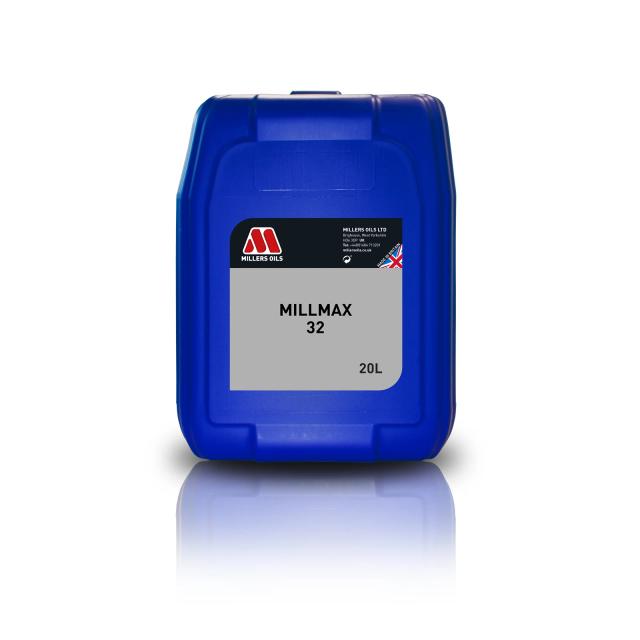
Millmax Hydraulic Oils (Millers Oils)
Please see our technical data sheets for more information on viscosities and applications.
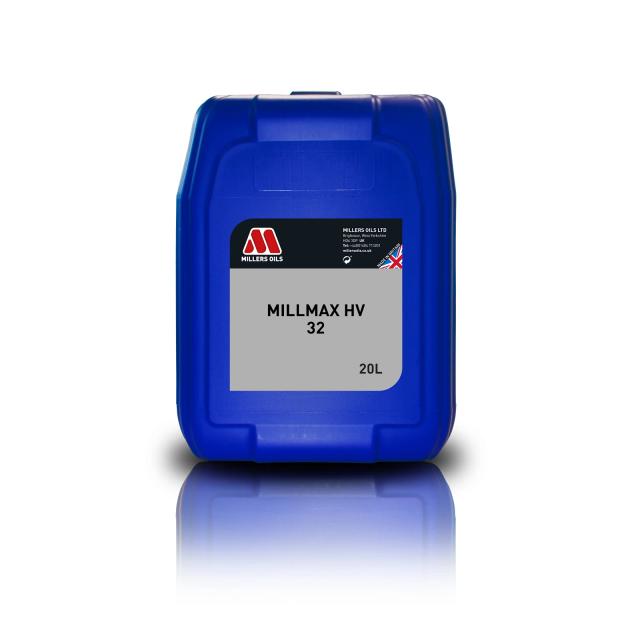
Millmax High Viscosity Hydraulic Oils (Millers Oils)
Please see our technical data sheets for more information on applications.
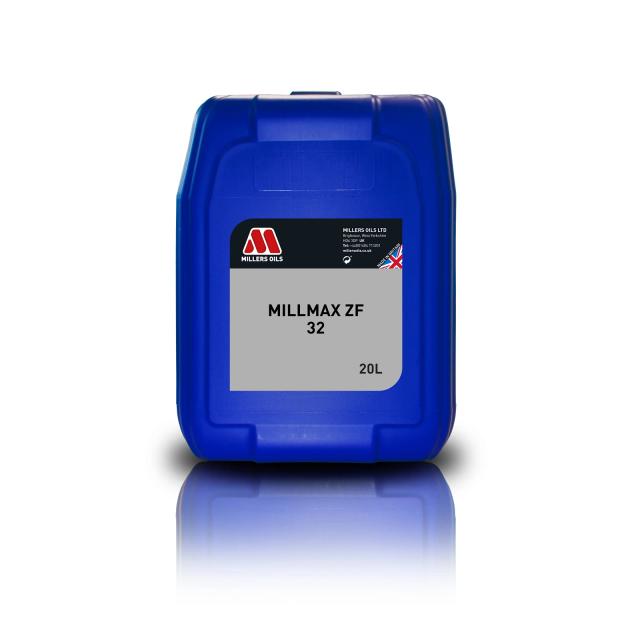
Millmax Longlife ZF 32 Hydraulic Oil (Millers Oils)
Millmax Longlife ZF 32 is suitable for use in a wide range of applications including industrial hydraulic systems, mobile equipment, injection moulding machines, mining and quarrying, and forestry and agricultural equipment.
Meeting strict industry standards including ISO 20763 Vane Pump Test and Fives Cincinnati P68, Millmax Longlife ZF 32 is the ideal choice for machinery requiring extended drain intervals without zinc-containing technology. For a full list of specification please refer to the technical data sheet.
In a machine tool, hydraulic oil serves as the working fluid in any hydraulic circuit, the medium through which mechanical force is transmitted from a pump to actuators such as cylinders, clamping systems, tailstock rams, chuck actuation mechanisms, power drawbars, or automatic tool changers. It also lubricates the pump itself and all valves, seals and internal components within the hydraulic circuit.
A hydraulic system operates on Pascal's principle: pressure applied to an enclosed fluid transmits equally in all directions. For this to work efficiently, the fluid must be nearly incompressible. Hydraulic oils are formulated from highly refined mineral base oils with very low compressibility — any dissolved gas, water or foaming would introduce compressibility into the circuit and cause spongy, inaccurate or slow actuator response.
Beyond transmitting force, hydraulic oil must protect metal components from wear. The hydraulic pump is the most vulnerable component as many pump designs (gear pumps, vane pumps, piston pumps) rely on extremely tight clearances and the oil film to prevent metal-to-metal contact. Without adequate anti-wear protection, pump wear produces metallic particles that circulate through the system and accelerate wear on valves and seals. Anti-wear (AW) additives including zinc dialkyldithiophosphate (ZDDP) in zinc-based formulations or ashless alternatives in zinc-free products form a protective film on metal surfaces at high-contact zones.
No general-purpose oil or engine oil provides this combination of high incompressibility, anti-wear chemistry, low foaming, water separation and seal compatibility in the balanced formulation that a dedicated hydraulic oil does.
ISO VG (Viscosity Grade) classifies oils by their kinematic viscosity at 40°C in centistokes (cSt), with each grade number being the midpoint of an allowed range. ISO VG 32 has a midpoint of 32 cSt; ISO VG 46 a midpoint of 46 cSt; ISO VG 68 a midpoint of 68 cSt.
For machine tool hydraulic systems the three grades stocked (VG 32, VG 46, VG 68) cover the vast majority of manufacturer specifications. The selection principle is straightforward, use the grade specified in the machine's maintenance manual or lubrication chart. Machine manufacturers specify viscosity based on the system's operating temperature range, pump type and pressure requirements.
As a broad guide for machine tools in a temperate workshop environment (15-25°C ambient):
ISO VG 32 is commonly specified for systems where rapid response and low viscous drag at start-up are important such as proportional valve systems, servo-hydraulic systems and machines specified for use in cooler environments. It is the thinnest of the three grades and provides the fastest response but the thinnest film at high temperatures.
ISO VG 46 is a common general-purpose specification for machine tool hydraulic circuits including lathes, milling machines and machining centres with standard hydraulic clamping and axis circuits. It balances film thickness, response speed and operating temperature range.
ISO VG 68 is specified for larger machines, higher-pressure systems or where the operating environment is warmer than typical. It provides a thicker film at temperature and greater resistance to viscosity breakdown under heavy load.
Never substitute a higher or lower viscosity grade without confirming it falls within the manufacturer's acceptable range. Running the wrong viscosity can cause pump wear (too thin), sluggish actuation (too thick) or overheating.
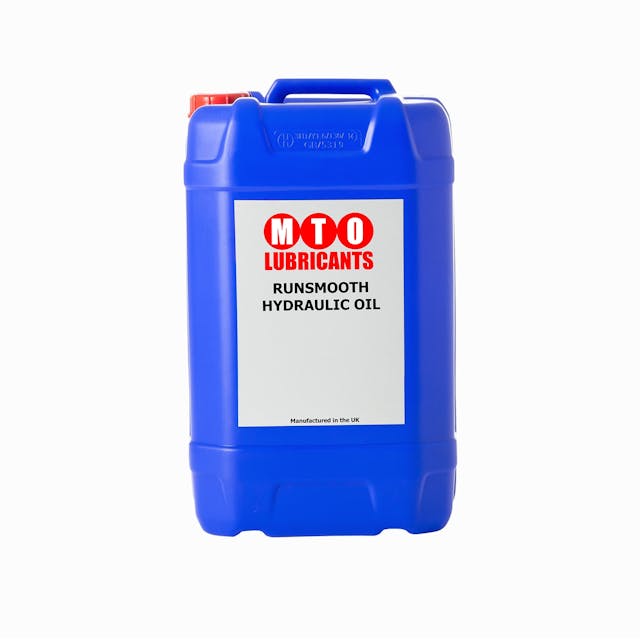
The MTO Runsmooth series describes a fourfold additive treatment covering four functional additive groups that together define a complete industrial hydraulic oil formulation:
Anti-wear (AW): the most critical performance attribute for hydraulic pump longevity. AW additives (typically zinc-based ZDDP chemistry in the Runsmooth range) adsorb onto metal surfaces and form a sacrificial film that prevents metal-to-metal contact at high-pressure, high-contact zones within the pump. Without AW additives, pump wear produces metallic debris that circulates through the system and rapidly deteriorates valves and seals.
Anti-oxidation: hydraulic oil operates at elevated temperatures, particularly in high-pressure circuits, and is circulated repeatedly through the system over its service life. Heat and the presence of metal catalysts cause base oil molecules to react with atmospheric oxygen, producing acidic degradation products and sludge that increase viscosity, form deposits and corrode metal surfaces. Anti-oxidant additives interrupt this degradation chain and extend the service life of the oil significantly.
Anti-corrosion: different metals are present in a hydraulic circuit (steel, cast iron, aluminium, brass, copper in valve bodies and fittings). Anti-corrosion additives form a protective film on these surfaces and neutralise acidic contaminants before they can attack the metal. This is particularly important for copper alloy components, which are susceptible to corrosion from acidic degradation products.
Low foaming: when air is entrained in hydraulic oil under the churning action of the pump and return oil entering the reservoir, bubbles form. Foam introduces compressibility into the circuit (air is highly compressible; oil is not), causing erratic actuation, cavitation damage to the pump and noise. Anti-foam additives destabilise the surface film on air bubbles, causing them to coalesce and release from the oil rapidly rather than persisting as stable foam.
Together, these four additive types define what is often described as an HM-grade hydraulic oil (the standard specification for industrial machine tool hydraulic systems).
Viscosity Index (VI) is a dimensionless number that describes how much a lubricating oil's viscosity changes with temperature. A high VI indicates that the oil's viscosity stays relatively constant across a wide temperature range. A low VI indicates the oil thins significantly when hot and thickens significantly when cold.
Standard hydraulic oils (including the MTO Runsmooth and standard Millmax series) have a VI typically in the range of 95-105 which is adequate for machine tools operating in a controlled workshop environment where temperature variation is modest and the system warms up from ambient to operating temperature within a predictable range.
High-VI hydraulic oils (Millmax HV) use viscosity index improvers (polymer additives that cause the oil to resist thinning at high temperatures) to achieve VI values typically above 150 and sometimes above 200.
The practical benefits are:
At cold start, the oil is less viscous than a standard grade of the same nominal viscosity, allowing the pump to prime and develop pressure more quickly without cavitation or overloading the motor.
At operating temperature, the oil maintains a higher viscosity than a standard grade that started at the same low-temperature viscosity, providing better film thickness protection.
For machine tools in heated workshops that run at consistent temperatures, a standard VI oil is entirely appropriate. Millmax HV is most beneficial for machines that experience significant temperature variation such as outdoor or unheated workshop environments, machines that are started cold and brought to temperature rapidly, or hydraulic systems on mobile equipment where ambient temperatures vary seasonally.
Standard hydraulic oils including all three MTO Runsmooth grades and the standard Millmax series use zinc-based anti-wear additives, primarily zinc dialkyldithiophosphate (ZDDP). ZDDP is effective, cost-efficient, and widely proven.
However, there are circumstances where zinc-containing additives are undesirable or incompatible:
Some hydraulic system components (particularly certain silver-plated components, specific pump alloys, and some filter media) can be degraded by zinc-containing oils. Certain OEM equipment specifications explicitly prohibit zinc-based hydraulic fluids.
Some environmental regulations and waste disposal requirements favour zinc-free (ashless) formulations as zinc compounds have aquatic toxicity implications.
Silver components: zinc compounds can attack silver-plated components found in some servo valve designs.
Millmax Longlife ZF 32 replaces the zinc-based ZDDP with ashless anti-wear chemistry that provides equivalent pump protection without zinc compounds. It meets the ISO 20763 Vane Pump Test (the industry-standard durability test for hydraulic oils) and also meets Fives Cincinnati P68, a specification used by Cincinnati machine tool systems that historically required zinc-free fluids.
The "Longlife" designation refers to the outstanding anti-oxidation properties that extend drain intervals beyond those of standard hydraulic oils. Combined with an oil analysis program (periodic sampling and laboratory analysis to monitor degradation, contamination, and additive depletion) drain intervals can be extended significantly compared to calendar-based oil changes, reducing consumable costs and downtime on high-value equipment.
Demulsification is the ability of an oil to rapidly separate from water that becomes mixed into it. A high demulsification rating means that if water enters the hydraulic system (through condensation in the reservoir, contaminated make-up oil, or external ingress) the oil quickly sheds the water rather than forming a stable water-in-oil emulsion.
The consequences of water in a hydraulic system are serious. Free water (water that has separated from the oil) settles at the bottom of the reservoir and causes corrosion of steel and cast iron surfaces. Emulsified water (water dispersed as micro-droplets throughout the oil) is more insidious: it reduces lubricating film strength, promotes bacterial growth in the reservoir, accelerates oxidative degradation of the oil and can freeze in cold conditions causing filter blockage or pump damage. Water contamination also accelerates cavitation in the pump.
Hydraulic oils for machine tools are specifically formulated to separate water rather than emulsify it (the opposite of the requirement for metalworking fluids (cutting oils & coolants)), which are deliberately formulated to form stable emulsions. The demulsification property is therefore a defining characteristic that confirms the oil is formulated for hydraulic use and not for any other application that might inadvertently have been considered as a substitute.
The Millmax series (standard and HV) specifically lists demulsification as a headline product feature. MTO Runsmooth's anti-corrosion treatment addresses the downstream consequences of water contamination. For machines in environments with high ambient humidity or large temperature swings that cause condensation, checking the reservoir periodically for water contamination (a milky or cloudy appearance to the oil is the visible indicator) is good preventive maintenance practice.
This is a question that arises in practice whenever a machine is topped up from a different supply than what was already in the system however the technical answer is nuanced.
Mixing different ISO VG grades within the same product family will produce an intermediate viscosity which is acceptable in emergency circumstances but not recommended as a routine practice, as the resulting viscosity may not correspond to any ISO VG grade and may not meet the machine's specification.
Mixing the same ISO VG grade from different brands is generally permissible if both products are formulated to the same DIN or ISO specification (typically HM for anti-wear industrial hydraulic oil).
Both MTO Runsmooth and the standard Millmax series are HM-specification oils, so topping up one with the other at the same viscosity grade is acceptable in practice. The additive packages are different but compatible in the quantities likely to be encountered in a top-up situation.
Mixing standard zinc-based hydraulic oil with the zinc-free Millmax Longlife ZF 32 should be avoided because the zinc-free oil's ashless additive chemistry is not designed to interact with zinc-based additives and mixing may reduce the performance of both. For systems specified for zinc-free oil, the reservoir should be drained and flushed before switching to ZF.
As a general principle: whenever a complete drain and refill is possible, use a single consistent product matched to the machine specification, sourced in a volume appropriate to the service interval. Top-up quantities are low risk however, for critical high-value systems, always use the same grade from the same product family for top-ups.
This question is particularly relevant to machine tools with combined hydraulic and slideway lubrication systems, a common design on manual lathes, milling machines, and cylindrical grinders.
The two oil types are formulated for different primary functions. Hydraulic oil (HM grade) is optimised for power transmission meaning low compressibility, anti-wear for pump protection, foam resistance, demulsification and thermal/oxidation stability. It does not contain friction modifiers, because these are not required in a hydraulic circuit.
Slideway oil is formulated with specific friction modifiers designed to prevent stick-slip on flat bearing surfaces. It may also contain tackiness additives for adhesion to vertical surfaces. On a dedicated hydraulic system, these additives are unnecessary and potentially counterproductive because tackiness additives can cause foam to persist longer in a hydraulic circuit.
On machines with a combined hydraulic/slideway circuit, the manufacturer specifies an oil that bridges both requirements which is most commonly an ISO VG 68 slideway oil (like MTO Slideway 68 or Millway 68) that is stated as suitable for combined systems. The friction modifiers in slideway oil are carefully selected not to interfere with hydraulic circuit performance at the viscosity grade specified.
Using a pure hydraulic oil (MTO Runsmooth or Millmax) in a dedicated slideway circuit will result in stick-slip, because the hydraulic oil contains no slideway friction modifiers. Using a slideway oil in a dedicated hydraulic circuit (separate from the slideway system) will function adequately in most cases but is not the optimal product for that application. For combined systems, always follow the machine manufacturer's specification rather than substituting one category for the other.