




-mounting-scroll-chuck-(a).jpg&w=640&q=75)
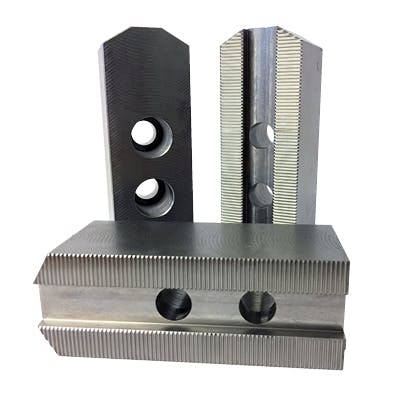
Supplied with one set of hard top jaws, one set of hard master jaws and one wrench. Bison scroll chucks are manufactured entirely within Bison Bial's factory in Poland, and are world renowned for offering superb quality and maximising tool life.
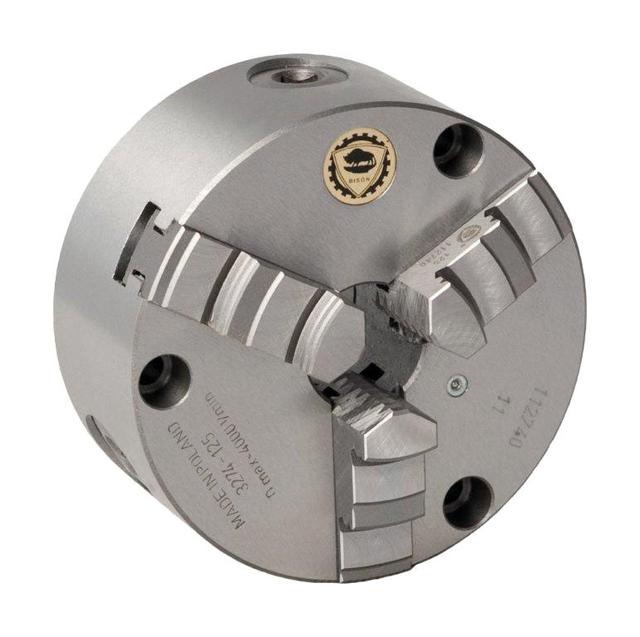
Supplied with one set of hard inside-outside solid jaws, one set of hard outisde solid jaws and one wrench. Bison scroll chucks are manufactured entirely within Bison Bial's factory in Poland, and are world renowned for offering superb quality and maximising tool life. Bison flexible front-mount scroll chucks feature mounting holes on the front face in addition to a recessed back for rear mounting. Front mount chucks are ideal for mounting directly onto to milling machine tables.
.jpeg&w=640&q=75)
Supplied with one set of hard top jaws, one set of hard master jaws and one wrench. Bison scroll chucks are manufactured entirely within Bison Bial's factory in Poland, and are world renowned for offering superb quality and maximising tool life.
.jpeg&w=640&q=75)
.jpg&w=640&q=75)
.jpg&w=640&q=75)
-din-55027-(a).jpg&w=640&q=75)
-din-55027-(a).jpg&w=640&q=75)
-din-55029-(a).jpg&w=640&q=75)
-din-55029-(a).jpg&w=640&q=75)
.jpg&w=640&q=75)
.jpg&w=640&q=75)
.jpg&w=640&q=75)
.jpg&w=640&q=75)
-lathe-chucks-(a).jpg&w=640&q=75)
A lathe chuck is a specialised clamp which gets mounted on the spindle of a lathe machine.
The purpose of a lathe chuck is to securely grip a workpiece so that it can be turned at high speed and shaped with metal cutting tools.
Scroll Chucks - these are often also called self-centering or scroll-place chucks and are the most common form of manual chuck used in metalworking.
Power Chucks - these can also be known as hydraulic, pneumatic, or automatic chucks and are actuated by hydraulic cylinders, pneumatic systems or very occasionally by electric power instead of a manual key. Power chucks are the industry standard on CNC lathes as well as high-production manual/CNC machines.
A scroll chuck is a self-centring workholding device that uses an internal spiral groove (the "scroll") machined into a flat plate to move all jaws simultaneously and concentrically. When the chuck key is turned it rotates the scroll plate and the spiral groove engages with corresponding teeth on the underside of each jaw base, driving all jaws inward or outward together. Because all jaws are driven by a single scroll, they move in perfect synchronisation (the chuck self-centres the workpiece automatically).
This is fundamentally different from an independent jaw chuck where each jaw is driven by its own separate screw and must be adjusted individually. In an independent chuck, the operator manually positions each jaw to centre the workpiece which is a slower process that requires skill and measurement, but allows asymmetric clamping of irregular workpieces. In a scroll chuck, turning the single key centres the workpiece in one motion.
The scroll chuck is ideal for clamping 3-sided (triangular) and 6-sided (hexagonal) bar stock, and for any workpiece where rapid concentric clamping is needed. The self-centring action means the workpiece axis aligns with the chuck axis (and thus the lathe spindle axis) automatically (essential for turning operations where concentricity between the outside diameter and the spindle centre is required).
Our range includes 2-jaw, 3-jaw, 4-jaw and 6-jaw scroll chucks, all manufactured by Bison in Poland. The 3-jaw configuration is the most common with the three jaws at 120° spacing provide stable, self-centring grip on round and hexagonal stock. 2-jaw chucks grip flat or irregular shapes. 4-jaw and 6-jaw chucks provide more contact points for thin-walled or delicate workpieces where concentrated clamping force could distort the part.
The chuck body is the main structural housing that contains the scroll mechanism, jaw guideways, and mounting features. The range offers both cast iron and steel body chucks, and the material choice affects performance, accuracy, and price:
Cast iron body chucks (3205, 3275, 3274, 3105 series and others) are manufactured from high-grade cast iron. Cast iron offers excellent vibration damping properties because the material's internal structure absorbs vibration, which helps produce smoother surface finishes during turning and reduces chatter. Cast iron is also dimensionally stable (it does not warp or move over time the way some steels can under stress), and it provides a good bearing surface for the sliding jaw components. Cast iron chucks are the standard, value-oriented choice but it should also be noted that cast iron is slightly more brittle than steel and can be damaged by impact, though under normal turning loads it provides excellent service life.
Steel body chucks (3504-P Premium series and others) are manufactured from high-grade steel. Steel provides higher rigidity and greater wear resistance than cast iron because the steel body is less prone to deformation under high clamping forces and heavy cutting loads and the jaw guideways resist wear longer. Steel body chucks cost more than cast iron chucks but deliver superior accuracy and longevity for demanding applications.
In our opinion cast iron chucks are the correct choice for general-purpose turning, where excellent value, good vibration damping and adequate accuracy are sufficient. Steel body chucks (particularly the Premium range) are the correct choice for high-precision work, production environments where the chuck will see sustained heavy use and applications where maximum rigidity and wear resistance justify the higher cost.
The mounting type refers to how the chuck attaches to the lathe spindle nose. The range offers four standard DIN mounting types, and the correct type is determined entirely by your lathe's spindle nose specification — the chuck must match the spindle nose geometry exactly:
Plain Back Mounting (DIN 6350): The chuck has a flat back face with a machined recess and threaded or through holes for mounting bolts. The chuck is attached to a separately purchased adapter plate (backplate) that matches the lathe spindle nose. The adapter plate is bolted to the chuck's plain back and the other side of the adapter plate is machined to match the spindle nose taper and thread. This is the most flexible mounting type because the same plain-back chuck can be fitted to any lathe by using the appropriate adapter plate. The 3205 and 3504-P series both use plain back mounting.
Type A Mounting (DIN 55026): A long taper spindle nose with a threaded centre for the draw-in arrangement. The chuck has a matching internal taper and thread.
Type C Mounting Bayonet (DIN 55027): A short taper with a bayonet (quarter-turn lock) mechanism. The chuck is pushed onto the spindle nose and rotated a quarter-turn to engage the bayonet lugs, then locked. This allows rapid chuck changes.
Type D Mounting Camlock (DIN 55029): A short taper with camlock studs. The chuck has camlock pins that are engaged by rotating cam levers which is a quick-locking mechanism used on many modern lathes.
If your lathe has a plain threaded spindle nose (common on smaller lathes) you need a plain back chuck plus an adapter plate threaded to match. If your lathe has a camlock spindle nose (e.g., a Colchester with A1-6 or D1-4 camlock),you need a chuck with the matching Type D mounting.
Check your lathe manual for the spindle nose specification before ordering. The Bison 8232 (semi-machined, Type C) and 8242 (semi-machined, Type D) adapter plates allow plain-back chucks to be fitted to Type C and Type D spindle noses respectively.
The jaws are the replaceable clamping components that grip the workpiece. The range offers two jaw configurations:
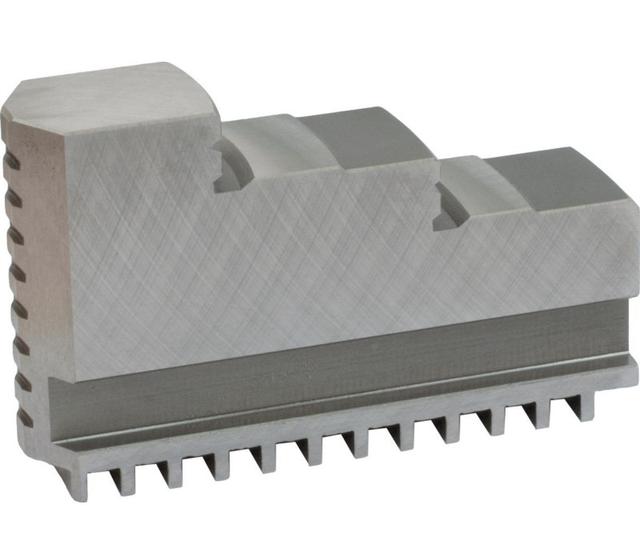
Solid jaws (one-piece jaws): The jaw is a single solid piece of metal from the base (which engages the scroll) to the clamping face (which contacts the workpiece). Solid jaws are simpler, more rigid (no joint between base and clamping face) and less expensive. They are supplied as "hard" jaws that are heat-treated to high hardness for wear resistance when clamping raw bar stock or rough castings. Solid jaws are the standard choice for general-purpose clamping where the workpiece surface finish is not critical (the hard serrated or smooth clamping face can mark the workpiece).
Two-piece jaws: The jaw is split into two components: a master jaw (the base that engages the scroll and remains in the chuck permanently) and a top jaw (the clamping face that bolts to the master jaw). The top jaw can be removed and replaced without disturbing the master jaw.
This modular design offers two key advantages:
Different top jaws can be fitted to the same master jaw. Hard top jaws for gripping rough stock, soft top jaws for finished surfaces or custom-machined top jaws for specific workpiece profiles
When top jaws wear, only the top jaw needs replacing rather than the entire jaw assembly. Two-piece jaws are the standard for production and precision work where jaw flexibility and economy matter.
The Bison scroll chucks are supplied with jaws included — the 3205 is supplied with "one set of hard top jaws, one set of hard master jaws and one wrench" (two-piece configuration). The 3504-P is supplied with "one set of hard outside-inside solid jaws, one set of hard outside solid jaws and one wrench" (solid jaw configuration). The 3105 (2-jaw) is supplied with "one set of soft top jaws, one set of hard master jaws and one wrench."
Hard jaws are heat-treated to high hardness (typically 55-62 HRC) and have serrated or textured clamping faces that bite into the workpiece surface. They are designed for gripping raw bar stock, rough castings and forgings where surface finish is not a concern because the serrations provide a high-friction grip that resists the workpiece being pulled out by cutting forces. Hard jaws are the standard jaw supplied with most chucks. They are not suitable for clamping finished or polished surfaces as the serrations will mark and damage the surface. The Bison SJZ3200-3500 hard solid jaws are an example of replacement hard jaws.
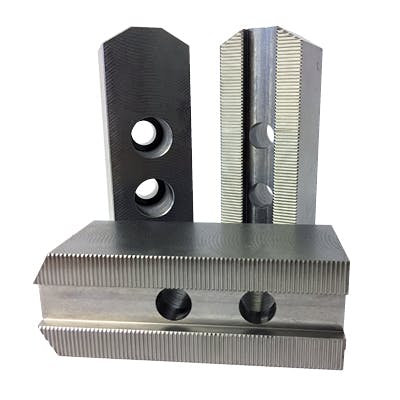
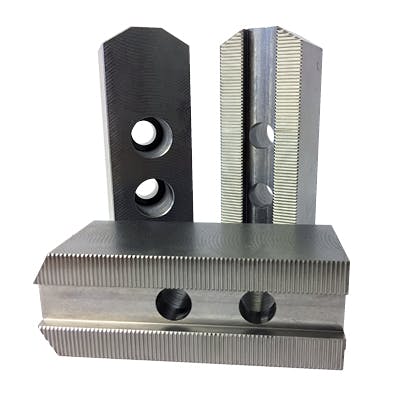
Soft jaws are manufactured from softer, unhardened steel (the MSJ Kitagawa-style soft jaws use Grade 080 M15 mild steel, described as "capable of being heat treated"). They are supplied in a semi-finished or soft state so they can be machined by the operator to the exact profile of the workpiece. The operator bores or turns the soft jaws to match the workpiece diameter while the jaws are clamped in the chuck, ensuring that the clamping faces are perfectly concentric with the chuck axis.
This provides several critical benefits:
Surface protection: The smooth machined soft jaw face contacts the workpiece without serrations, protecting finished surfaces from marking
Concentricity: Because the jaws are machined in-situ in the chuck the clamping diameter is perfectly concentric with the spindle axis meaning they typically achieve a runout of a few microns, far better than the factory-set concentricity of hard jaws
Custom profiling: Soft jaws can be machined to grip complex workpiece profiles (stepped diameters, threads, thin-walled tubes, or irregular shapes) that hard jaws cannot accommodate
Second-operation accuracy: For second-operation work where the workpiece was already turned in a previous operation, soft jaws machined to the first-operation diameter ensure the second operation is perfectly concentric with the first.
The MSJ series provides soft jaws in standard, extra long (MSJ-L) and extra high (MSJ-H) configurations for Kitagawa-style power chucks.
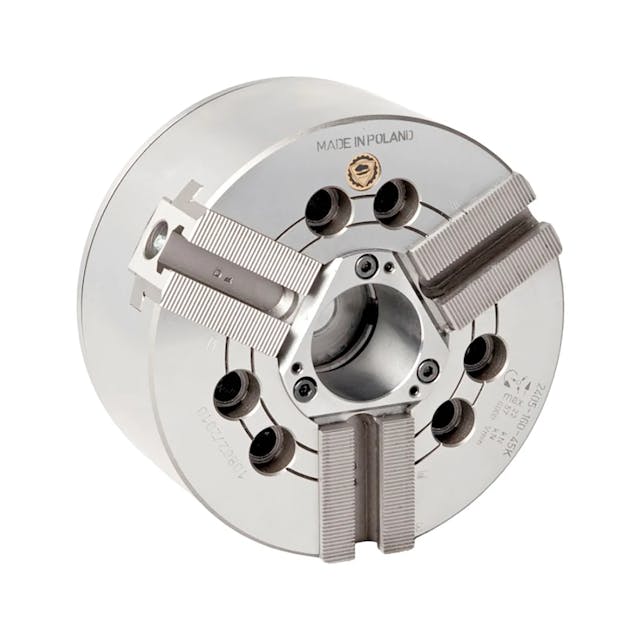
The 2405 series (Bison 3-Jaw Power Chuck with Through Hole) is the primary power chuck in our range. A power chuck uses the same self-centring jaw principle as a scroll chuck but is designed for actuation by an external power source rather than manual operation with a chuck key.
Key differences from manual scroll chucks:
Actuation method: A manual scroll chuck is operated by turning a chuck key (T-handle wrench) that engages a bevel gear on the scroll plate. The operator applies force by hand which limits the clamping force to what can be achieved manually. A power chuck is actuated by a pneumatic or hydraulic cylinder mounted behind the lathe spindle, connected via a draw tube that passes through the spindle bore. The cylinder pulls (or pushes) a drawbar that actuates the chuck's internal wedge mechanism, driving the jaws inward or outward with far greater force than manual operation can achieve.
Through-hole design: The 2405 power chuck has a through hole and the chuck body is hollow, allowing long bar stock to pass through the chuck and spindle for bar-fed work. This is essential for production turning where material is fed through the spindle.
Wedge-hook mechanism: The 2405 uses a 90° serration (DIN 6353) and a drawbar-driven wedge mechanism. The product description states: "The drawbar design results in its rigid structure and enables direct power transmission to the master jaws in direct area of jaw guideways meaning effective counteracting of the loss of gripping force and resulting in high power transmission efficiency." This means the clamping force is applied directly and efficiently to the jaws, maintaining high grip even under heavy cutting loads where a scroll chuck might lose grip.
Material and construction: The 2405 is "manufactured from high grade alloy steel which extends machine life while providing higher rigidity and greater wear resistance" which is a more robust construction than the cast iron scroll chucks, suited to the higher forces and production duty cycle of power chuck operation. The unbalance is rated G 6.3, suitable for higher rotational speeds.
Power chucks are used on CNC lathes with hydraulic or pneumatic bar-feed systems and on production turning centres where rapid, high-force, automated clamping is required. They are not suitable for manual lathes without a powered drawbar system.
The chuck diameter must be appropriate for the lathe's spindle nose size and the workpiece sizes being turned. The range spans from 80mm (3") to 630mm (25") diameter.
Some key considerations:
Spindle nose compatibility: The chuck must fit the lathe spindle nose and both the physical size and the mounting type must match. A small lathe with an MT3 spindle nose and a small spindle flange cannot physically accommodate a 400mm chuck and a large industrial lathe with a D1-8 camlock spindle would be poorly matched to an 80mm chuck.
As a general guide, lathe swing (the maximum diameter that can rotate over the bed) correlates with appropriate chuck size:
Up to 250mm (10") swing: 80-125mm (3–5") chuck
250-330mm (10–13") swing: 125-160mm (5–6") chuck
330-400mm (13–16") swing: 160-250mm (6–10") chuck
400-500mm (16–20") swing: 250-315mm (10–12") chuck
500mm+ (20"+) swing: 315-630mm (12–25") chuck
Workpiece diameter: The chuck must be large enough to grip the maximum workpiece diameter you intend to turn. The through-bore (the hole through the centre of the chuck) determines the maximum bar stock diameter that can pass through. Larger chucks have larger through-bores. The 2405 power chuck's through-hole design is specifically for bar-fed work.
Jaw travel: The jaw travel (how far the jaws can open from fully closed to fully open) determines the range of workpiece diameters a single chuck can accommodate. Select a chuck whose jaw travel covers your typical workpiece range.
Practical sizing: For a general-purpose workshop lathe with 300mm swing, a 160mm (6") 3-jaw scroll chuck (i.e. 3205) is the typical choice because it is large enough for most work, not so large that small workpieces are difficult to grip. For a small bench lathe, an 80mm or 100mm chuck (3504-P) is appropriate. For a large industrial lathe, a 315mm or 400mm chuck (3275) provides the capacity needed.
The number of jaws determines how the workpiece is gripped and what workpiece shapes the chuck can accommodate:
2-jaw chucks: (3105 series) have two opposing jaws that clamp the workpiece from two sides. They are used for irregularly shaped workpieces (flat bars, rectangular sections, castings with two parallel faces) that cannot be gripped by a 3-jaw chuck. The 3105 is supplied with soft top jaws for custom machining to match the workpiece profile. 2-jaw chucks are also used for gripping square stock. The range includes 2 variants.
3-jaw chucks: (3205, 3275, 3504-P, 3274 and many others) are the standard general-purpose configuration. Three jaws at 120° spacing self-centre round and hexagonal workpiece in one motion. The 3-jaw scroll chuck is the most common lathe chuck (the majority of turning work involves round or hexagonal bar stock, and the 3-jaw chuck provides rapid, automatic centring).
4-jaw chucks: serve two purposes:
4-jaw independent chucks (where each jaw is adjusted separately) can grip square, rectangular, and irregular workpieces by positioning each jaw independently
4-jaw self-centring scroll chucks grip round workpieces with four contact points instead of three, providing more uniform clamping on thin-walled or delicate tubes that might distort under three-point clamping.
6-jaw chucks: have six jaws at 60° spacing, providing six contact points around the workpiece. They are used for thin-walled tubes and delicate components where even four-point clamping might cause distortion. The six contact points distribute the clamping force so evenly that even very thin-walled tubes can be gripped without ovalising. 6-jaw chucks are the specialist choice for precision tube turning and for components with extremely thin walls.
The selection rule: use 3-jaw for general round/hex bar work, 4-jaw for thin-walled round stock or square/rectangular work (if self-centring), 6-jaw for very thin-walled tubes, 2-jaw for flat or irregular profiles.