




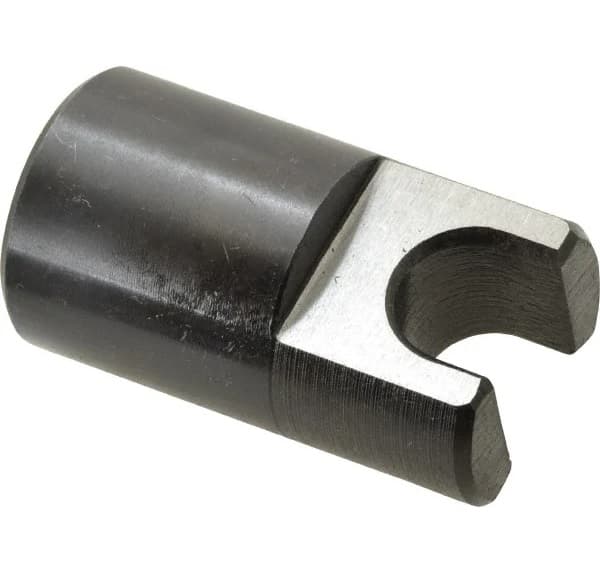

Bison Thrust Bearing for 4300 Series Independent Lathe Chucks
Series: 3985733...20% DISCOUNT£66.40 excl. VAT
£79.68 incl. VAT
£53.12excl. VAT
£63.74incl. VAT
| SKU | Price (Ex VAT) |
|---|---|
| 398573360500 | £110.00£88.00 |
| 398573310600 | £66.40£53.12 |
| 398573340100 | £95.60£76.48 |
| 398573350300 | £97.40£77.92 |
| 398573370700 | £118.00£94.40 |
Frequently Asked Questions
Hard jaws are supplied hardened and ground with a serrated or machined gripping face ready to use straight out of the box. They are the general-purpose jaw for gripping a raw bar, a rough casting or a finished diameter that will tolerate the jaw marks and they hold by biting into the work.
Soft jaws are supplied unhardened (in a mild steel such as 080 M15) and are bored or turned by the user to the exact diameter of the workpiece, so they grip a finished surface over a wide arc without marking it and without the runout that a used set of hard jaws accumulates.
The choice is driven by the work;
Hard jaws for the raw stock and the roughing, where grip and bite are what matters and a few jaw marks are acceptable.
Soft jaws for the second operation, the finished bore or the delicate work, where the part must be held without damage and held true to the chuck.
A complete turning set-up keeps both to hand, because the work moves between the two as the job progresses.
Soft jaws are unhardened jaws that the user machines to the exact shape and diameter of the workpiece before use. They are bored in the chuck (clamped in their working position and turned to the required diameter with a boring bar) so the gripping arc is a true circle concentric with the chuck’s axis, to within a few thousandths of a millimetre. That is the great advantage of soft jaws, the runout is whatever you cut them to, not whatever the chuck has accumulated over years of use.
You bore your own for three reasons: to hold a finished diameter without marking it (the soft steel will not bite the way a hard jaw does), to hold to a tight runout on a second operation (the bored jaw is true to the chuck, so a part flipped end-for-end comes back running true), and to grip an awkward shape (a thin ring, a hexagon, a profiled part) that a standard hard jaw cannot grip cleanly.
The soft jaw is the tool of precision second-operation work and the boring is done in the chuck so the grip matches the chuck.
On a power chuck or a scroll chuck with a two-piece jaw system, the master jaw is the base jaw that sits in the chuck body and is driven by the scroll or the power mechanism. It carries the serrated or dovetailed interface that the top jaw bolts onto.
The top jaw (sometimes called the jaw insert) is the replaceable piece bolted to the master jaw and it is the part that actually contacts the work. The master jaw is the permanent carriage and the top jaw is the consumable and interchangeable grip.
The advantage of the two-piece system is that the top jaws are swapped in minutes without disturbing the master jaw (hard top jaws for the raw stock, soft top jaws for the finished work, special top jaws for an awkward shape) all on the same master jaw carriage.
The master jaw is bought once with the chuck (or replaced only if damaged); the top jaws are the everyday change, which is why our category carries the top jaws (hard and soft) separately from the master jaws.
Inside clamping (sometimes called internal or expansion clamping) is where the jaws grip the inside of a bore, expanding outward to hold a ring, a tube or a part with a finished bore. The jaws move outward as the chuck closes, bearing on the internal surface.
Outside clamping (external clamping) is the reverse, where the jaws grip the outside diameter, closing inward onto the work.
The two are mirror images and most jaw ranges offer both because the work demands one or the other. A bar or a shaft is held by outside clamping; a ring, a bush or a thin-walled tube with a finished bore is held by inside clamping.
Some chucks use the same jaws reversed for the two modes, others use separate jaw sets; the jaw listing will state which clamping mode it is for, and a complete set-up keeps both so the work can be held either way.
The MSJ series soft jaws are made to fit the Kitagawa style of power chuck: the scroll-and-serration interface used by Kitagawa, one of the most widely fitted CNC power chucks in the industry, and by the many chucks that follow the same serration pattern. The jaws are machined all over with chamfered edges and a ground serration that matches the Kitagawa master jaw, so they seat and clamp on the chuck the same way an original-equipment jaw does.
Because the Kitagawa pattern is so widely followed, the MSJ jaws fit a great many CNC power chucks beyond the Kitagawa brand itself. The “style” is the key word, meaning the jaws are made to the Kitagawa serration and will fit any chuck using that pattern.
Match the jaw to the chuck’s master-jaw serration and the chuck’s size and the MSJ will seat correctly.
If you are unsure whether your chuck is a Kitagawa style, our team of in-house, time-served engineers can confirm from the chuck model.
The standard soft jaw (MSJ) is the everyday jaw, sized to the chuck and giving the normal grip and projection. The extra-long soft jaw (MSJ-L) has a longer body so it projects further from the chuck and can grip a longer workpiece or reach past a shoulder (useful for longer parts or for clearing a fixture).
The extra-high soft jaw (MSJ-H) has a taller gripping face so it bears on a wider arc of the workpiece, giving more grip and better support for thin-walled or delicate parts that would distort under a narrow jaw.
Choose the standard for the bulk of work, the extra-long where the reach is needed (a longer part, a shouldered part, clearing a fixture) and the extra-high where the part is thin-walled or delicate and a wider grip is needed to hold it without distortion.
All three are the same Kitagawa-style serration and the same 080 M15 soft steel, so they bore the same way and interchange on the same chuck and the choice is purely about the grip and the reach the job needs.
The MSJ soft jaws are made from 080 M15 which is a low-carbon mild steel, soft and free-machining, which is why it takes a clean bored finish and why it grips without biting the work.
Because it is low-carbon it can be case-hardened or carburised after boring, giving a thin hard skin on the gripping face while keeping the body soft which is useful where a soft jaw would wear too quickly on a repetitive job but where a full hard jaw would mark the work.
Heat-treating is an option but not a requirement. Most soft jaws are used as-bored, in the soft state, for the simple reason that the soft grip is the point. Heat-treating is worth it where a particular soft jaw is bored for a long run and the grip would otherwise wear; a case-hardened face gives the wear life of a hard jaw with the bespoke grip of a soft jaw.
For a one-off or a short run, the soft jaw is used as-bored and replaced when worn.
The Bison series numbers identify the chuck family the jaws fit. The 3200 and 3500 series are Bison’s 3-jaw self-centring scroll chucks, the 3105 and 3600 series cover other scroll and independent chuck families, and the 3700, 3800 and 4300 series cover the larger and the power chuck ranges.
We list the jaws against the series (for example, the SJZ3200-3500 hard solid jaws fit the 3200 and 3500 series) so matching the jaw to the chuck is a matter of the series number on the chuck body.
The series is marked on the chuck body, often on the face or the rim. Match the jaw series to the chuck series exactly because a 3200-series jaw will not fit a 3105-series chuck, even though both are Bison 3-jaw chucks, because the scroll pitch, the jaw serration and the body geometry differ between the families.
When ordering jaws, identify the chuck series first, then the jaw type (hard solid, hard master, soft top) and the clamping mode, and the jaw will fit straight out of the box.
A hard solid jaw is a one-piece hardened jaw where the gripping face and the scroll/serration body are a single piece of hardened steel, used on the lighter and the manual chucks where the two-piece system is not fitted.
A hard master jaw is the hardened base jaw of a two-piece system, it carries the serration for the top jaw and is driven by the scroll, and it is the permanent carriage.
A soft top jaw is the unhardened top piece bolted to a master jaw, bored by the user to the workpiece.
The hard solid jaw is for the one-piece chuck, the hard master jaw is the base of the two-piece system (bought with the chuck or replaced if damaged) and the soft top jaw is the everyday consumable of the two-piece system, swapped and bored for each job.
The three are not interchangeable (the solid jaw is a different chuck design) so match the jaw type to the chuck’s jaw system.
An adaptor plate (commonly called a backplate) is the plate that mounts a plain-back lathe chuck to the spindle nose of the lathe. The chuck has a plain machined back (to DIN 6350) with a register and bolt holes; the spindle nose has a taper, a flange and a thread or a cam-lock. The adaptor plate bridges the two: it is turned to fit the spindle nose on one side and the chuck register on the other and the chuck bolts to the plate and the plate bolts to the spindle.
You need one whenever a plain-back chuck is fitted to a spindle nose it does not directly match. The common spindle-nose standards (the C taper (DIN 55027) and the D taper (DIN 55029)) are served by the Bison 8232 and 8242 series adaptor plates.
Matching the adaptor to the spindle nose standard is the key: a C-taper spindle takes the 8232, a D-taper spindle takes the 8242 and the chuck then mounts to the adaptor.
Without the right adaptor a plain-back chuck cannot be fitted.
A semi-machined adaptor plate (the Bison 8232-X and 8242-X series) is machined on the spindle-nose side (the taper, the flange and the fitting diameter are finished to the standard but the chuck-side register is left oversize and semi-finished, for the user to machine to the exact chuck bore. This lets the plate be bored to a specific chuck for a true running fit, which is the precision way to mount a chuck and the way a chuck is fitted when runout matters.
A fully finished adaptor plate (the Bison 8237 series) is machined to the standard on both sides, ready to bolt on without further machining. It is the quick-fit option for a standard chuck, where the chuck register matches the plate register and the precision of a bespoke boring is not needed.
The semi-machined is the choice for the precision fit; the fully finished is the choice for the quick, standard fit and the two serve different needs at different price points.
The C taper (DIN 55027) and the D taper (DIN 55029) are the two common European short-taper spindle-nose standards. Both use a tapered flange and a flange-face mounting but they differ in the taper angle, the flange diameter and the bolt pattern, so an adaptor plate for one will not fit the other. The C taper is the older, smaller-flange standard whereas the D taper is the newer, larger-flange standard, and the two are not interchangeable.
You identify yours from the lathe’s spindle-nose specification.
The manual will state DIN 55027 (C taper) or DIN 55029 (D taper) or give the spindle-nose size (e.g. C5, D6) from which the standard follows. Failing that, the flange diameter and the bolt pattern measured against the standard tables will identify it.
The adaptor plate must match the spindle standard so this is the first thing to establish before ordering a backplate.
Our team of in-house, time-served engineers can help identify it from the lathe model.
The safety wrench (the Bison 3985340 series) is the chuck key, the T-handle wrench that engages the square on the scroll pinion and turns the scroll to open and close the jaws on a manual scroll or independent chuck. A safety wrench has a release mechanism that ejects the key from the chuck when the operator lets go, so the key cannot be left in the chuck when the spindle starts which is a classic cause of a wrecked lathe and a serious injury.
One wrench fits a family of chucks (the Bison 3985340 covers the 3105, 3200, 3500, 3600, 3700, 3800 and 4300 series) so a single spare keeps the shop going.
A spare is worth having because the wrench is the one thing that gets lost or mislaid and without it the chuck is unusable. The safety type is the right type to fit because a non-safety key left in the chuck is a known hazard and a safety wrench removes it.
Keep the jaw faces and the serrations clean. The accuracy of the jaw (whether hard or soft) depends on the jaw seating cleanly in the chuck, so swarf and coolant residue trapped between the jaw and the master jaw, or in the serrations, is the most common cause of a jaw that does not run true. Brush the serrations clean before fitting a jaw and wipe the master-jaw faces because a jaw fitted dirty will grip off-centre and the work will run out.
For soft jaws, bore them in the chuck they will be used in, clamped in their working position, so the grip is true to that chuck. Mark the jaws and the chuck body so a set of bored soft jaws goes back into the same position each time.
Store jaws racked and clean, with the soft jaws kept separate from the hard since a soft jaw will dent on contact with a hard one.
And replace the master jaw if it shows wear in the serration because a worn master jaw will not hold any top jaw true, however good the top jaw.
Start with the chuck you have and the work you are doing. For a first-operation raw-bar or rough-casting grip, a set of hard jaws (solid for a one-piece chuck, or hard top jaws for a two-piece) is the everyday choice.
For a second-operation or a finished-diameter grip, a set of soft jaws (standard, or extra-long / extra-high if the reach or the part demands) bored to the workpiece.
For mounting a plain-back chuck to a spindle nose, an adaptor plate matched to the spindle standard (C-taper 8232 or D-taper 8242, semi-machined for a precision fit or fully finished for a quick fit).
Add a safety wrench if one is not already to hand and a spare set of soft jaws for the next job so the set-up time is minimised.
Tell us the chuck model (or the lathe and the spindle nose), the workpiece and the operation and our in-house, time-served engineers will put together the matched jaw and accessory set that fits straight out of the box.
They will also be able to advise on the boring of the soft jaws for the specific job.
Customers Also Viewed
ex VAT
ex VAT

ex VAT
ex VAT
ex VAT

ex VAT
Service & Delivery Information
If the order is placed online, we offer free shipping to mainland UK on orders over £25 ex VAT.
This offer excludes certain items due to weight restrictions. These items will be highlighted in the shopping cart.
Delivery to Ireland, Northern Ireland, Scottish Highlands etc may incur additional charges.
Please see our delivery information page for a full breakdown.
You are able to cancel or return the goods of items that we stock. Goods which are ordered in from suppliers specifically for your order will be subject to a restocking fee.
We are able to offer businesses trade accounts subject to a soft credit check.
Please contact us if you would like to set up a trade account.
Tracking details will be emailed for all orders sent tracked once the goods have been shipped. This will include a link to the relevant courier's website.
Alternatively, you can also contact us who can track the order for you.
Please contact us if you have any questions regarding this product or any other product or service.
You can contact us by:
- Phone: 01274 872822
- Email: sales@milotools.co.uk
- Online chat