




Bison Quick Change Toolposts & Tool Holders
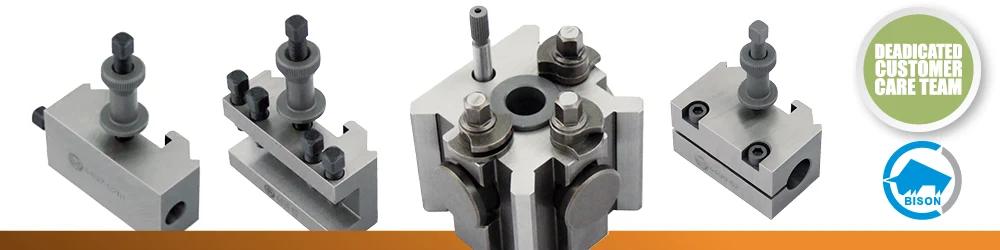
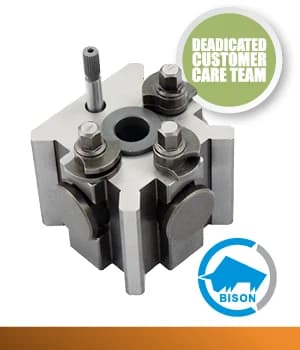
This page lists Bison quick change toolposts and tool holders for lathe work: the 4414 Series toolpost and the holders that fit it, covering square shank tools, round shank tools, boring bars, parting off and Morse Taper tooling. It is aimed at machinists who want quick changeover of tools with precise repeatability.
The 4414 Series quick change tool post is the base of the system. Holders are grouped by the tool they clamp. The 4494 Series standard toolholders take square shank tools and are compatible with Dickson holders; the 4495 Series vee type toolholders take round shank tools and are likewise Dickson compatible. The 4496 Series is a parting off toolholder. For Morse Taper tooling, the 4497 Series clamps from Morse Taper 1 upwards.
Two ranges cover boring bars. The 4499 Series is the standard quick change tool holder for boring bars within the Bison toolpost system. The 4498 Series is an anti-vibration holder for boring bars, intended to reduce vibration and increase rigidity when machining.
Start with the 4414 Series toolpost, then match holders to shank type: 4494 for square shank, 4495 for round shank, 4497 for Morse Taper, 4496 for parting off. For boring, choose the 4499 Series for general use, or the 4498 Series where vibration and rigidity are the deciding factors.

Toolholders For Boring Bars - 4499 Series (Bison)
If you're looking for a high-quality, quick change tool holder for your boring bars, look no further than the Bison quick change tool post system. This system is ideal for quick changeover of tools an...
£137.00 excl. VAT
£164.40 incl. VAT
£109.60excl. VAT
£131.52incl. VAT

Toolholders For Boring Bars - 4498 Series (Bison)
Looking for an easy way to reduce vibration and increase rigidity when machining? Look no further than the Bison Quick Change Anti-Vibration Tool Holder for Boring Bars! This innovative tool ho...
£142.00 excl. VAT
£170.40 incl. VAT
£107.20excl. VAT
£128.64incl. VAT

Morse Taper Toolholders - 4497 Series (Bison)
Looking for a quick and easy way to change your Morse Taper tools? Look no further than the Bison Quick Change Tool Holder! This handy tool holder is perfect for clamping from Morse Taper 1 to...
£122.00 excl. VAT
£146.40 incl. VAT
£92.00excl. VAT
£110.40incl. VAT

Part Off Toolholders - 4496 Series (Bison)
Looking for a brand new, quick change parting off tool holder? Look no further than the Bison Quick Change Parting Off Tool Holder! This top-quality tool holder is perfect for anyone who wants to...
£102.00 excl. VAT
£122.40 incl. VAT
£81.60excl. VAT
£97.92incl. VAT

Vee Type Toolholders - 4495 Series (Bison)
Looking for a high-quality, quick change vee type tool holder for round shank tools? Look no further than the Bison quick change tool post system! These tool holders are fully compatible with Dic...
£60.10 excl. VAT
£72.12 incl. VAT
£45.60excl. VAT
£54.72incl. VAT

Standard Toolholders - 4494 Series (Bison)
Looking for a quick and easy way to change your square shank tools? Look no further than the Quick Change Standard Tool Holder from Bison! This tool holder is fully compatible with Dickson too...
£59.80 excl. VAT
£71.76 incl. VAT
£47.84excl. VAT
£57.41incl. VAT

Quick Change Toolposts - 4414 Series (Bison)
Looking for a quick and easy way to change your lathe tools? Look no further than the Bison Quick Change Toolpost! This system is ideal for quick changeover of tools with precise repeatability, so...
£276.00 excl. VAT
£331.20 incl. VAT
£208.80excl. VAT
£250.56incl. VAT
Frequently Asked Questions
A quick change toolpost replaces the simple top-slide or four-way turret that comes on many lathes with a system that holds individual toolholders, each clamped and released with a single lever. The benefit is right there in the name, you swap a toolholder in and out in seconds, with the tool returning to its set height and centre line every time.
On a manual lathe doing anything beyond the most basic work, the time saved on tool changes and re-setting heights is considerable. Each tool can be pre-set in its own holder (turning, facing, parting, boring) and brought back into position repeatably, so you are not re-establishing centre height or re-shimming between operations.
For batch work and one-offs alike, it transforms the rhythm of the job.
Yes, this is one of the most important practical points about the Bison range in this category.
The Bison standard, vee type and several other holders are fully compatible with the Dickson toolpost system, and the toolpost sizes follow the same numbering.
That means if your lathe already runs a Dickson-pattern toolpost, you can buy Bison holders and they will locate and clamp correctly.
This interchangeability is a real advantage, because Dickson-pattern holders and toolposts are fitted as original equipment on a great many British and continental lathes.
You are not locked into a single supplier, and you can mix holders from the Bison range into an existing Dickson set-up without issue.
The Bison system is sized by a number; 48, 62, 82 & 100 in this category which corresponds to the height of the toolpost and the shank size of the holders it accepts. The size must match the swing and the centre height of your lathe: a size 48 suits smaller bench lathes, while 82 and 100 are the territory of larger industrial machines.
The clamping range figures; the 0-114, 114-127, 127-203 & 203-292 mm bands you see in the filters describe the swing over the bed that the toolpost is designed for.
Match the clamping range to your lathe’s swing and the size to the holders you intend to use. If you are unsure, our team of in-house, time-served engineers can confirm the correct size from your machine model.
These are the Bison type designations that pair a toolpost with the holder series it accepts, for example a T.2 or T.2T toolpost takes the corresponding T.2 holder series. The type defines the dovetail and clamping interface so the holder type must match the toolpost type exactly.
Some toolposts are listed with multiple types such as T.0/T.1/T.1X or T.3/T.3HX; these accept a family of holders across those designations, giving flexibility in the holder shank sizes you can fit.
When you order a toolpost and holders together, make sure the types line up; when adding holders to an existing toolpost, identify the type marked on the post first.
The 4494 Standard Toolholders are the everyday workhorse of the system, they hold square-shank turning and facing tools, the brazed or indexable lathe tools that do the bulk of the cutting on a manual lathe. Each holder sets the tool at centre height so once a tool is shimmed and clamped in its holder it returns to height every time it is fitted.
This is the holder to start a quick change kit with. A set of standard holders, each carrying a different turning tool, lets you move between roughing, finishing and facing operations without re-setting and this is by far the core benefit of the quick change system.
They are compatible with the Dickson equivalent, so they drop into existing set-ups.
The 4495 Vee Type Toolholder holds round-shank tools rather than square shanks. A V-shaped seat cradles the tool and a clamp secures it which makes it the natural choice for indexable inserts on cylindrical shanks, micro-boring heads and any tool supplied as a round bar rather than a square shank.
Choose a vee holder whenever your tooling comes on a round shank, many modern boring bars and adjustable boring heads fall into this category.
Keeping both standard and vee holders in the rack gives you the flexibility to take on square-shank and round-shank tooling without compromise.
The 4496 Part Off Toolholders are purpose-built for parting-off and grooving blades.
Rather than clamping a parting blade in a standard holder (where it can be poorly supported and prone to chatter) these holders seat the blade correctly and rigidly, with the geometry intended for deep parting cuts.
Parting off is one of the most demanding operations on a lathe and a properly supported blade makes the difference between a clean cut and a jammed tool.
A dedicated part-off holder keeps the blade square to the work and well clamped which is why it earns a place in any complete quick change kit.
The 4497 Morse Taper Toolholders accept Morse taper shanked tooling (typically MT1 up to MT2 in this range) and bring it into the quick change system. That means drills, reamers, small boring heads and centres held on a Morse taper can be mounted in a holder and changed over in seconds, just like a turning tool.
This is a quietly useful holder. It turns the toolpost into a quick-change mounting for drilling and reaming in the tailstock position and for light boring work using taper-shank boring bars.
If you do second-operation drilling or reaming on the lathe, a Morse taper holder removes the need to swap between tailstock and toolpost constantly.
Both the 4498 & 4499 series hold boring bars (the cylindrical tools used for internal turning of bores). The 4499 is the standard boring bar holder, clamping the bar firmly and setting it on centre for internal work.
The 4498 is the anti-vibration version. Long boring bars are the classic source of chatter in the lathe, because a slender bar overhang resonates under the cutting load.
The 4498 anti-vibration holder addresses this at the clamping point, damping vibration and allowing heavier, cleaner cuts from the same bar.
Where a standard holder is adequate for short, rigid bars, the anti-vibration holder earns its keep on deeper bores where chatter would otherwise force you to reduce depth of cut.
A well-made quick change toolpost is considerably more rigid than the lightweight top-slide assemblies fitted to many lathes as standard. The dovetail clamping interface, the substantial body of the post and the direct mounting to the compound all combine to hold the tool still under heavier cuts which shows up directly as better finish, longer tool life and the ability to take deeper passes.
The gain is most noticeable on smaller and medium lathes, where the original toolpost is often the weakest link in the cutting chain. Fitting a Bison post does not make the machine bigger, but it lets you use more of the rigidity the bed and spindle already have, by removing the flex and play of a poor original set-up.
No, and that is the whole point of the system.
Each toolholder brings its tool back to a repeatable position on the toolpost, so a tool that was set to centre height in its holder returns to centre height every time that holder is fitted.
Once a tool is shimmed and clamped correctly in its holder, the setting travels with the holder.
The practical effect is that each operation gets its own dedicated, pre-set holder and the set-up time between operations collapses to the few seconds it takes to release one holder and clamp another.
Over a day’s work, especially on batch jobs, the time saved is significant and the consistency of height improves the accuracy of every job.
Centre height is the distance from the lathe centre line to the cutting tip and it must be spot-on for clean turning and a true diameter. Set the tool to centre using a height gauge, a centre in the tailstock as a reference or the time-honoured method of touching the tool to a bar held between centres and judging the tip position by eye.
Once the tool is at height, shim beneath square-shank tools in a standard holder until the tip sits on centre, then clamp. Round-shank tools in a vee holder are usually adjustable for height within the holder. When the height is correct, lock everything and make a light cut to verify (a tool above or below centre will produce a poor finish and an inaccurate diameter).
Take the time to get this right once per holder, because the quick change system will reproduce that setting faithfully thereafter. A few minutes spent setting centre height properly saves hours of chasing tapered or poor-finish parts.
Within the same type and size designation, yes.
Because the Bison holders in this category are compatible with the Dickson system (and Dickson-pattern toolposts are fitted to many lathes) you can generally mix Bison holders with original Dickson holders on a matching toolpost without issue, provided the types line up.
The thing to watch is the type designation.
A T.2 holder must go on a T.2 toolpost; mixing types will not clamp correctly.
As long as the type and size match, the holders seat on the same dovetail and clamp with the same geometry, so mixing makes and series across a single toolpost is perfectly acceptable.
Keep the dovetail interfaces clean. The accuracy and rigidity of the system depend on the holder seating cleanly on the toolpost dovetail, so swarf and coolant residue trapped between the faces is the most common cause of a holder not clamping true. Wipe the dovetails before fitting a holder and the system will repeat indefinitely.
Check the clamp lever and wedge mechanism periodically — it should move freely and clamp positively. Keep the threads lightly oiled and free of swarf. If a holder begins to creep under cut, the cause is almost always contamination on the seating faces or a worn wedge rather than the system itself.
Store spare holders clean and together, with the tooling left in place where possible. Because each holder carries its pre-set tool, leaving the tool clamped in the holder between jobs preserves the centre height setting and keeps the kit ready to drop straight back into use.
Begin with the toolpost itself (the 4414 series) sized to your lathe, then build the holder set around the work you actually do.
A sensible starter kit is a pair of standard holders (4494) for your main turning and facing tools, a part-off holder (4496) and a boring bar holder (4499, or 4498 anti-vibration if you do deeper bores).
From there, add holders as the work demands: a vee type (4495) for round-shank indexable tooling, a Morse taper holder (4497) for drilling and reaming and additional standard holders so each commonly used tool has its own permanent home.
The system rewards having a holder per tool, because the set-up time is zero once a tool is bedded into its holder.
If you tell us your lathe model and the kind of turning you do, our in-house engineers will put together a matched toolpost and starter holder set that fits straight out of the box.