




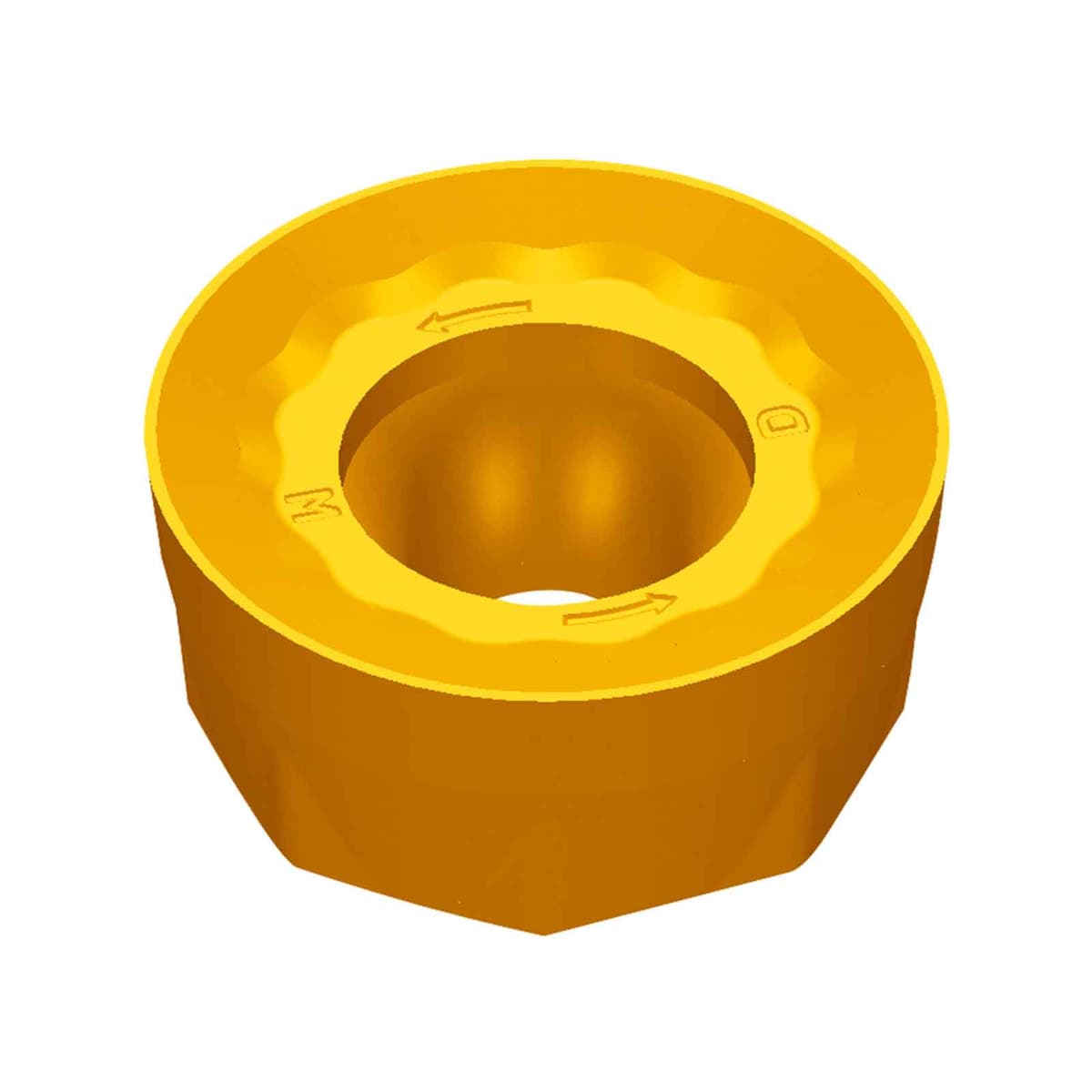
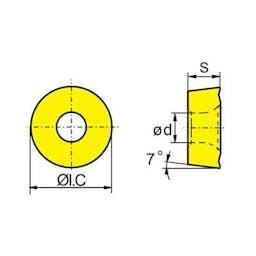
RCKT Insert For Machining Hrsa YB9320 (ZCC-CT)
Series: RCKT-DM YB9320£5.59 excl. VAT
£6.71 incl. VAT
| SKU | ISO Code | Price (Ex VAT) |
|---|---|---|
| RCKT10T3MO-DM YB9320 | RCKT10T3 | £9999.99 |
| RCKT1204MO-DM YB9320 | RCKT1204 | £5.59 |
Frequently Asked Questions
Face milling is a milling operation in which the cutting tool produces a flat surface by cutting with the peripheral edges and the face of the cutter simultaneously. The axis of rotation is perpendicular to the machined surface.
In indexable face milling, a reusable cutter body carries a ring of replaceable carbide inserts at its periphery and face; the body mounts on a spindle taper via a face mill arbor and when the inserts wear they are indexed or replaced without discarding the body.
This makes indexable face milling the standard, most economical way to produce flat surfaces on CNC machining centres from light finishing passes to heavy roughing of large castings and plates.
The diameter range in our indexable face mill category runs from 15 mm cutters up to 400 mm cutters, covering everything from small pocket facing to large-block roughing.
A face mill is a large-diameter cutter designed to produce a flat surface; it cuts with its face and periphery, is mounted on an arbor via a central bore, and typically has only a few cutting edges (inserts).
An end mill is a smaller cutter that cuts primarily with its periphery (and sometimes face) to produce slots, walls, pockets and contours and it is held by its solid shank and usually has many flutes.
Face mills are efficient for facing large areas with a single pass; end mills are better for profiling, slotting and pocketing.
A face mill cannot cut a slot the full width of its body (it has no central cutting capacity), whereas an end mill can plunge and cut a slot.
The two are complementary as most jobs use a face mill to rough a surface flat and end mills for the detailed work.
The difference is the entering angle, the angle between the cutting edge and the machined surface, which is set by the insert geometry in the body.
A 45° face mill presents the cutting edge at 45 degrees to the surface; a 90° face mill presents it at 90 degrees (square to the shoulder).
The 45° entering angle is the general-purpose choice for face milling: it splits the cutting force into roughly equal axial and radial components (less axial load than 90°), reduces vibration, allows a thicker chip for the same feed and produces a better surface finish (it is the most common and most productive face mill).
A 90° face mill can mill a square shoulder (because the edge is perpendicular to the surface) and is preferred for thin-wall work where axial force would deflect the part. Both are covered on this page.
The entering angle (sometimes called the lead or approach angle) is the angle between the main cutting edge of the insert and the machined surface. It is determined by the geometry of the cutter body, not by how the cutter is used.
The entering angle affects how the cutting force is split into axial and radial components, how thick the chip is for a given feed per tooth and how the cutter behaves in terms of vibration and surface finish.
A 45° entering angle produces a chip thicker than the feed (by a factor of ~1.4) and splits the force evenly; a 90° angle produces a chip equal to the feed and directs force more axially; a round insert produces a variable chip that thins towards the centre.
Matching the entering angle to the part and the machine is a key part of selecting a face mill.
Insert types are each suited to a specific entering angle and application:
Round inserts (RCGX, RCKT, RDKW, RCMW) produce a strong, variable chip thickness and are used for heavy roughing and high-strength materials
Square inserts (SNMX, SNEG, SEEN, SEKN) offer a 90° entering angle for square-shoulder work
Octagon inserts (ONHU, OFKT, OFKR, ODHT, ODMT) give eight cutting edges per insert for economy and a near-square shoulder with a small chamfer
Trigon inserts (WNEX, WNHU) and diamond inserts (LNKT) balance edge strength and sharpness.
The most common general-purpose face mill insert is a 45° square or rectangular insert (SEET, PNEG, SEKT, TPKT), offering four or two cutting edges and the 45° entering angle that suits most face milling.
A multi-edge face mill is a cutter body carrying many inserts (for example a 100 mm cutter might carry 5-8 inserts and a 200 mm cutter 8-14).
More cutting edges mean more cutting edges to share the load which allows a higher table feed (feed rate equals feed per tooth × number of teeth × spindle speed) and so a faster metal-removal rate and shorter cycle time.
Multi-edge cutters are preferred for production facing where cycle time matters. The trade-off is that a very high tooth count needs a high-power spindle to maintain the feed per tooth and on a low-power machine a cutter with fewer teeth may actually perform better.
For general face milling, a cutter with 4-8 inserts is a good balance; for high-production facing, a high-density cutter is the productive choice.
These are the cutter-body families in this product category, grouped by application.
FMA01, FMA02, FMA03 & FMA11/FMA12 are fine/finishing face mills carrying small inserts for light cuts and good surface finish
FMR01, FMR02, FMR03 & FMR04 are roughing face mills carrying stronger inserts and bodies for heavy material removal
The letter group tells you the cut the cutter is optimised for (A=fine, R=roughing, D=heavy, E=extra-heavy, P=multi-purpose) and the number tells you the generation and insert family.
Choosing the right series depends on whether the job is fine, roughing or heavy roughing.
The inserts in this category are rated for Steel, Stainless Steel, Cast Iron and Heat-Resistant Super Alloys (HRSA — Inconel, Hastelloy, titanium and the nickel/cobalt-based aerospace alloys).
Each material group has matching insert grades and chipbreaker geometries:
Steel and cast iron are the most common face-milling materials and have the widest grade choice
Stainless steel needs a sharper, more positive insert geometry to work-harden less and manage chip control
HRSA needs a tough, wear-resistant grade and often a round insert to handle the high cutting forces and heat.
Selecting a face mill requires matching the cutter to the job, the material and the machine:
The diameter must suit the surface being faced and the spindle power
The entering angle (45° for general work, 90° for square shoulders) must match the part geometry The insert type and grade must suit the material
The spigot must match the arbor
The tooth count must suit the spindle power and the required feed rate
And the series (fine, roughing, heavy) must suit the depth of cut being taken.
Our engineers can work through each of these with you and specify the correct cutter body, insert grade and arbor for your application.
Choosing the insert requires knowing the cutter body (the body is designed for a specific insert shape and size; an SEET body takes SEET inserts, an RCKT body takes RCKT inserts and so on), the material being cut (which sets the grade, the carbide substrate and coating) and the cutting conditions (which set the chipbreaker geometry).
Within an insert family there are usually several grades and chipbreaker options for the same shape, covering different materials and cutting conditions.
This category page lists grades by application (Steel, Stainless, Cast Iron, HRSA), so you match the insert grade to the material.
If you are running an unfamiliar material or a difficult application our engineers can recommend the correct insert grade and chipbreaker for your cutter.
Yes.
Our team includes time-served engineers who can help you select the correct face mill cutter body, insert grade and arbor for your application, whether that's choosing the right diameter and entering angle, matching an insert to a difficult material like stainless or a heat-resistant super alloy, specifying a 45° general-purpose cutter or a 90° square-shoulder cutter, or selecting between the ZCC-CT and Europa Tool ranges.
We can advise on speeds, feeds, depth of cut and chip control.
You can reach us by phone, online chat or email with your part material, surface size and machine details and we will be happy to help you specify the correct face milling tooling for your job.
Customers Also Viewed
ex VAT
ex VAT

ex VAT
ex VAT

ex VAT

ex VAT
Service & Delivery Information
If the order is placed online, we offer free shipping to mainland UK on orders over £25 ex VAT.
This offer excludes certain items due to weight restrictions. These items will be highlighted in the shopping cart.
Delivery to Ireland, Northern Ireland, Scottish Highlands etc may incur additional charges.
Please see our delivery information page for a full breakdown.
You are able to cancel or return the goods of items that we stock. Goods which are ordered in from suppliers specifically for your order will be subject to a restocking fee.
We are able to offer businesses trade accounts subject to a soft credit check.
Please contact us if you would like to set up a trade account.
Tracking details will be emailed for all orders sent tracked once the goods have been shipped. This will include a link to the relevant courier's website.
Alternatively, you can also contact us who can track the order for you.
Please contact us if you have any questions regarding this product or any other product or service.
You can contact us by:
- Phone: 01274 872822
- Email: sales@milotools.co.uk
- Online chat