




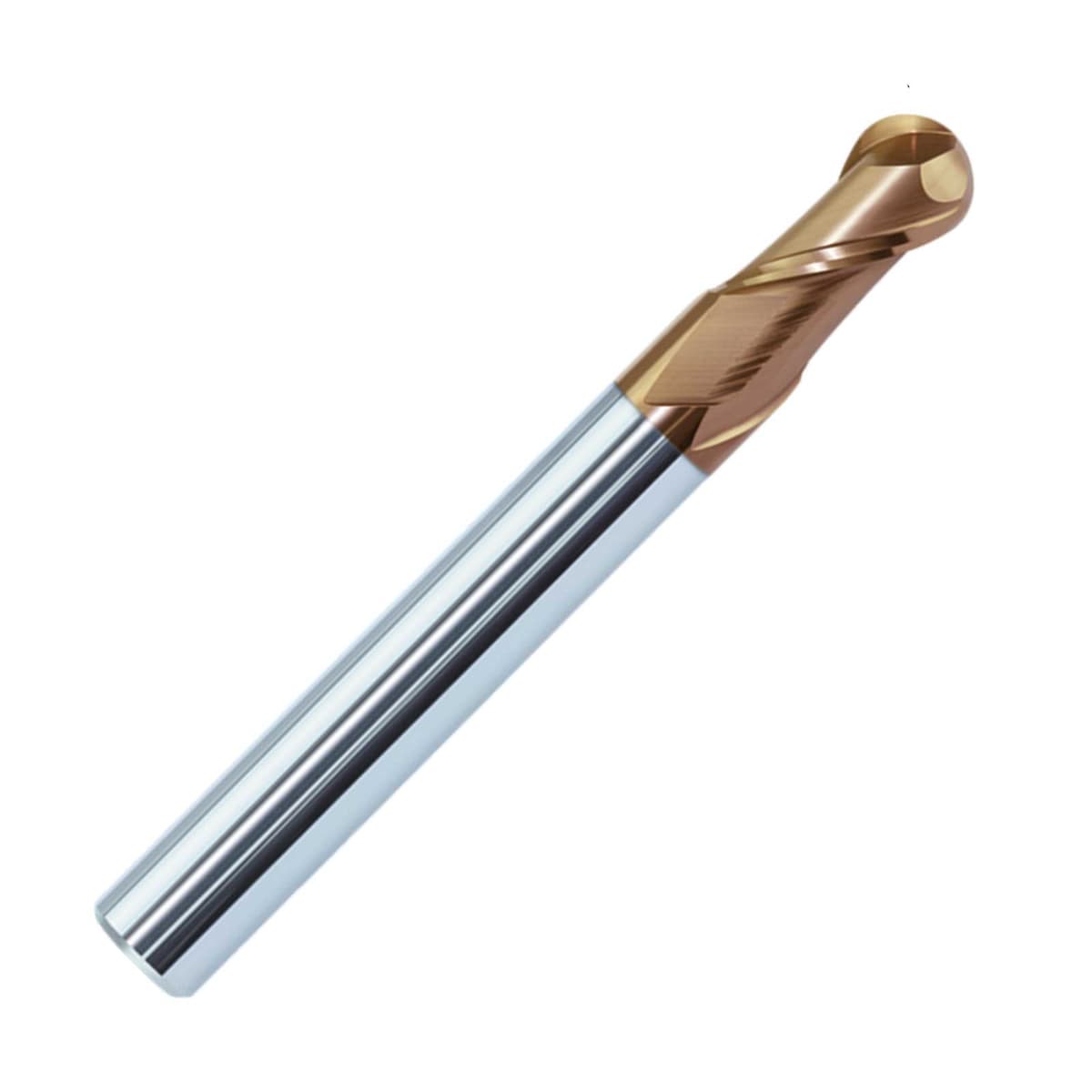
ZCC-CT HM-2B Series 2 Flute Ball Nose End Mill with Straight Shank for Hardened Steel Machining
Series: HM-2B£29.51 excl. VAT
£35.41 incl. VAT
ZCC-CT HM-2B 2 Flute Ball Nose End Mill with Straight Shank
- Excellent tool design covers large chip pocket, good stability and machining efficiency
- Optimized cutting geometry (Rake angle) assures edge stabitlity and sharpness
- Ultra fine grain carbide
- KMG555 Nano-ALTiN coating base for hard machining at high temperatures
- For machining upto 68HRC
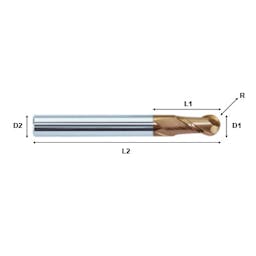
| SKU | Diameter / D1 | Shank Diameter / D2 | Cutting Length / L1 | Overall Length / L2 | Radius / R | Price (Ex VAT) |
|---|---|---|---|---|---|---|
| HM2BR20KMG555 | 4mm | 6mm | 8mm | 50mm | 2mm | £32.54 |
| HM2BR80KMG555 | 16mm | 16mm | 32mm | 100mm | 8mm | £127.10 |
| HM2BR70KMG555 | - | - | - | - | - | £92.69 |
| HM2BR60KMG555 | 12mm | 12mm | 24mm | 75mm | 6mm | £71.98 |
| HM2BR50KMG555 | - | - | - | - | - | £58.34 |
| HM2BR45KMG555 | 9mm | 10mm | 18mm | 75mm | 4.5mm | £58.34 |
| HM2BR40KMG555 | - | - | - | - | - | £43.00 |
| HM2BR35KMG555 | 7mm | 8mm | 14mm | 60mm | 3.5mm | £43.00 |
| HM2BR30KMG555 | - | - | - | - | - | £32.54 |
| HM2BR275KMG555 | 5.5mm | 6mm | 12mm | 50mm | 2.75mm | £32.54 |
| HM2BR25KMG555 | - | - | - | - | - | £32.54 |
| HM2BR20SKMG555 | - | - | - | - | - | £29.51 |
| HM2BR05KMG555 | 1mm | 6mm | 2mm | 50mm | 0.5mm | £32.54 |
| HM2BR175KMG555 | 3.5mm | 6mm | 8mm | 50mm | 1.75mm | £32.54 |
| HM2BR15SKMG555 | - | - | - | - | - | £29.51 |
| HM2BR15KMG555 | 3mm | - | - | - | - | £32.54 |
| HM2BR125SKMG555 | - | - | - | - | - | £29.51 |
| HM2BR125KMG555 | 2.5mm | - | 5mm | 50mm | 1.25mm | £32.54 |
| HM2BR10SKMG555 | - | - | - | - | - | £29.51 |
| HM2BR10KMG555 | 2mm | - | - | - | - | £32.54 |
| HM2BR100KMG555 | - | 20mm | 40mm | 100mm | 10mm | £181.74 |
| HM2BR075SKMG555 | - | - | - | - | - | £29.51 |
| HM2BR075KMG555 | 1.5mm | - | - | - | - | £32.54 |
| HM2BR05SKMG555 | - | - | - | - | - | £29.51 |
Frequently Asked Questions
The HM Series is the ZCC-CT range of carbide end mills purpose-built for hard milling (the machining of hardened steels in the HRC 45 to HRC 65 range), the through-hardened and the case-hardened tool and die steels that a general-purpose end mill will not cut cleanly or economically.
The HM uses an ultra-fine-grain carbide substrate, a hard, heat-resistant coating and a geometry tuned for the light, fast, rigid cuts that hardened steel demands.
Hard milling replaces the traditional 'grind-and-polish' route for the hardened tool and die work (the cavity of a mould, the profile of a die, the fine features of a hardened component) by milling the steel after heat treatment, to final size and finish, on a precise CNC.
The HM Series is the tool for that work, with the diameter range from the micro 0.3 mm up to 20 mm that covers the die-and-mould detail and the larger hardened-steel milling alike.
A hardened steel above around HRC 45 is a different cutting proposition to the soft steel a general end mill is tuned for. The hardness resists the cutting edge, so the edge must be sharp, rigidly held, and made of a carbide that holds its edge at the high cutting temperatures and pressures.
The chip is hard and abrasive, so the edge wears fast and any deflection of the tool or the set-up causes the edge to rub, which generates heat, accelerates wear and can chip the edge instantly. The cut must be light (a small radial and a small axial engagement) and the speed high, so the chip thins and the edge cuts rather than rubs.
A general-purpose end mill run in hardened steel will rub, build up heat, wear rapidly and chip the corner because it is the wrong geometry, the wrong carbide and often the wrong coating.
The HM Series addresses all of this: the sharp, positive edge, the fine-grain carbide, the hard coating and the geometry that takes the light cut the hard work needs. It is not a harder general end mill; it is a different tool, designed around the hard-milling regime.
ZCC-CT is one of the world's largest carbide tooling manufacturers, a Chinese brand whose ultra-fine-grain substrates and coatings now rival the established die-and-mould names, at a keener price.
The HM Series is its dedicated hard-milling end mill, the tool ZCC-CT specifies for the hardened steel work (the die, the mould, the hardened component) where the general carbide end mill is not enough.
The HM sits as the specialist in the ZCC-CT catalogue, above the general-purpose UM in hardness capability. Where the UM is the everyday carbide end mill for the soft and the moderately hard, the HM is the tool for the hardened work, the harder carbide and the harder coating taking the cut that the UM cannot sustain.
The two series are complementary and a shop that does both the soft and the hardened work runs both; the UM for the bulk, the HM for the hardened detail.
The 2-flute HM is the form for the smaller diameters and the deeper cuts, where the chip space matters most. The two large gullets give the room the chip needs to clear, which is critical in the small diameters. The micro end mills, the 0.3 mm to 3 mm range, are mostly 2-flute, because the chip space per tooth in a tiny tool is everything. The 2-flute is also the choice for the deeper profiling and the slotting, where the chip has further to travel and the larger gullet helps it out.
The 4-flute is the general hard-milling form, for the medium diameters and the profiling and the finishing of the larger features. The 3 mm to 12 mm range, where the four edges give a smooth, productive cut and the chip load per tooth in the hard steel is light enough that the smaller gullet is adequate.
The 6-flute is the high-feed finishing form, for the larger diameters and the finishing passes where the chip is light, the feed per tooth small and the extra edges give a higher feed rate and a finer finish.
As a rule, the smaller the diameter and the deeper the cut, the fewer the flutes; the larger the diameter and the lighter the cut, the more the flutes.
A square-profile HM has the sharp 90° corner for the square shoulders, the flat bottoms and the precise corners, the straight-wall pocket and the flat-faced feature in the hardened steel. A ball-nose HM has a hemispherical end, for the 3D and the contoured work (the curved mould cavity, the sculpted die surface, the blended radii) where the tool must follow a path in three axes and leave a smooth, sculpted surface.
A corner-radius HM has a radiused corner, the bull-nose, which strengthens the corner for the flat-bottomed work with a fillet, combining the strength of the ball nose with the flat-bottom cutting of the square.
The ball-nose dominates the hard-milling work because so much of the die-and-mould work is 3D.
The curved surface is the mould or the die itself and the ball nose is the only profile that can finish it in the hardened state.
The square is for the flat and the shouldered work, the corner radius for the flat work with a stress-relieving fillet.
The choice is set by the geometry of the feature and a die-and-mould shop runs all three; the ball nose for the curves, the square for the corners, the corner radius for the flat-bottomed pockets.
The standard-length HM has the flute length and projection matched to the diameter for general hard milling; the most rigid form, for the shallow and the medium-depth work. The long-length HM extends the flutes and the projection for the deeper cavities and the taller walls, the deep mould and the tall die, at the cost of more deflection and a greater tendency to chatter, and in the hard milling, deflection is the enemy, because a deflecting tool rubs and chips.
Use the shortest tool that will reach the cut, every time. The projection is the single biggest factor in the tool rigidity and in the hard work a long, slender tool will chatter, rub and fail where the same tool shortened will run clean.
The long HM is for the deep cavities only and even there, take a light cut to stay within the tool's stable range.
The standard length is the default; the long is the specialist for the depth that forces it.
The diameter-for-length, the cutting length and the overall length are all matched in the HM Series so a tool of the right reach can be chosen without over-projection.
The wide range reflects the nature of the die-and-mould and the hardened-component work.
The micro end mills (the 0.3 mm to 3 mm sizes) are for the fine detail: the engraving, the small ribs and slots, the tiny features of a mould or a die, the corner clean-up of a hardened cavity.
The medium diameters (the 3 mm to 10 mm) are for the general profiling and the finishing of the hardened surfaces, the bulk of the 3D mould and die work.
The larger diameters (the 12 mm to 20 mm) are for the bigger features and the roughing of the larger hardened surfaces, where the rigidity and the metal removal rate of a larger tool are needed.
No other end-mill series covers the micro-to-medium range so completely because the hard-milling work spans it; a single mould can need a 0.5 mm ball nose for the fine detail and a 12 mm ball nose for the larger curves, all in the same hardened steel.
The HM Series gives a shop one consistent series for the full span, with the same carbide, the same coating, the same cutting characteristics across the sizes.
The HM Series is rated for the hardened steels; the tool and die steels such as H13, D2, A2, S7, the mould steels such as P20 in its hardened state, the case-hardened steels, the through-hardened carbon and alloy steels (in the HRC 45 to HRC 65 range).
It is the tool for the steel that has been heat-treated to its final hardness and must be machined at that hardness, either because the geometry cannot be ground or because the milling replaces the grind for speed and economy.
Above HRC 65, the work moves into the ultra-hard milling and a yet-harder substrate and coating may be needed; below HRC 45, the general-purpose UM is the more economical choice, because the HM is over-specified for the softer work.
The HM is also used for the difficult, heat-resistant and the abrasive materials where the hard, sharp edge and the heat-resistant coating give an advantage, even if the material is not formally hardened.
Always match the HM to the hardness because the cutting data is set by the HRC and the harder the work, the lighter and the faster the cut.
The HM Series carries a hard, heat-resistant coating (an AlTiN-type or a nanocomposite coating in the AlCrN family) chosen for the high cutting temperatures and the abrasive chip the hardened steel produces.
The coating is a hard, thin layer on the cutting edge that resists the abrasive wear of the hard chip, carries the heat that the hard cut generates and prevents the chemical adhesion that can build up at the cutting temperature. In the hard milling, where the edge runs hot and the chip is abrasive, the coating is a large part of the tool life.
The coating is why the HM can run dry at high speed; the coated edge carries the heat the uncoated carbide cannot, and the hard surface resists the abrasive wear that would strip an uncoated edge in the first cut.
The coating also matters for the surface finish; a smooth, low-friction coating reduces the rubbing and the built-up edge, giving the clean, polished surface the die and mould work often requires. The HM's coating is matched to its substrate and geometry and the three together are what makes the series a hard-milling tool rather than a hard-coated general end mill.
Hard milling is a light, fast cut.
The surface speed for the hardened steel in the HRC 50 to 60 range is typically in the 100 to 200 m/min range, with the harder steel at the lower end; the feed per tooth is light (a few hundredths of a millimetre) and the radial engagement is small, often 5 to 10 percent of the diameter, to keep the chip thin and the edge cutting rather than rubbing. The rpm is high, because the small diameters need the speed to reach the surface speed and a micro end mill will run in the tens of thousands of rpm.
The key is the light radial engagement and the light chip load; the HM is not for the heavy roughing, it is for the light, productive cut that the hardened steel allows. The axial engagement can be higher, especially with the peel-milling or the trochoidal strategies, but the radial must stay small.
Start at the lower end of the cutting data for the specific HM and the hardness and bring the speed and the feed up while watching the surface and the edge; a clean, quiet cut and a bright, thin chip mean the tool is in its range; a dull, rubbing cut or a chipped edge mean the radial is too heavy or the speed too low.
Climb milling is the standard for the hard milling the chip starts thick and thins, which keeps the edge cutting rather than rubbing, and the cutting force is downward, which stabilises the tool.
Conventional milling, which starts the chip thin and thickens it, causes the edge to rub at the start of the cut, generating heat and wear in the hardened steel and is generally avoided. The exception is the very fine finishing pass on a work-hardening steel, where a light conventional cut can give the best finish, but for the bulk of the hard milling, climb is the default.
For the radial strategy, peel milling or trochoidal milling (taking a small radial engagement and a high feed, or a circular path that keeps the engagement small) is the productive way to remove the hardened stock, keeping the chip thin and the edge cool.
For the 3D finishing, the step-over is small, often 5 to 10 percent of the ball-nose diameter, to give the smooth, sculpted surface the mould and die work requires.
The path strategy matters as much as the tool in the hard milling because the right path keeps the HM in its light, fast cutting regime.
The HM Series is built to run dry and the hard-milling standard is dry cutting with an air blast. The hard coating carries the cutting heat and the chip carries the heat out of the cut, so a dry cut at the high speed is the clean, cool regime.
Flood coolant in the hard milling can thermally shock the carbide (cycling a hot edge in and out of the coolant cracks the edge) and is generally avoided, especially at the higher speeds and the higher hardness.
An air blast is the standard aid, to clear the chip from the cutting zone because if the chip, left in the cut, is recut and damages the edge and the surface. A mist coolant, applied lightly and consistently, can be used for the chip-evacuation help and the lubrication in the fine finishing, but the flood coolant is the exception, not the rule.
For the micro end mills, the air is especially important, because a recut chip will break the tiny edge quickly.
Run the HM dry with air and reserve the coolant for the specific cases where it is justified.
The hard milling demands a rigid, precise holder, because any runout or deflection causes the edge to rub, generate heat and chip. The ideal is the shrink-fit holder because the holder grips the shank by heating and cooling the fit, giving a true, high-grip hold with the lowest runout/or the hydraulic holder, which gives a similar precision.
The collet chuck, even a good one, has more runout than the shrink-fit and the hydraulic and in the hard milling and the micro diameters, that runout shows up as chatter and edge chipping.
The set-up is as important as the tool.
The shortest holder that reaches the work, the shortest projection, the clean, good-quality collet or the shrink-fit; these are the rigidity the HM needs to do its work.
The machine, too, should be rigid and precise since a light machine or a worn machine will deflect and chatter where a rigid, precise machine will run clean.
The HM is a precise, high-performance tool and it deserves the precise, rigid set-up that lets it perform.
The HM end mill in the hardened steel wears by the abrasive wear of the hard chip, which rounds and dulls the cutting edge and by the chipping of the edge, which is the failure mode when the edge is overloaded or the set-up deflects.
The signs of a wearing tool are a rising cutting force, a dulling or a stripping of the coating at the edge, a change in the surface finish (a roughening or a witness mark) and a change in the chip. A ball-nose that is wearing will leave a poor surface on the 3D work, which is where the wear shows first.
Watch the surface and the edge, and change the tool at the first sign of wear, before the edge chips because a chipped edge will damage the workpiece and the holder and a worn edge runs hotter and accelerates the wear.
The micro end mills, in particular, should be changed proactively, because the tiny edge can chip and fail quickly.
Keep the tools clean, store them carefully (the micro sizes are fragile and a knock can chip the edge before the tool is ever used) and inspect the edge under magnification before the fine finishing pass.
The resharpening is possible on the larger sizes by a specialist service, but the micro sizes are consumable.
Begin with the ball-nose HM in the 4-flute standard length, in the diameters that cover the bulk of the 3D work; the 2 mm, 3 mm, 4 mm, 6 mm & 8 mm ball noses handle most of the curved mould and die finishing, with the step-over set to give the required surface.
Add a 1 mm and a 0.5 mm ball nose for the fine detail and the corner clean-up & add a 10 mm or 12 mm for the larger curves and the roughing of the bigger surfaces.
For the flat and the shouldered work, add a 4-flute square HM in the 3 mm, 6 mm and 10 mm & a corner-radius 6 mm and 10 mm for the pocketed features. The 2-flute HM in the micro sizes, the 1 mm to 3 mm, is the choice for the deeper small features where the chip space matters.
The HM Series is consistent across the sizes and the profiles, so a set built from it gives uniform performance and a single source for the spares.
Tell us the hardened steel, the hardness, and the die or mould work you do, and one of our team of in-house, time-served engineers will put together the starter set that fits the work.
Customers Also Viewed
ex VAT
ex VAT

ex VAT
ex VAT
ex VAT

ex VAT
Service & Delivery Information
If the order is placed online, we offer free shipping to mainland UK on orders over £25 ex VAT.
This offer excludes certain items due to weight restrictions. These items will be highlighted in the shopping cart.
Delivery to Ireland, Northern Ireland, Scottish Highlands etc may incur additional charges.
Please see our delivery information page for a full breakdown.
You are able to cancel or return the goods of items that we stock. Goods which are ordered in from suppliers specifically for your order will be subject to a restocking fee.
We are able to offer businesses trade accounts subject to a soft credit check.
Please contact us if you would like to set up a trade account.
Tracking details will be emailed for all orders sent tracked once the goods have been shipped. This will include a link to the relevant courier's website.
Alternatively, you can also contact us who can track the order for you.
Please contact us if you have any questions regarding this product or any other product or service.
You can contact us by:
- Phone: 01274 872822
- Email: sales@milotools.co.uk
- Online chat