




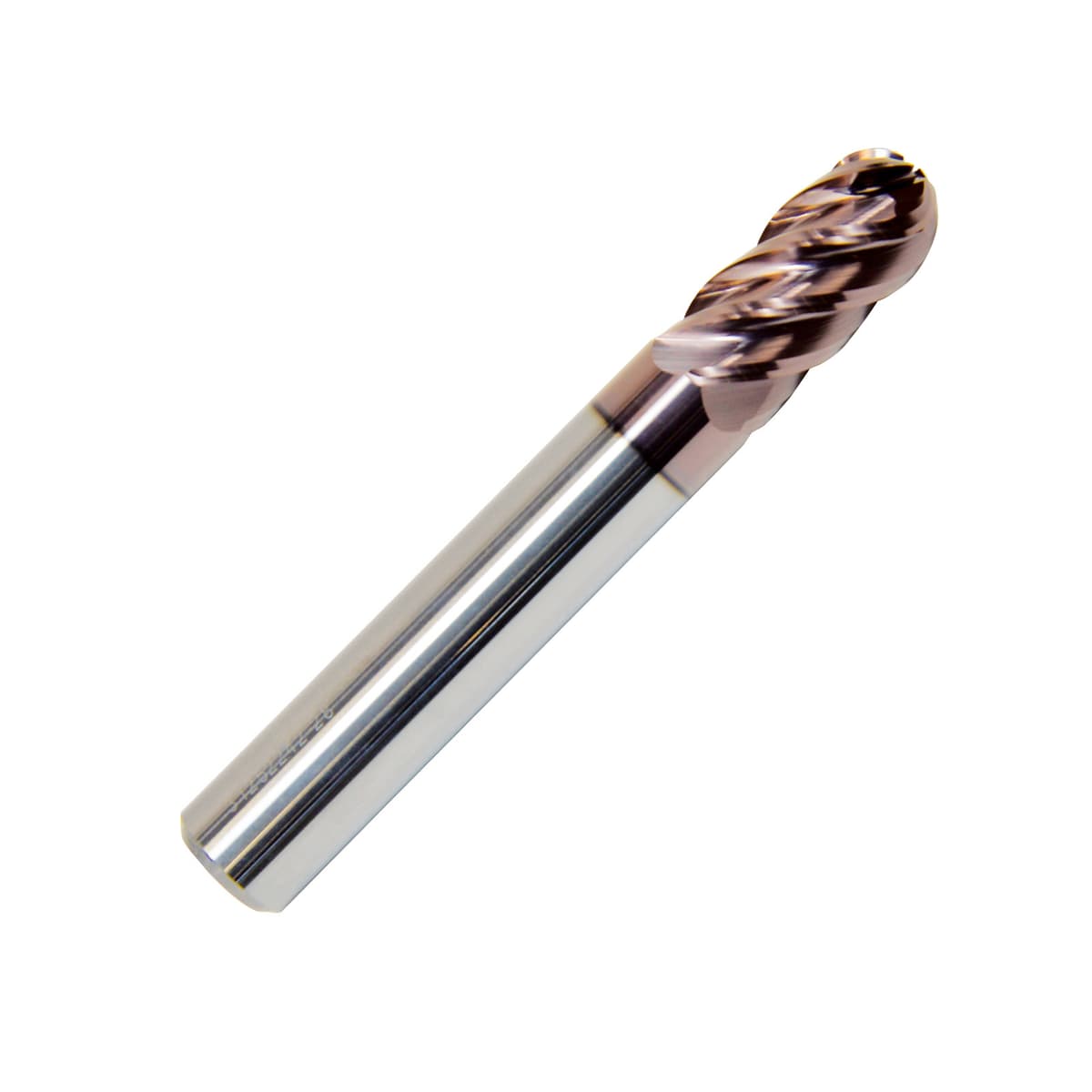

ZCC-CT TM-5BL Series 5 Flute KMS405 Coated Carbide Ball Nose Long Length End Mill for Titanium & Heat-Resistant Alloy Machining
Series: TM-5BL...15% DISCOUNT£30.74 excl. VAT
£36.89 incl. VAT
£26.13excl. VAT
£31.36incl. VAT
ZCC-CTÕs new TM range of high performance milling cutters for heat resistant super-alloys feature a revolutionary proprietary KMS405 coating for exceptional thermal stability and wear resistance. Designed specifically for roughing and finishing of titanium, nickel and cobalt based alloys, these high performance end mills perform to exceptional standards on particularly demanding cutting jobs thanks to their high cutting edge stability.
Features:- Specially ground for more cutting edge stability for demanding cutting jobs.
- Latest coating technology for thermal stability and wear resistance
- Roughing and finishing of titanium, nickel and cobalt based alloys
- Innovative substrate with optimized thermal conductivity and high level wear resistance
- TM multi series with up to 9 cutting edges for outstanding productivity
- Factory standard
- High Performance
- Ball Nose
- Long Series
- Centre cutting
- Helix angle 38¡
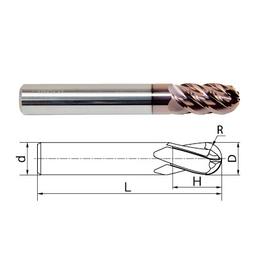
| SKU | Diameter / D1 | Shank Diameter / D2 | Cutting Length / L1 | Overall Length / L2 | Radius / R | Price (Ex VAT) |
|---|---|---|---|---|---|---|
| TM5BLR100KMS405 | 20mm | 20mm | 38mm | 104mm | 10mm | £241.03£204.88 |
| TM5BLR30KMS405 | 6mm | 6mm | 16mm | 57mm | 3mm | £30.74£26.13 |
| TM5BLR40KMS405 | 8mm | 8mm | 20mm | 63mm | 4mm | £49.43£42.02 |
| TM5BLR50KMS405 | 10mm | 10mm | 22mm | 72mm | 5mm | £64.75£55.04 |
| TM5BLR60KMS405 | 12mm | 12mm | 25mm | 83mm | 6mm | £87.96£74.77 |
| TM5BLR80KMS405 | 16mm | 16mm | 32mm | 92mm | 8mm | £149.97£127.47 |
Frequently Asked Questions
A ball nose milling cutter (also called a ball end mill) is a solid carbide or HSS milling cutter with a hemispherical cutting tip.
The radius of the ball is exactly half the cutter's nominal diameter so a 10mm ball nose has a 5mm tip radius.
This rounded geometry allows the tool to machine curved surfaces, 3D contours, fillets, radii and complex profiles that flat-bottom end mills cannot produce.
Ball nose cutters are essential for 3D profiling, die & mould work plus any application requiring smooth, contoured surfaces.
Flat end mill / square end mill - has a flat bottom cutting face with sharp corners and is used for slotting, pocketing and machining flat floors and true 90° shoulders
Ball nose end mill - has a hemispherical tip and cannot produce a flat floor but excels at 3D surface machining, radii, fillets and scalloped profiling passes
For most 3D milling and contouring work, a ball nose is the correct choice.
For pocketing and flat-floor operations, a flat end mill or corner-radius end mill is more appropriate.
A corner radius end mill (sometimes called a bull nose or toroidal cutter) has a flat cutting face with a small radius blended into the corner and not a full hemisphere.
It combines the flat-floor capability of a square end mill with improved edge strength and a gentle radius.
A full ball nose produces the maximum possible radius equal to half the tool diameter.
Use a ball nose for 3D profiling and use a corner radius tool when you need flat floors with a small blended fillet or where edge strength on a flat-bottomed pocket is important.
2-flute ball nose - the most common ball nose option with the best chip evacuation, especially in pockets and deep cavities, most suitable for most materials & general-purpose profiling
3-flute ball nose - a good balance between chip clearance & rigidity, making them useful in materials where vibration or tool deflection is a concern
4-flute (and above) ball nose - improved rigidity and surface finish making them better suited to finishing passes where chip load per tooth is low. They have less chip clearance, so less suitable for slotting or deep pockets!
For most profiling and 3D surface finishing work, a 2-flute cutter is the standard starting point. Where surface quality is the priority on the finishing pass, 4-flute tools can improve results.
Our solid carbide ball nose range covers all common engineering materials:
Steel and alloy steel - general machining grades with AlTiN or TiAlN coatings
Stainless steel - requires sharp, positive-rake geometry and appropriate coatings to avoid work hardening
Aluminium and non-ferrous alloys - polished flutes, high helix geometry and ZrN or uncoated grades for clean chip evacuation and bright finish
Hardened steels (up to ~70 HRC) - specialist ultra-fine grain carbide with hard coatings for die and mould finishing
Titanium and HRSA - specific grades with high edge toughness and suitable coatings
Plastics, composites, and wood - sharp geometry, polished flutes and reduced coating for clean cutting without burr
Check the individual product listing for material suitability, coating type and recommended cutting data.
Coatings extend tool life which in turn allows higher cutting speeds and improves cutting performance in specific materials:
TiAlN / AlTiN - the most common general-purpose coating which offer high hardness, excellent heat resistance. Suitable for steel, stainless & cast iron
TiSiN / nACo / AlCrN - advanced coatings for hardened steels, high-speed dry machining & very hard materials
ZrN / TiN - lower hardness but excellent for non-ferrous metals (aluminium, copper, brass) where built-up edge is a concern
DLC (Diamond-Like Carbon) - extremely slippery coating for aluminium & soft non-ferrous which prevents sticking
Uncoated (bright) - occasionally used for very fine finishing in aluminium or where coating adhesion could affect surface quality
Flute length (cutting length) - determines the maximum depth of profile cut. You should select a flute length just sufficient for the required depth as excessive flute length beyond the cutting zone reduces tool rigidity and increases the risk of chatter and deflection
Overall length (OAL) - the total length of the cutter from tip to shank end. Longer tools reach deeper into pockets and cavities but are more prone to deflection. Always minimise the gauge length (stick-out from the collet) to maximise rigidity
Neck clearance - many long-reach ball nose cutters feature a reduced-diameter neck behind the cutting head, allowing deep cavity access while maintaining a full-diameter shank for rigidity in the collet.
The step-over determines the cusp height (scallop) left on the machined surface between adjacent tool passes.
The smaller the step-over relative to the tool radius, the finer the surface finish:
A step-over of 5–10% of tool diameter gives a very fine finish with minimal scallop height, this is used for high-quality die & mould surfaces
A step-over of 15–25% of tool diameter is typical for semi-finishing passes
A step-over of 30–50% is used for roughing or semi-roughing passes where finish quality is secondary
Calculate cusp height as: h = R − √(R² − (ae/2)²), where R is the ball radius and ae is the step-over.
At the very tip of a ball nose cutter, the cutting edge passes through the centreline of the tool (the point at which peripheral speed drops to zero).
This "dead zone" at the centre produces rubbing rather than cutting, which generates heat and can cause poor surface quality, especially at low tilt angles.
To avoid this you should:
Tilt the tool 10–15° in the CAM program so the effective cutting zone is slightly off-centre
Use a higher spindle speed to maintain adequate surface footage
Avoid plunging directly on the ball tip - use helical ramping or a roughing tool to pre-clear material before ball nose finishing
These refer to the ratio of overall length to diameter:
Short (stub) reach - maximum rigidity and is used where access allows. Best for high-speed finishing where deflection must be minimised
Standard reach - the most versatile option and is suitable for the majority of profiling & pocketing operations
Long reach - for deep cavities, pockets & moulds where standard length cannot reach the work
Extra-long / extended neck - specialist tools for very deep cavities with reduced neck diameter behind the cutting head allows deep access while retaining a full shank in the holder
Always use the shortest tool that reaches the feature as every extra mm of overhang reduces rigidity and increases the risk of chatter!
Technically yes, but it is not ideal!
The hemispherical geometry produces a rounded slot floor rather than a flat one and chip evacuation in a full-width slot can be challenging.
For full-width slotting a flat-bottom end mill is preferable. Ball nose cutters can be used for profiling slots with curved floors (e.g. in cams and guides) or where the rounded floor geometry is acceptable.
Customers Also Viewed
ex VAT
ex VAT

ex VAT
ex VAT

ex VAT

ex VAT
Service & Delivery Information
If the order is placed online, we offer free shipping to mainland UK on orders over £25 ex VAT.
This offer excludes certain items due to weight restrictions. These items will be highlighted in the shopping cart.
Delivery to Ireland, Northern Ireland, Scottish Highlands etc may incur additional charges.
Please see our delivery information page for a full breakdown.
You are able to cancel or return the goods of items that we stock. Goods which are ordered in from suppliers specifically for your order will be subject to a restocking fee.
We are able to offer businesses trade accounts subject to a soft credit check.
Please contact us if you would like to set up a trade account.
Tracking details will be emailed for all orders sent tracked once the goods have been shipped. This will include a link to the relevant courier's website.
Alternatively, you can also contact us who can track the order for you.
Please contact us if you have any questions regarding this product or any other product or service.
You can contact us by:
- Phone: 01274 872822
- Email: sales@milotools.co.uk
- Online chat