


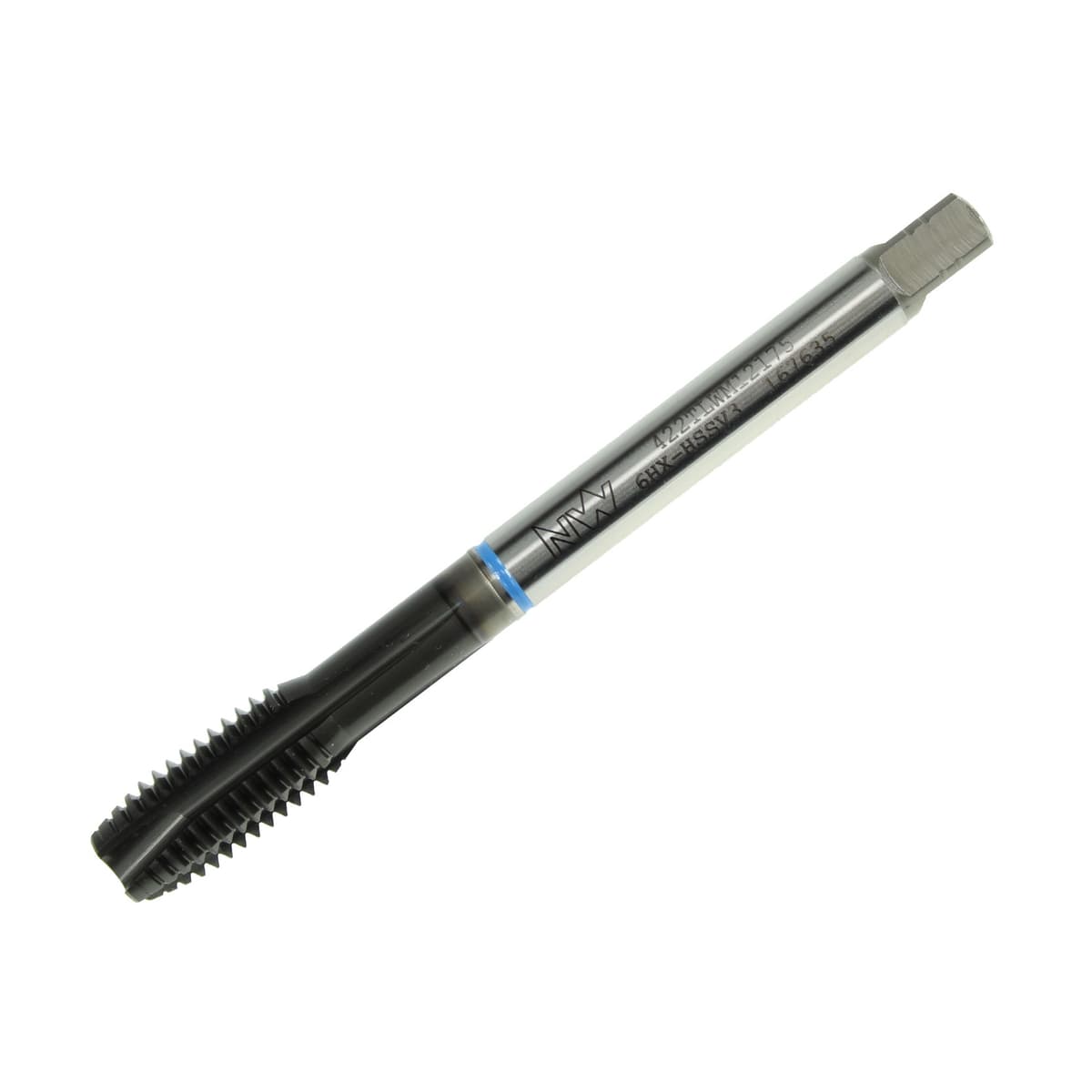

NEUWERK Metric Coarse Machine Tap Spiral Point HSSV3 422TLWM Series for Stainless Steel
Series: 422TLWM...Clearance (Whilst Stocks Last)£18.46 excl. VAT
£22.15 incl. VAT
£17.23excl. VAT
£20.68incl. VAT
The 422TLWM series machine tap from NEUWERK is our 1st choice tap for high performance threading of stainless steel, carbon steel and tempered steel. It is made from Vanadium Cobalt Substrate with a TiN Alox coating providing long tool life.
Application: Metric Coarse Stainless Steel
Geometry: Spiral Point for through holes
Chamfer form: B/4-5
Substrate:HSS / Vanadium Cobalt
Coating:TLW (TiN Alox)
Max Depth: 3xD
Tolerance:6HX
NEUWERK are a leading European manufacturer of high quality machine taps providing high performance and reliability
| SKU | Price (Ex VAT) |
|---|---|
| 422TLWM03050 | £18.46 |
| 422TLWM05080 | £18.46 |
| 422TLWM14200 | £36.99£17.23 |
| 422TLWM16200 | £41.62£23.63 |
| 422TLWM04070 | £18.46 |
| 422TLWM06100 | £18.46 |
| 422TLWM08125 | £20.77 |
| 422TLWM10150 | £24.25 |
| 422TLWM12175 | £30.04 |
Frequently Asked Questions
A machine tap is a cutting tool designed to be driven by a machine, i.e. a CNC machining centre, CNC lathe, tapping machine or pillar drill with a tapping attachment.
The key differences from a hand tap are:
Drive geometry: machine taps typically have a straight square drive on the shank for positive torque engagement in a machine tap holder or floating tap holder; the shank is precision-ground for consistent concentricity in the holder
Geometry optimised for power feed: machine taps are designed for continuous, consistent feed and speed rather than the intermittent reversal motion of hand tapping
Point geometry: the majority of machine taps use either spiral point or spiral flute geometry rather than the straight-fluted taper/second/plug progression of a traditional hand tap set
Speed: machine taps are intended to run at controlled speeds with synchronised feed; running a machine tap by hand will not use it to its designed capability and risks premature failure.
For CNC applications a rigid tapping (synchronised spindle speed and axial feed, no floating holder) is the preferred method as it gives the most accurate thread depth control and allows the use of full-performance machine tap geometries.
The geometry of a machine tap determines how it handles chip formation which is the single most important selection criterion for a machine tap.
Spiral Point (also called gun tap or chip-pushing tap)
Chips are pushed forward ahead of the tap then into and through the hole
Used exclusively in through-holes where chips can exit freely from the far side
The most common machine tap geometry and accounts for the majority of our range (+600 SKUs)
Lower cutting forces than spiral flute making them suitable for a wide range of materials
Available in general purpose (steam tempered), GLT-1 coated and HSSE variants.
Flutes have a helical form that lifts chips back up and out of the hole (upward chip evacuation)
Used in blind holes where chips cannot exit from the bottom, the spiral flute extracts chips to prevent them packing at the bottom of the hole and causing tap breakage
Essential for blind-hole tapping in steel, stainless steel and other ductile materials.
Roll Tap (Cold-Forming / Chipless Tap)
No cutting geometry, the tap displaces material by plastic deformation, forming the thread without producing any chips
Produces no chips, the ideal choice for blind holes where chip evacuation is a problem and for high-volume production where tap life is critical
Produces a work-hardened, burnished thread surface with superior fatigue and pull-out strength
Only suitable for ductile materials (steels with reasonable elongation, aluminium, copper, brass); not for cast iron, hard steels or brittle materials
Requires a larger tapping drill than a cutting tap (the displaced material is pushed outward rather than cut away).
Our machine tap range covers five major thread form standards:
Metric Coarse (MC): ISO general-purpose metric thread - the most common in European and global engineering / M2 to M30
Metric Fine (MF): Metric thread with a finer pitch than the standard coarse series and is used where greater resistance to vibration loosening, finer adjustment or thinner wall sections are required / M2 to M24
Unified National Coarse (UNC): American/imperial coarse thread standard, very common on American-designed components and widely used in aerospace and defence / No. 4 to 1"
Unified National Fine (UNF): American/imperial fine thread and used on the same applications as UNF where a finer pitch is specified / No. 4 to 1"
G Whitworth (BSP): British Standard Pipe thread and Whitworth thread forms. The G (parallel) form is used extensively for hydraulic and pneumatic fittings and fluid system connections / 1/8" to 1".
Both are ISO metric threads with the same 60° thread form angle, but differ in pitch (axial distance between thread crests) for the same nominal diameter:
MC (Metric Coarse): the standard pitch for each diameter as defined in ISO 261/262; e.g., M10 Coarse = 1.5mm pitch. Faster to assemble, easier to start and more tolerant of minor thread damage. The default choice for most fastening applications
MF (Metric Fine): a finer pitch than MC for the same diameter; e.g., M10×1.0 or M10×1.25 Fine. More thread engagement per unit of thread depth meaning better resistance to vibration loosening and smaller pitch means less axial movement per turn which is useful for adjustment mechanisms. Common in automotive, hydraulics, bearings and aerospace.
When ordering a Metric Fine tap, always confirm the pitch. For example, M12 Fine taps are available with 1.0mm, 1.25mm, and 1.5mm pitch — the 1.5mm pitch is Metric Coarse for M12. Be specific on both diameter and pitch.
The G thread form (ISO 228, also known as BSP "British Standard Pipe" parallel) is a 55° Whitworth-form thread used on pipe fittings, hydraulic adaptors, pneumatic connectors and fluid system components throughout the UK and much of Europe.
The G thread is a parallel (non-tapered) thread used with a sealing face or O-ring & not the taper that creates a mechanical seal.
You will need a G-form machine tap when:
Manufacturing or repairing hydraulic manifolds, valve bodies or cylinder heads
Producing pneumatic fittings or connections in a component body
Reworking a damaged BSP port in a machine or component
Manufacturing pump bodies or fluid system housings
G thread sizes in our range run from 1/8" (G1/8) to 1" (G1") - the designation refers to the nominal pipe bore and not the actual thread diameter. G1/4 has an actual thread diameter of approximately 13.16mm at 19 TPI whereas G1/2 is approximately 20.96mm at 14 TPI.
Our machine tap range is drawn from four specialist threading brands:
Emuge-Franken Machine Taps: German-engineered precision threading tools and the largest brand stocked in our range. The Emuge range covers both general purpose and high-performance applications and are renowned for excellent tool life and consistent thread quality
Osborn Machine Taps: long-established German tool manufacturer with a broad range across all geometries and thread forms and they are the primary brand in the high-performance universal machine taps subcategory (516 SKUs)
Neuwerk Machine Taps: competitively priced HSS/HSSE taps across standard thread forms and geometries making them a good choice for general workshop use where cost-per-tap is a key consideration
NUI Machine Taps: specialist HSSE spiral point taps for aluminium and soft materials (13780 Series)
The surface finish on a machine tap affects its friction characteristics, lubricity and suitability for different materials:
Steam Tempered (black oxide)
Produced by exposing the finished tap to steam at elevated temperature and creates a magnetite (Fe₃O₄) black oxide layer
Improves corrosion resistance and provides a degree of lubricity
The standard finish on general-purpose HSS machine taps
Suitable for steel, cast iron, aluminium and general-purpose applications
The most common finish on workshop taps globally
GLT-1 Coated
A PVD (Physical Vapour Deposition) coating which is a hard, low-friction coating applied at relatively low temperature to preserve the tool's heat treatment
Higher surface hardness than steam tempered with significantly lower coefficient of friction
Improved performance in stainless steel, heat-resistant alloys and other difficult-to-machine materials where cutting edge temperatures and adhesion are higher
Enhanced chip flow in spiral flute taps meaning better release in blind holes
The recommended choice for stainless steel and high-performance production applications.
The machine tap range is divided into four application-focused subcategories to aid selection:
General Purpose Machine Taps: covers the broadest range of materials and applications / steam-tempered and GLT-1 finishes / all geometries
High Performance Universal Machine Taps: premium tools for production machining and difficult materials / all tools are GLT-1 PVD coated
Machine Taps for Stainless Steel: tools specifically optimised and rated for austenitic and duplex stainless steels / spiral flute geometry recommended / GLT-1 coating essential
Machine Taps for Aluminium: NUI HSSE spiral point taps from the 13780 Series / HSSE substrate with geometry optimised for the long, stringy chips characteristic of aluminium through-holes.
A roll tap (also called a cold-forming tap or form tap) does not cut thread material away, it plastically deforms the bore material outward to form the thread profile.
The end result is:
No chips produced: eliminates chip evacuation problems entirely and is ideal for blind holes in production environments
Superior thread strength: the deformed metal retains a continuous grain flow and a work-hardened, burnished surface, plus the pull-out strength and fatigue resistance are both higher than a cut thread in the same material
Longer tap life: without a cutting edge to wear roll taps are significantly more durable in suitable materials meaning production volumes per tap can be 3–5× higher than an equivalent cutting tap.
Suitable materials: Ductile steels (carbon and alloy steel, typically below ~1000 N/mm² tensile), austenitic stainless steel, aluminium, copper, brass and most non-ferrous alloys.
Not suitable for: Cast iron (brittle, no ductility), hardened steels and materials with low elongation.
Important! drill size!: Always use the roll tap manufacturer's specified tapping drill for cold-forming. The drill size is slightly larger than for a cutting tap (to accommodate the displaced material). Using a cutting tap drill size with a roll tap will overload the tap and cause breakage.
The tapping drill size determines the percentage of thread engagement in the tapped hole.
A common workshop rule is to use a drill diameter approximately equal to the tap's nominal diameter minus the pitch (D − P). For standard metric coarse threads this gives approximately 75% thread engagement, which is the optimum balance between thread strength and tapping torque.
Example reference values for common metric coarse sizes:
M3 Thread = 0.5mm Pitch & 2.5mm Tapping Drill
M4 Thread = 0.7mm Pitch & 3.3mm Tapping Drill
M5 Thread = 0.8mm Pitch & 4.2mm Tapping Drill
M6 Thread = 1.0mm Pitch & 5.0mm Tapping Drill
M8 Thread = 1.25mm Pitch & 6.8mm Tapping Drill
M10 Thread = 1.5mm Pitch & 8.5mm Tapping Drill
M12 Thread = 1.75mm Pitch & 10.2mm Tapping Drill
For metric fine threads the pitch is smaller so the tapping drill is closer to the nominal diameter. For UNC/UNF and Whitworth threads please use a dedicated tap drill chart.
Note for roll taps: always use the roll tap manufacturer's specified drill as it will be slightly larger than the cutting tap equivalent to accommodate material displacement.
Customers Also Viewed
ex VAT
ex VAT

ex VAT
ex VAT

ex VAT

ex VAT
Service & Delivery Information
If the order is placed online, we offer free shipping to mainland UK on orders over £25 ex VAT.
This offer excludes certain items due to weight restrictions. These items will be highlighted in the shopping cart.
Delivery to Ireland, Northern Ireland, Scottish Highlands etc may incur additional charges.
Please see our delivery information page for a full breakdown.
You are able to cancel or return the goods of items that we stock. Goods which are ordered in from suppliers specifically for your order will be subject to a restocking fee.
We are able to offer businesses trade accounts subject to a soft credit check.
Please contact us if you would like to set up a trade account.
Tracking details will be emailed for all orders sent tracked once the goods have been shipped. This will include a link to the relevant courier's website.
Alternatively, you can also contact us who can track the order for you.
Please contact us if you have any questions regarding this product or any other product or service.
You can contact us by:
- Phone: 01274 872822
- Email: sales@milotools.co.uk
- Online chat